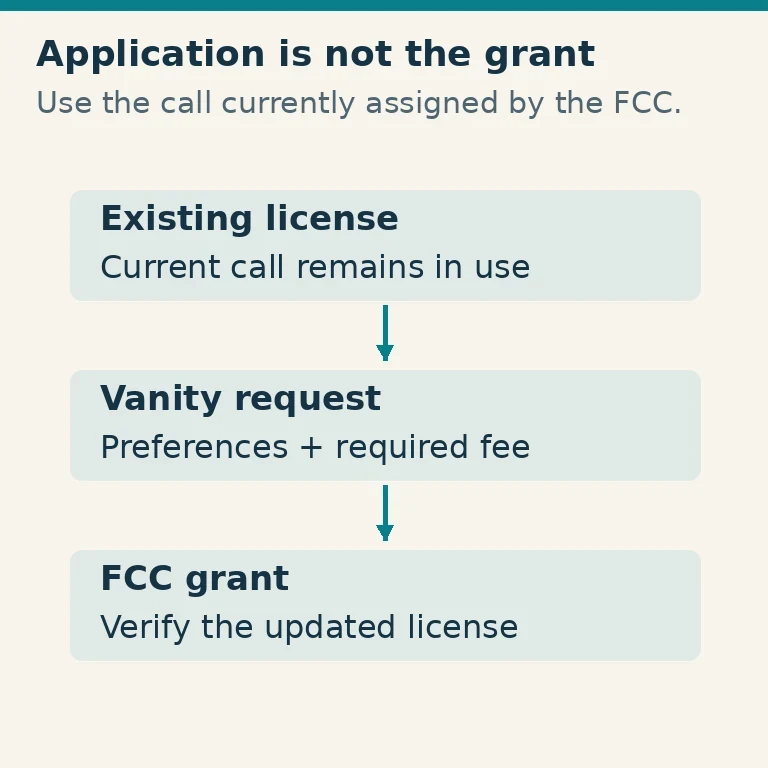
A US amateur radio vanity call sign is a specific available call sign you ask the FCC to assign to your existing station license. It can be easier to say, more memorable, or meaningful to you. Applying does not reserve it, and paying the fee does not authorize you to use it. Wait until the FCC grants the change and the new call appears on your license record.
This guide covers the ordinary US individual-license “request by list” route. Former-holder, deceased-relative and club requests have additional rules. Other countries operate different systems. The fee and rules below were checked on October 29, 2026; consult the FCC's current instructions when filing.
Start with an Existing License and the Correct Account
A vanity request is not the way to obtain your first amateur license. You first qualify for and receive an operator/primary station license and its assigned call sign. You then apply to modify the existing license to a requested vanity call.
Find your active license in the FCC Universal Licensing System, usually called ULS. Record the current call sign and your FCC Registration Number, or FRN. Make sure you can access the FCC account associated with that license. Creating another FRN because you cannot remember a password can complicate access without moving the license to the new account.
Check your name, contact details and email before filing. Use the official FCC account recovery or association process if the license is not available under your login. Never send a helper your password simply to ask whether a call is available.
If your license is expiring or a renewal is pending, resolve the timing with the current FCC instructions. A vanity request does not replace your responsibility to maintain a valid license. Keep separate application receipts so you can tell a renewal from a vanity modification.
Know Which Call-sign Groups You May Request
For an ordinary request by list, eligibility depends on your operator class and the call-sign group. A shorter call is not available to everyone simply because a search finds it unused. ARRL's FCC guidance describes these groups.
| Operator class | Ordinary eligible groups | Practical examples of formats |
|---|---|---|
| Amateur Extra | A, B, C and D | Includes eligible 1×2 and 2×1 calls |
| Advanced | B, C and D | Includes eligible 2×2 calls, subject to prefix rules |
| General or Technician | C and D | Eligible 1×3 and 2×3 calls |
| Novice | D | Eligible 2×3 calls |
In this notation, 1×3 means one letter before the numeral and three after it. The numeral is not counted as a letter. Group eligibility is only the beginning: prefixes, reserved series and location restrictions still matter. Not every combination fitting a visual pattern is assignable.
A General and a Technician normally have the same group choices for this purpose. A vanity call does not upgrade operating privileges, and a memorable call does not reveal which bands you are allowed to use. Your actual license class remains controlling.
Special rules can permit a former holder to request a former call under circumstances different from an ordinary list application. If that is your situation, read the relevant branch rather than applying the ordinary table to it automatically.
Build a List You Would Actually Want to Use
Consider how each candidate sounds in voice operation and how it sends in CW. Say the full call several times using standard phonetics. A clever written abbreviation can be awkward when spoken over a weak radio path.
Think about confusion between letters, repeated characters, suffixes resembling common procedural words and how the call fits your usual activities. These are preferences, not FCC eligibility tests. A longer call you enjoy using may suit you better than a scarce short call chosen only for status.
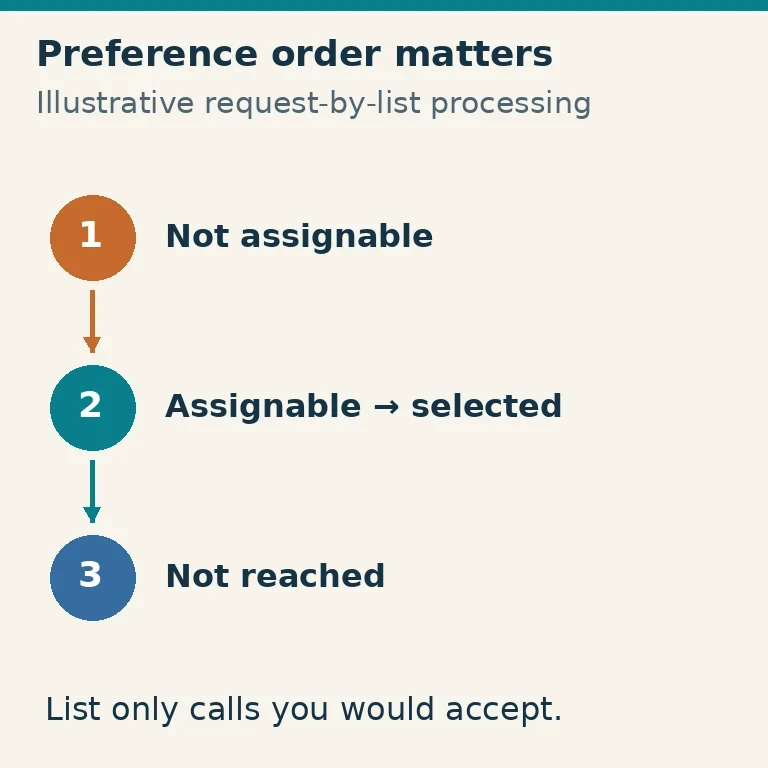
Write candidates in genuine preference order. Under Part 97's request-by-list rules, you may list up to 25 calls, and the FCC assigns the first listed call it can assign when processing the request. If none is assignable, you retain the existing call. Do not put a call first merely as a placeholder.
You can submit fewer than 25. Every entry should be one you would accept. The list is not a request for several simultaneous personal station calls, and it does not guarantee that the first choice will still be available at processing time.
Research Availability and Waiting Periods
Use official FCC license and application records to investigate each candidate. A third-party call-sign finder can help organize searches, but it is not the licensing authority. Check the current holder, license status, relevant dates and pending applications rather than searching only a callsign directory.
“Expired” does not mean immediately available. Part 97 includes waiting periods for expired, surrendered, revoked, canceled and deceased-holder calls, with specific exceptions. Ordinary candidates commonly involve a two-year waiting period, but the applicable trigger and exceptions depend on the case. Do not calculate eligibility solely from a directory's “last seen” date.
For a call associated with a deceased licensee, rules about death, expiration and cancellation can interact. Former-holder and close-relative requests also have special conditions. Use the actual rule and FCC instructions for that situation, and provide required documentation through the official process.
Certain Alaska, Pacific and Caribbean-area call-sign choices have location conditions. A mainland mailing address and an interest in a distinctive prefix do not necessarily qualify you. Other reserved or restricted series are not ordinary vanity choices.
A clear search today is useful evidence, not a reservation. Another eligible applicant may seek the same call. Record when you checked each candidate and review the list again before filing.
File the Request Against Your Existing License
Enter the FCC's official online licensing service through its current amateur licensing page. Sign in, select the correct existing license and choose the option to request a vanity call sign. ARRL's application guide describes the “Request By List” route for ordinary preferences. Screen wording can change, so follow the current FCC prompts rather than an old screenshot.
Choose the route that matches your eligibility. Do not select a former-holder or relative category to improve your chances if the stated relationship or history is untrue. Ordinary preferences belong in the ordinary list request.
Enter each call exactly and in the intended order. Check every prefix, numeral and suffix. Review the application summary before certifying it: correct license, correct request type, correct order and accurate contact details. Save or print the submitted summary and application file number.
Avoid sending multiple speculative applications on the same receipt day. Part 97 states that when more than one application is received from the same applicant on the same day, only the first will be processed. Refiling to correct a preference can therefore have consequences; use the FCC's amendment or withdrawal instructions where appropriate.
Treat certification seriously. The form asks you to make factual statements, not merely to register interest. If an eligibility condition is unclear, resolve it before making the certification.
Complete the Separate Fee Payment
The current amateur vanity application fee is $35 per application, rather than per candidate on the list. ARRL's fee guidance and the FCC fee schedule support that amount. Fees can change, so confirm the charge on the official payment screen before paying.
Submitting the licensing form and paying the fee are separate milestones. Follow the FCC's instructions to the CORES payment system, associate payment with the correct FRN/application, and meet the deadline provided. An application file number alone is not a payment receipt.
Use the official payment destination, not an advertisement or unsolicited email demanding an extra “reservation” payment. Save the receipt and confirm the application/payment status afterward. If the browser times out, check whether payment was recorded before submitting it again.
Do not assume the fee buys the requested call or priority over competing applicants. It pays for processing the application. Consult current FCC refund and dismissal rules if something goes wrong rather than assuming an unsuccessful request will be refunded automatically.
Track the Application and Wait for the Grant
Use the application file number to inspect status in ULS. Distinguish submitted, pending, dismissed and granted records. A third-party predicted outcome is not a grant, and a fixed processing-time promise is unreliable when eligibility, competing requests or administrative issues intervene.
Until a grant takes effect, continue using the call currently assigned to your station. Do not identify on the air with a hoped-for call, even if nobody else appears to hold it. Check the actual license record when the application status changes.
If the request is dismissed, read the reason and compare it with your submitted summary and payment receipt. A failed candidate search, an eligibility problem and an unpaid fee require different corrections. Preserve the application record before deciding whether another paid request makes sense.
After a grant, save the updated license and confirm the spelling. Notify regular contacts and update logging software, digital-mode configuration and station labels. Request the appropriate LoTW certificate changes through its supported process while retaining the identity needed for historical contacts.
Old QSOs stay under the callsign used when they occurred. Do not bulk-rename them to the new vanity call. When operating, identify according to the rules using the new assigned call, and allow directories and third-party services time to update.
A successful application ends with a verified FCC license change, not just a desirable search result. Careful eligibility research, a deliberate preference list and retained filing/payment records make that process much easier to follow.