A US amateur radio call sign can be read in three parts: letters before a numeral, one numeral, and letters after it. Those parts help a listener recognize a format, but they do not, by themselves, establish who holds the sign, where that person lives, or what operating privileges they have. For a new station grant, the FCC normally selects a call sign through its sequential system. An eligible licensee can instead request a vanity call sign, while a designated special-event sign can temporarily stand in for a station’s assigned sign under separate rules. The license grant and the applicable operating rules settle questions that the visible letters and number cannot.
Reading the Letters and Number
Start at the numeral. In an ordinary US call-sign shape, the letters to its left form the prefix, the single digit is the call-area numeral, and the letters to its right form the suffix. Format shorthand counts letters on either side of that numeral. A 1×3 shape has one prefix letter and three suffix letters; a 2×3 shape has two prefix letters and three suffix letters. ARRL uses both format labels in its guidance for General and Technician vanity applicants.
Consider two illustrative shapes, not claims about assigned or available call signs:
| Illustrative shape | Prefix | Numeral | Suffix | Format |
|---|---|---|---|---|
K4ABC |
K |
4 |
ABC |
1×3 |
KB4ABC |
KB |
4 |
ABC |
2×3 |
The useful first move is to locate the digit, then count the letters on each side. In KB4ABC, for example, KB is the prefix—not K alone—and ABC is the suffix. The numeral is a call-area number, but reading it is not the same as locating the station. ARRL says the sequential system uses a call-area number determined in part by the applicant’s license address; its vanity guidance also says the FCC does not confine a vanity choice to a matching numeral.
There is a broader layer behind the US prefixes. The International Telecommunication Union (ITU) allocates international call-sign series to countries. Its allocation table lists AA–AL blocks, along with the K, N and W series, for the United States. “AA–AL blocks” means blocks beginning with those two-letter combinations; it does not mean a continuous “A-through-AL” prefix range.
That country allocation is not a catalog of call signs available to individual amateurs. It identifies international series associated with the United States; FCC assignment rules determine which call sign appears on a particular amateur station grant. Similarly, the table’s listing of K, N and W series does not promise that every matching arrangement of letters and a number is a valid, vacant or assignable amateur call. A visible call therefore has two different readings: its shape can be parsed immediately, but its assignment must be established through the FCC grant and rules.
How a New Station Receives a Sequential Call Sign
The default route starts with the grant, not with a licensee picking a memorable combination. FCC §97.17 says that one unique call sign appears on each new primary, club and military recreation station license grant, selected through the sequential call sign system. The FCC’s definition of that system says it selects from an alphabetized list corresponding to the geographic region of the licensee’s mailing address and operator class. The selected sign is shown on the license.
That description gives “sequential” a specific meaning. It does not mean that a new applicant can predict an exact call by looking at a few recent grants, nor does it mean that any unused-looking combination can be requested through the default route. The FCC uses the applicable region-and-class list to select the sign. For an operator/primary station applicant, class and mailing-address region help identify which list applies; the call that results is recorded on the grant. The rule describes the selection basis, not a promise about the next particular set of letters.
Imagine a hypothetical new operator whose mailing address falls in one FCC geographic region. If that operator holds a class for which a given sequential group applies, the FCC selects from the alphabetized list corresponding to that class and mailing-address region. A different class or a mailing address in another region changes the relevant selection criteria. This example illustrates the rule’s inputs; it does not assert that any particular illustrative sign is next in line.
“Mailing-address region” matters here. It describes information used in selecting the sequential call; it is not a statement about the place from which each future transmission will originate. A listener who hears only the call sign cannot use the sequential-selection rule to establish the station’s present operating location. Nor should the listener assume that a licensee’s address or class has stayed unchanged since the sign first appeared on a grant. The assignment step explains how a sign began; later modification, renewal and vanity choices make its present-day interpretation a separate question.
The grant provides the firmer reference point. It shows the selected call sign, rather than leaving the operator to construct one from a country prefix, area numeral and preferred suffix. Those components help you read what you see; the FCC’s selection and grant explain why that station has that assigned call.
Why License Class and Region Constrain the Choices
A call-sign group is a way of relating formats to eligibility, not a way of reading someone’s current privileges off the air. ARRL’s vanity guidance says General and Technician licensees can seek Group C 1×3 signs beginning with N, K or W, or Group D 2×3 signs beginning with K or W. Thus N4ABC illustrates the 1×3 arrangement, while KW4ABC illustrates the 2×3 arrangement. Both strings are examples of structure only—not assertions that either sign is assigned or available. In each, the numeral separates the prefix letters counted on the left from the three suffix letters counted on the right.
ARRL describes wider format-group choices for higher classes. Its account says an Extra licensee can seek calls in Groups A through D, subject to limited choices. Its description of Advanced eligibility covers Groups B through D: Advanced holders cannot seek the special Extra-type 1×2, 2×1, or A-beginning 2×2 formats, but ARRL describes other 2×2 choices, as well as 1×3 and 2×3 choices, for that class. This comparison explains why shorter and differently prefixed formats enter discussions of class eligibility. It does not establish the present class of a person who happens to hold one of those shapes.
There is an important time distinction in that Advanced guidance. FCC §97.17(a) states: “No new license grant will be issued for a Novice or Advanced Class operator/primary station.” That does not mean every reference to those classes describes an applicant seeking a new grant. Existing holders can still appear in guidance about their grants, and the FCC’s upgrade provision expressly refers to people named in Novice and Advanced grants. ARRL’s account of what an Advanced holder may seek should be read in that context, not as an invitation to obtain a new Advanced grant.
Format eligibility and geographic eligibility also answer different questions. The class-group guidance addresses which types of call sign a licensee may seek; a separate FCC rule limits assignment of certain region-designated series by mailing address. Passing a format test therefore does not settle every condition attached to a requested vanity sign. Equally, seeing a 1×3, 2×3 or shorter call does not establish which route placed it on the grant or whether its holder’s class has changed. The format is a clue to the structure of the sign. Eligibility, assignment and present privileges require more information.
Choosing a Vanity Call Sign
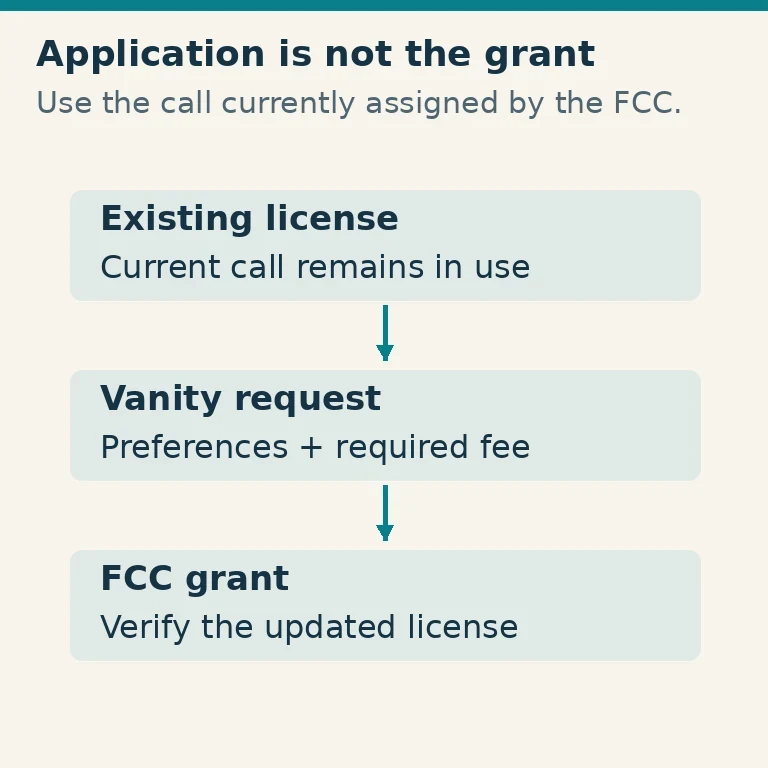
A vanity call sign is a chosen-call route for an eligible licensee, rather than the FCC’s default sequential selection for a new grant. Under FCC §97.19, the person named in an operator/primary station or club station grant may apply to modify or renew the grant to show a vanity-selected call. The rule also restricts an additional vanity sign for a club grant that already shows a call selected by a trustee. In other words, this route concerns a licensed station and a change or renewal of its grant; it is not permission for anyone who likes a sequence to put it on the air.
First, the requested call has to fit the applicant’s class eligibility: the FCC says it must come from a call-sign group corresponding to the same or a lower class than the operator license held. ARRL’s Group C and D examples show how that principle can affect a Technician or General applicant’s range of formats. They describe eligible shapes, not a guarantee that a particular combination within a shape can be assigned.
A separate limit concerns certain geographically designated series. FCC §97.19(d)(4) says a call designated under the sequential system for Alaska, Hawaii, Caribbean Insular Areas or Pacific Insular Areas will be assigned only to a primary or club station whose licensee’s mailing address is in the corresponding state, commonwealth or island. That is not a blanket prohibition on every applicant elsewhere. The stated limitation does not apply when the applicant seeks the call as a listed relative of its now-deceased former holder: a spouse, child, grandchild, stepchild, parent, grandparent, stepparent, brother, sister, stepbrother, stepsister, aunt, uncle, niece, nephew or in-law. This exception is specific; it should not be generalized into open access to the region-designated series.
The request itself has an order of preference. The applicant asks that the call currently on the grant be vacated and supplies up to 25 desired calls, ranked in order. Suppose a hypothetical licensee lists three illustrative choices, labeled first, second and third preference. The FCC uses the first assignable choice from that list when it processes the application; it does not simply award the choice whose format looks valid to the applicant. If none of the listed calls qualifies, the existing call remains on the grant. This is why the ordered list matters without requiring a beginner to memorize an availability-search procedure.
“Unassigned” and “assignable” are not synonyms. One concrete FCC exception is a call shown on an expired grant: it is unavailable to the vanity system for two years following expiration. The FCC assesses whether a requested vanity call is assignable when it processes the application, not when the applicant writes a list. A sign that looks unused at one moment therefore cannot be treated as a promised choice. These rules also explain why illustrative call strings in this article are only examples of formats.
Submitting duplicate requests on the same receipt day does not create additional chances: if the FCC receives more than one vanity application from an applicant that day, it processes only the first entered in the Universal Licensing System (ULS) and does not accept the later same-day applications. The central distinction remains straightforward: sequential selection supplies the call on a new grant, while the vanity route lets an eligible licensee request ranked choices subject to group, regional and assignability rules. In either case, the result to rely on is the call shown on the grant.
What a Call Sign Can—and Cannot—Tell You Now
The numeral can suggest something about a sign’s assignment history, but it is a poor address label. For a sequential call, FCC selection uses a list tied to the geographic region of the licensee’s mailing address and operator class. ARRL also says the FCC does not restrict a vanity applicant’s choice of numeral from 0 through 9. Consequently, a numeral might reflect the region used for an original sequential selection—or it might be part of a chosen vanity call without a matching address-area requirement. Neither possibility proves the holder’s current residence or where the station is transmitting now.
A call can also stay with a station across later paperwork. FCC §97.21 says that, subject to its stated exception, a call obtained through the sequential or vanity system is reassigned to the station upon renewal or modification of its license. Consider an address change or a class upgrade as an explanatory scenario: the license record can change without the visible call automatically changing to a newly matching numeral or format. That is why a listener should not treat the sign as a live encoding of the holder’s current circumstances.
Class needs the same caution. The FCC says the operator license grant specifies the operator class whose privileges the named person is authorized to exercise as a control operator. A short call may prompt a question about how it was assigned, but the shape alone does not prove today’s grant class or operating privileges. Nor does matching a sign to a class-associated sequential format show that every person using the station has the same privileges: the relevant question is which control operator’s authority applies to the operation. A grant, rather than a prefix guess, is the starting point.
Even a grant-class check has a defined qualification. Under FCC §97.9(b), a person named in a Novice, Technician, General or Advanced operator grant who has properly submitted the specified FCC Form 605 examination request to administering volunteer examiners and holds a certificate of successful completion of examination (CSCE) for the necessary examinations within the previous 365 days may exercise the higher class’s privileges pending final disposition. That authority ends at final disposition or 365 days after passing the examination, whichever comes first. It is a conditional, time-limited rule—not a reason to assume an upgrade merely because someone is using a particular call-sign shape.
For a concrete interpretation, separate three questions. What letters and numeral do I hear? Parse the format. What call and class are recorded? Consult the FCC license grant or its ULS record rather than guessing from the sign. What operation is authorized? Apply the relevant control-operator rule, including any qualifying pending-upgrade provision. That approach can establish the recorded assignment and guide a privileges check; the visible call alone cannot establish current home, current transmitting location or current privileges.
Using the Assigned Sign on the Air
Reading a call and transmitting one are different responsibilities. FCC §97.119 requires each amateur station other than a space station or telecommand station to transmit its assigned call sign on its transmitting channel at the end of each communication and at least every 10 minutes during a communication. The purpose is to make the source of transmissions clear to those receiving them. The same rule prohibits unidentified communications or signals and prohibits transmitting, as the station call sign, one that is not authorized to the station. For ordinary identification, then, use the call assigned to the station—not a pleasing variation assembled from familiar prefixes and suffixes.
An indicator can be included with a call without becoming the call on the grant. FCC §97.119(c) permits one or more indicators, each separated from the call by a slash (/) or a suitable word denoting that slash. A self-assigned indicator may appear before, after, or on both sides of the call, but it cannot conflict with an indicator specified by FCC rules or a prefix assigned to another country. The distinction is between adding a properly separated indicator while identifying and claiming a different call sign as the station’s assigned identity.
A special-event call sign is different again. The FCC-defined shape has a single-letter prefix K, N or W, then one digit 0–9, then one letter A–W, Y or Z. That last-letter list excludes X. K4Y is an illustrative 1×1 shape, not a claim about a designated, assigned or available special-event sign.
The shape alone does not authorize its use. FCC §97.119(d) allows a station transmitting for an event of special significance to substitute a special-event call shown for that station and period in the common database coordinated, maintained and disseminated by the special-event call-sign database coordinators. During those transmissions, the station must additionally transmit its assigned call at least once per hour. The FCC describes the special-event call as a substitute for the call on the grant while the station is transmitting—not as a new permanent call on that grant.
Keep the clocks and identities separate. The ordinary end-of-communication and ten-minute identification provision applies to covered stations; the special-event provision adds an hourly transmission of the assigned call when an authorized event sign is being used. The hourly requirement is not a replacement for the ordinary timing rule, and the temporary event sign is not evidence that the station’s licensed call has changed.
The whole system is easier to read once those roles stay distinct. A sequentially selected call or a granted vanity call is the station’s assigned sign. Its letters and numeral reveal a structure, not a complete history or a current location-and-privileges report. An authorized special-event sign is a temporary substitute used under its own conditions. When the question matters—whether interpreting a station or identifying your own transmission—start with the call on the grant and apply the rule governing its use.