To check a US amateur-radio call sign, search the FCC’s Universal Licensing System (ULS), open the matching license detail, and read the status and dates shown there. ARRL’s search can provide a convenient, dated view of FCC actions, while QRZ may add context useful after a contact. Use each listing for what it actually records: even a correctly matched license record does not prove that the person named on it was the voice you heard on air.
Choose a Lookup for the Question You Have
Start by deciding what you need to establish. If the question is “What does the US license record for this call sign show?”, use the FCC’s ULS license search. FCC search guidance describes searches by call sign and a search specific to the Amateur service. Its result information includes the radio service, status, and expiration date; selecting a call sign opens the detailed license information. That makes ULS the place to inspect a US license record, rather than relying on a short result copied elsewhere.
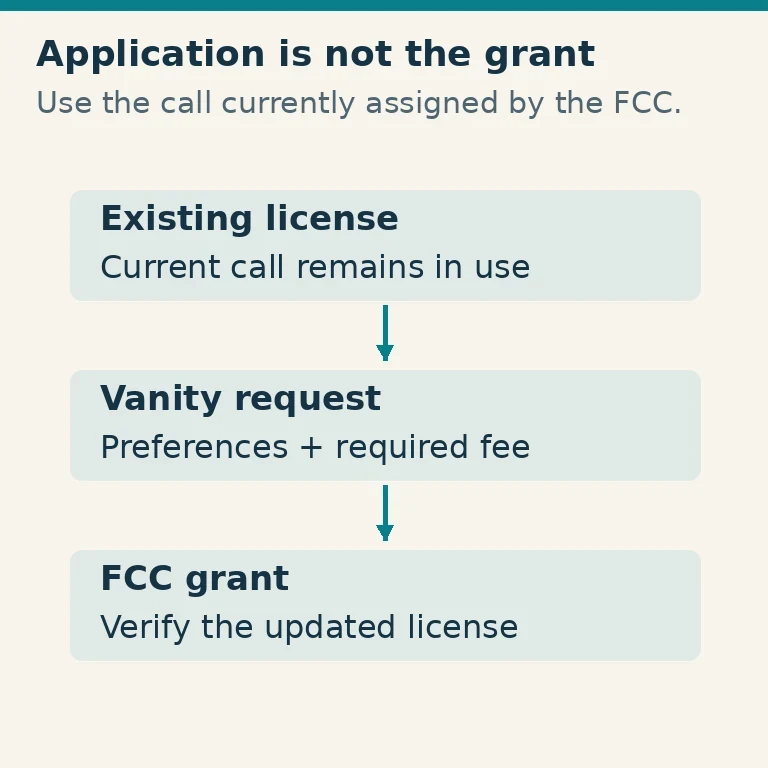
A different question needs a different search. If you want to know whether someone has requested a call sign through a pending vanity application, a license search alone does not answer it. FCC guidance directs people researching that question to both an Amateur License Search and a Vanity Call Sign Application Search. An application is not the same thing as an issued license; keep the two record types separate as you search.
ARRL offers an FCC-data search with a Call Sign field. The page also displays an “Includes FCC actions through” date. Read the date currently shown on the page, especially if the call sign recently changed or the status matters now. An ARRL result can be a useful cross-check, but its displayed coverage date tells you why it should not replace inspection of the live FCC record for a time-sensitive decision.
QRZ serves another purpose: it can help you look for a call sign and, where a listing contains it, read material maintained by a member. QRZ identifies certain items on its US listings as coming from the FCC, while it says an optional biography is maintained by the user who manages the listing. Those are different kinds of information on the same page. A non-US listing has a different provenance: QRZ describes member-assisted additions and a documentation-and-review route, not verification as a US FCC grant.
In short, choose FCC for a US license question, ARRL for a dated cross-check, and QRZ for possible call-sign or QSO context. A QRZ profile, whether US or non-US, is not a reason to skip the relevant official record when the question is what the FCC has granted.
Search the FCC License Record by Call Sign
Begin with the call sign as you received it—from a contact, a log entry, or another source—and copy the whole string before searching. For an input illustration, suppose your notes say W0QXZ. Treat that as a fictitious example of text to enter, not as a claim that a live search will return a license. The point of copying it first is practical: you can compare the search result against the characters in your notes instead of trying to recognize a name.
Go to the FCC ULS license search and search by call sign. FCC guidance also describes an Amateur-specific license search, so use that route if it is offered and helpful for narrowing the results. The FCC documentation establishes these search routes, but it should not be read as a promise that today’s page has the same button names or layout as the documented version. Follow the available call-sign or Amateur license-search controls, and enter the call you copied.
On the results page, first look for the full call sign you meant to search. FCC guidance says matching license rows display the call sign, licensee name, FCC registration number, radio service, status, and expiration date. Check that the radio service is Amateur as well as checking the call sign. A familiar-looking name is not a substitute for those checks: your task is to find the record for the call, not to guess which row looks most plausible.
Then select the matching call sign to open its detailed license information. Do not stop at a result-row excerpt or a third-party snippet when you need to interpret the license. The row is useful for deciding which record to open; the detailed record is where you can examine what that particular license entry shows. FCC guidance explicitly directs readers to select a call sign for its detail.
If the results are unexpected, slow down rather than selecting the first row. Compare each candidate’s complete call sign and radio service with your search input, then inspect the relevant detail. For example, if your notes are uncertain about one character, a result for a different full call is not confirmation merely because its licensee name seems familiar. This is a checking method, not evidence about either person or call.
Keep the type of search in view throughout. A ULS license result concerns a license record. A Vanity Call Sign Application Search concerns pending requests; the FCC names it as a separate search for checking whether a desired call has an existing pending vanity application. If your original question was simply about the license associated with a call heard during a QSO, start with the license record. If your question later becomes whether that call has been requested, change to the application search rather than treating the license results as though they cover both.
Read What the License Record Establishes
Read the detailed record as an observation of a particular license entry. Confirm the call sign, licensee, and Amateur radio service, then note the status and expiration date displayed. These are among the items FCC guidance describes in license search results; opening the detail lets you check the entry you actually matched. Write down when you checked it if you may need to explain the result later.
Those fields answer related but distinct questions. The call sign identifies the record you opened. The radio service helps establish that you are looking at an Amateur license entry rather than merely a similar search hit. Status tells you what the displayed record says about that license at the time you viewed it, while an expiration date is a date shown for the license—not a stand-alone account of every change that may have happened to it. Read status and date together instead of turning one field into a broader conclusion.
If the detailed record displays a license class, grant date, or other license dates, note their labels and values as shown. Do not assume every result will present the same collection of dates in the same way. QRZ lists class and license dates among the FCC-supplied items in its US call-sign information, but if a class or date is important to your present question, check the live FCC detail rather than making an older copy your final reference. A class entry is a record detail; this lookup alone is not an operating-privileges guide.
Most importantly, distinguish a grant from a request. Finding a pending vanity application shows that an application exists; it does not by itself show that the requested call has been issued as a license. Conversely, searching licenses does not also check for pending vanity applications. That is why the FCC directs vanity researchers to separate Amateur license and application searches.
A careful report names both the source and the observation: for example, “When I checked the FCC license detail on [date], the record for [call sign] displayed [status] and [expiration date].” Fill in those brackets only from the record you actually opened. If the status or a date is unclear, return to that detail before describing the call as currently licensed; if you have only an older mirror result, do not silently turn it into a current FCC finding. Nor does the licensee name identify who spoke during a particular transmission.
Use ARRL and QRZ for Their Different Strengths
For an ARRL cross-check, enter the call in its Call Sign field and read the result alongside the page’s “Includes FCC actions through” date. That date is part of interpreting the lookup, not background decoration. Suppose you are checking a change you believe happened recently: if the page’s included-actions date does not settle whether that change is reflected, the appropriate next step is to inspect the FCC license detail. Read the date currently displayed rather than relying on a date someone recorded previously.
On QRZ, start with a call-sign search if you are looking for a listing associated with the call you heard. QRZ’s search help also describes callsign searching that can include aliases, prefixes, and suffixes. It separately describes a biography-text search for words members mention in their biographies. Use that second option only if your purpose is to find member-written context, not to verify a license. QRZ describes these advanced search types as available to logged-in users, so check what search options your own access provides rather than assuming every visitor sees or can use them all.
An alias hit needs an extra check. QRZ describes aliases as unofficial inputs from members—potentially a nickname or previous call sign—not as official licensing entries. If an alias leads you to a listing, identify the actual call sign represented there and check the relevant FCC license record before drawing a US licensing conclusion. An alias may help you find context; it does not change which call was granted.
Within a US QRZ listing, separate the material by origin. QRZ says its FCC-provided items include the call sign, name, postal address, license class, and license dates. It also says a listing may contain an optional biography maintained by the user managing it. A personal note in a biography can be useful context for someone trying to understand a QSO, but it is not an FCC finding. The same distinction applies to any contact information a listing supplies: it may help with communication without establishing license status.
Do not carry the US provenance assumption over to a non-US QRZ listing. QRZ describes one way such a call can be added with another member’s assistance and another in which the person supplies valid-license documentation for staff review before the submitted information becomes visible. That describes QRZ’s listing process; it does not make the resulting page a US FCC license record. If your question is about a US grant, return to ULS.
Resolve a Missing or Conflicting Result
A blank search is a cue to check your method, not an immediate finding that no license exists. Recheck the characters you copied, including any character you may have misheard or mistyped. Confirm that you searched for the call sign rather than entering it under a name or another criterion, and retry the call-sign or Amateur license search as appropriate. FCC guidance says that when no results match the specified criteria, the remedy is to revise the criteria and search again.
If you find a result in ARRL or QRZ but the FCC record appears different after a recent change, compare what each source covers before calling it a contradiction. Read ARRL’s currently displayed FCC-actions-through date and inspect the live FCC license detail for the status or date that matters. QRZ advises allowing a few days for changed FCC information to reach its listing. Separately, QRZ says it automatically adds a new US call sign within three days of its becoming effective on the FCC website. Treat the latter as QRZ’s description of its process, not as a guaranteed countdown for a particular lookup.
If your real question is “Could I request this call as a vanity call?”, take a separate branch. FCC guidance points you to both Amateur License Search and Vanity Call Sign Application Search, the latter for an existing pending application. ARRL warns that a call sign absent from the FCC license database still may not be available for assignment. A blank license search, even followed by a blank application search, is therefore not an availability verdict.
There are further limits to that conclusion. The FCC says a call sign is normally assignable two years following license expiration, surrender, revocation, set aside, cancellation, being void from the outset, or the grantee’s death. It also says availability depends on geographic and operator-class eligibility. Those conditions explain why “no hit” cannot safely be translated into “I can have it.” This is a reason to use the relevant FCC searches and rules for a vanity question, not a filing procedure or a prediction that a particular call qualifies.
When checks still do not agree, stop at a narrower statement you can support. Record which source you viewed, whether it was a license, application, or third-party listing, and the date or coverage date relevant to that view. You can say that an ARRL result displayed one thing as of its included-actions date while the FCC license detail you checked on another date displayed something else. Do not declare current status—or vanity availability—from an unresolved mismatch. Return to the relevant live FCC records when that decision actually matters.
Keep Address and Identity Claims Within the Record’s Limits
A successful lookup has privacy and interpretation limits. Part 97 requires a license grant to show the grantee’s correct name, mailing address, and email address. The address is identified as a mailing address; it does not establish where a transmitter was located during a QSO. Likewise, the name on the record identifies the grantee shown there, not necessarily the person whose voice you heard.
Use wording that preserves those limits: “The FCC record for this call showed [status] when I checked on [date]” is more accurate than claiming the lookup identified an on-air operator or located their station. There is usually no need to reproduce someone’s postal address, email, or QRZ profile to explain a call-sign check. QRZ also says the email displayed on a listing is set separately from the user’s account-registration email; neither kind of contact detail needs to be republished as proof of a grant.
Choose the database for the question, open the relevant record, note when its information applies, and state only what it supports. That habit makes a lookup useful without asking a license entry—or a community profile—to prove more than it can.