The best POTA power supply is the one that delivers the voltage and current your particular station requires, has enough usable energy for your planned session, and fits the site you can actually use. Start with the radio manual, not a battery recommendation. Reject incompatible sources and cables first; then estimate energy, compare what you can carry or access, and rehearse the complete setup before leaving.
There is no single best POTA battery chemistry or supply type. Parks on the Air describes activations from parking lots, hiking routes and picnic areas—situations with different carrying and charging constraints. Its rules do not set a separate transmitter-power limit, but your license conditions, applicable law, band plans and the requirement to use the minimum power necessary still matter. In the US, check the privileges of your license class for the band and operation you intend; POTA participation does not expand them. Park regulations also apply.
Define the Load and the Trip
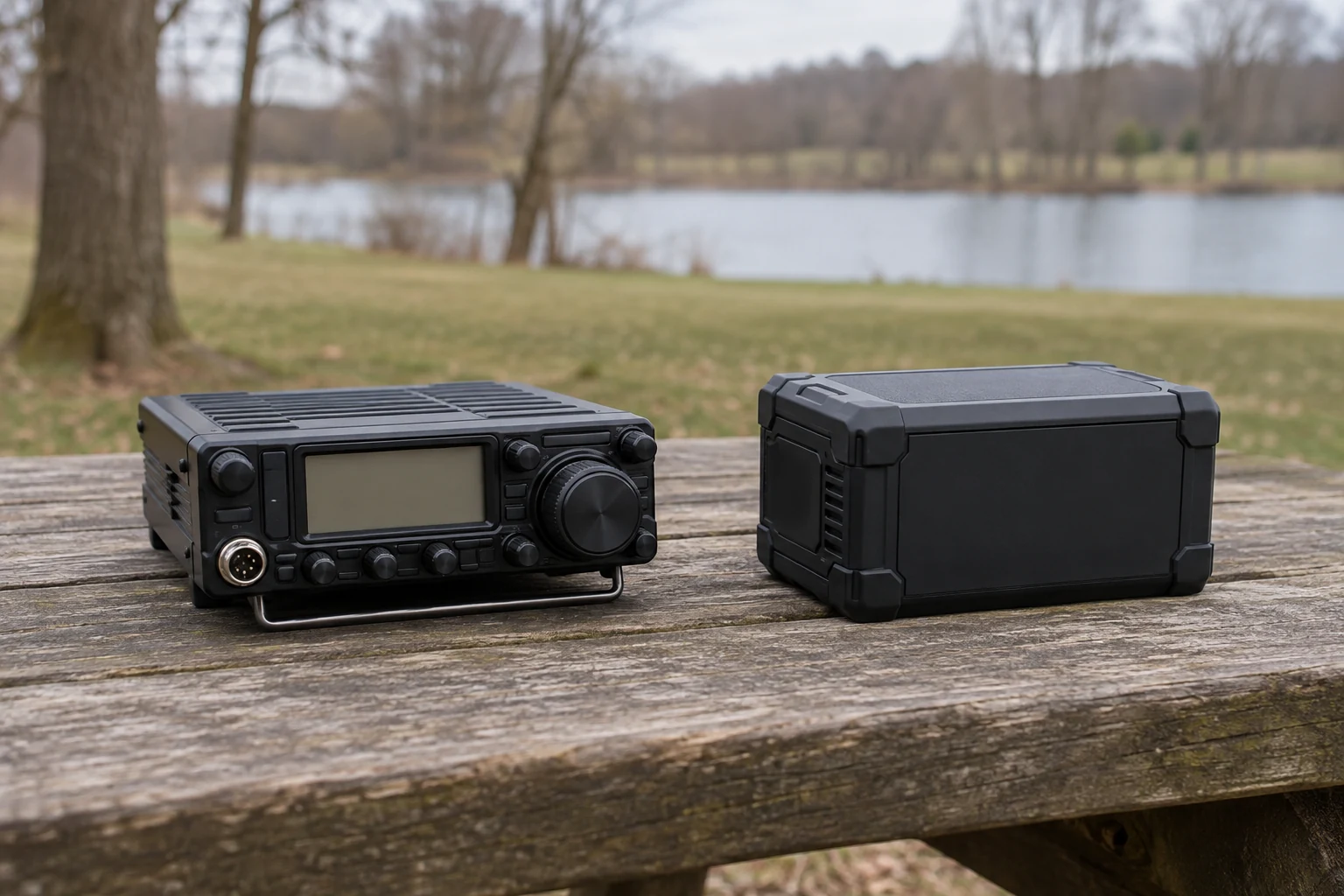
Picture two activations. For a short walk-in session, everything must be carried to the operating spot and back; a heavy supply may be a poor fit even if it has ample capacity. At a picnic table near the vehicle, carrying weight may matter less, but that does not mean vehicle electricity or a mains outlet is available. The distance from the car, expected operating time and opportunity to recharge can all change the sensible choice. POTA describes operators working from a parking lot, hiking with equipment and setting up in picnic or similar areas.
Make a station list before shopping for power:
- Radio and operation: Record the exact transceiver model, intended transmit-power setting, mode and expected time spent receiving versus transmitting. A radio’s RF output rating is not its supply-current requirement.
- Shared-source accessories: List every item the proposed supply must run during the session, such as a computer, along with its own power requirements. POTA mentions a tablet or laptop among possible accessories.
- Recharge needs: Mark which devices run on their own batteries throughout the activation and which you plan to recharge from the station source. A phone that remains on its own charge is a different load from one you expect the station pack to refill. An ARRL portable-operations author notes that bringing laptops, phones or GPS devices can add battery consumption.
- Trip constraints: Note how far you must carry the supply, whether you can legally operate at the intended location, the session length and whether any permitted charging opportunity will exist during that session.
Treat your transmit share as an estimate of what you will actually do, not a number inferred from the radio’s maximum output. A session with long receive periods has a different energy demand from one with frequent transmissions, even at the same transmit setting. Conversely, a low estimated average draw cannot excuse a source that fails when the radio transmits. Keeping those two questions separate—can it supply the peak load, and can it sustain the session?—makes the rest of the choice much clearer.
Reject Incompatible Power and Cable Arrangements
For the exact radio you will take, find the manufacturer’s permitted input-voltage range, required current at the settings you intend to use, specified connector and polarity, and cable instructions. Check whether the source stays within the permitted voltage range throughout its relevant operating and charging states—not merely at its advertised “nominal” voltage. Then confirm that its continuous output-current capability and the complete lead arrangement can meet the radio’s maximum required current at the proper voltage. ARRL explicitly places that requirement on both the supply and the connecting cables.
Cable length is part of this screen. The voltage that matters is what reaches the radio under full load, not just a reading at the supply with the radio idle. ARRL advises using the radio manual’s wire-size guidance for the required cable length so adequate voltage reaches the radio during full load. If the planned cable is longer than the arrangement addressed by your instructions, do not assume it will perform like a short lead. Resolve the cable and voltage question before relying on the setup.
Check accessories separately. A supply output suitable for the transceiver does not thereby become a suitable connector, voltage or charging input for a tablet or other device. Use each item’s instructions and count its load when it shares the source. Likewise, matching plugs do not establish matching polarity. Verify the connector against the approved instructions with an appropriate tester before connection. ARRL describes a polarity tester that can reveal a mating connector wired with reversed DC polarity.
A dated example shows why nominal voltage is insufficient. In his March 2020 QRP account, ARRL author Mayer described a nominal 14.8 V lithium-ion pack whose voltage when fully charged exceeded the KX3’s 15 V supply limit. That is a warning to compare a candidate pack’s actual voltage range with your radio’s specification—not a 15 V limit for every transceiver or a reason to improvise a voltage reducer. Mayer also notes that his own radio requirements changed with his intended transmit setting and directs readers of other radios to their manuals.
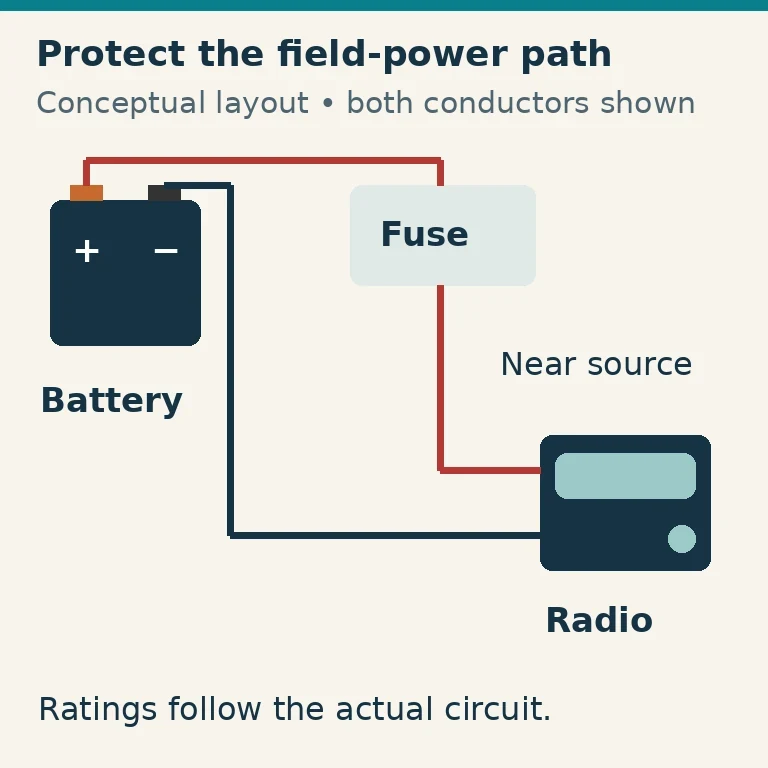
A vehicle needs its own compatibility decision. POTA permits an activation from a vehicle parked on public property within the park boundary, but permission to operate there does not make every vehicle outlet suitable for a transceiver. For example, the FT-891 manual requires a supplied or specified DC cable, warns against using an in-car cigarette-lighter connector as its power source, and specifies a 25 A blade fuse when replacing that model’s fuse. Those are manufacturer-specific instructions, not a cable, outlet or fuse recipe for another radio or vehicle.
Follow both the particular radio’s and vehicle’s applicable instructions. If you cannot reconcile them for the proposed vehicle arrangement, choose a compatible standalone pack or seek qualified installation help rather than guessing at a connection. Make this decision before estimating runtime: an outlet that cannot safely supply full transmit load is not rescued by a large theoretical energy reserve.
Estimate Session Energy Without Mistaking It for a Guarantee
Once a source passes the electrical screen, estimate how much energy the session needs. Ampere-hours (Ah) express current over time: one ampere sustained for one hour is one ampere-hour. Mayer illustrates the idea with a nominal 5 Ah battery supplying 1 A for five hours. Watt-hours (Wh) express energy: watts equal volts multiplied by amps, and watt-hours equal watts multiplied by hours. Keep Ah figures at the same stated voltage when adding loads; if devices run at different voltages, convert their demands to Wh before combining them.
Here is a deliberately hypothetical four-hour estimate at a 12 V output. Assume the radio draws 1 A while receiving for 80% of the time and 8 A while transmitting for 20%. Assume accessories draw another 0.5 A continuously from that same 12 V output. These numbers illustrate the calculation; they are not specifications for a POTA radio or a tested station.
| Planning quantity | Calculation | Result |
|---|---|---|
| Average current at 12 V | (0.8 × 1 A) + (0.2 × 8 A) + 0.5 A | 2.9 A |
| Four-hour demand at 12 V | 2.9 A × 4 h | 11.6 Ah |
| Equivalent energy | 12 V × 11.6 Ah | 139.2 Wh |
| Simultaneous transmit-plus-accessory load | 8 A + 0.5 A | 8.5 A |
The 8.5 A figure answers a different question from the 2.9 A average: the output, connectors and leads must support the simultaneous load when transmitting. Do not buy an output rated only for 2.9 A because the session average is 2.9 A. Nor does the arithmetic replace the exact radio manual’s maximum-current requirement; use whichever documented simultaneous demands apply to the real station.
Suppose you choose a 25% planning allowance for the example. The target becomes 11.6 Ah × 1.25 = 14.5 Ah at 12 V, or 174 Wh. That allowance is your planning choice, not proof that a pack advertised as 14.5 Ah will deliver four hours in this setup. Compare candidate specifications at their stated conditions and verify performance with the intended equipment rather than treating label capacity as guaranteed usable capacity.
To adapt the calculation, replace the example’s receive and transmit currents with figures appropriate to your model and settings, or measurements made with suitable equipment. Replace the 80/20 split with a plausible pattern for your mode and operating plans; list any accessory loads on the same output. If an accessory instead draws at another voltage, estimate its Wh demand separately and include it in a Wh-based energy plan rather than adding unlike Ah figures.
Avoid borrowing another operator’s duty cycle as a default. Mayer’s 25% transmit-duty calculation concerned active Field Day CW using full-break-in keying, where the radio switches to receive between key elements; it is not a universal POTA transmitting share. His KX3 measurements also depended on a particular transmit setting and receiver-feature choices. He notes that supply current may vary as battery voltage changes. Actual transmit time, settings, accessory use, usable pack capacity, voltage during discharge and temperature all make a field session less tidy than a worksheet. The estimate narrows the choice; a rehearsal checks it.
Choose the Source That Fits the Site
With voltage, full-load current, leads and estimated energy defined, compare sources that are genuinely available for this trip. ARRL identifies vehicle electrical power, a deep-cycle battery and an AC-operated supply as possible external sources; POTA describes a battery or possibly a solar panel for portable operations. Neither list says every option will work at every site.
A standalone rechargeable pack is the practical choice for a walk-in location if its documented output range and current capability suit the station and its usable energy covers the plan with your chosen allowance. Its weight matters over the whole carry, not just at the operating table. Check how and when you can recharge it after or between activations, especially if you plan more than one session without returning to an appropriate charger. A pack also gives a vehicle-adjacent operator a separate option when a proposed vehicle-power arrangement is uncertain; it still must pass the same radio compatibility screen.
An AC-operated supply is an option only if a permitted and suitable source of AC power will actually be available where you operate, and the supply and its leads meet the station’s requirements. Do not plan around an assumed picnic-area outlet. If availability is uncertain, take a verified standalone source or change the operating plan. This is a site decision as well as an electrical one.
Vehicle electrical power can be considered only if the planned vehicle location meets POTA and park requirements and the radio- and vehicle-specific power arrangement checks out. POTA allows vehicles parked on public property within the park boundary, while also requiring compliance with applicable rules. A vehicle close to the table reduces what you must carry, but proximity alone says nothing about a socket’s current rating or wiring. If those details remain unresolved, a compatible standalone pack is the bounded alternative—not an improvised vehicle connection.
For rechargeable packs, compare sealed lead-acid and lithium iron phosphate (LiFePO4) candidates by the output and usable capacity you need, then by the weight you can carry, charging logistics and current cost. In a 2020 low-power-station comparison, Mayer characterized sealed lead-acid as a budget choice and LiFePO4 as much lighter but more expensive. That describes his comparison at the time; it is not a current price claim or a ranking of today’s products. Check present candidate specifications and costs for your particular requirement instead.
Treat solar as charging input, not stored energy you can count on unconditionally. POTA mentions a possible solar panel as a portable power source, and Mayer says a solar charger, like other chargers, must follow the battery’s charging specifications. For a shaded operating position or a session after dark, plan enough stored energy without assuming the panel will supply the radio. For a daytime session with a workable charging window, solar may help replenish a suitable pack—but only after its charger and battery requirements are matched. Do not replace the energy estimate with an unsupported promise of panel output.
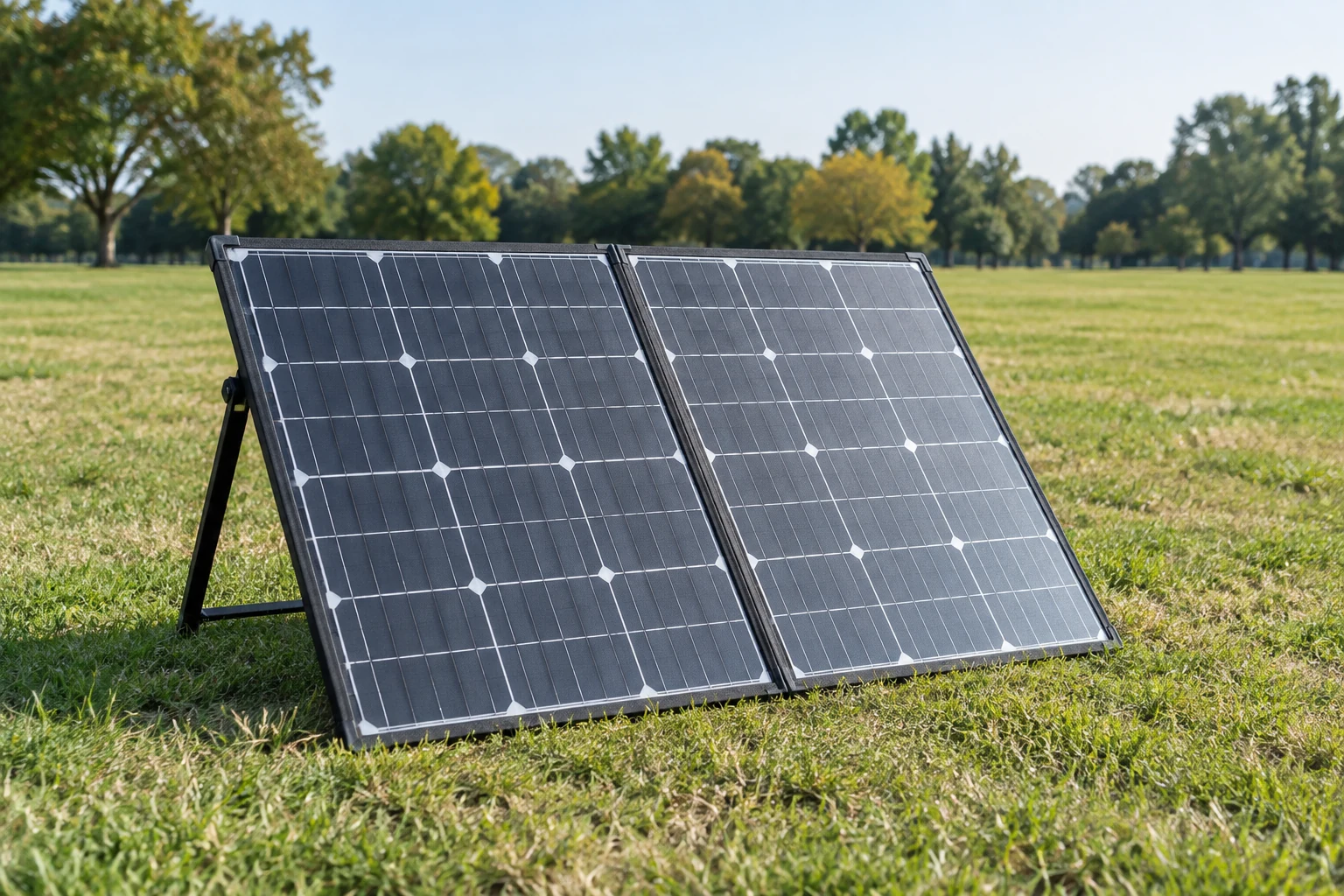
For a backpack activation, the conditional verdict is a carryable, verified pack with enough stored energy for the intended session; an assumed outlet or sunlight is not an adequate fallback. For a vehicle or picnic-area activation, heavier storage may be reasonable if transport allows it, while permitted AC or properly verified vehicle power may avoid drawing down a pack. In either case, select transmitter power for the communication you intend, within your license and applicable rules. POTA prescribes neither a separate power limit nor a battery chemistry, and it calls for the minimum transmitter power necessary—not a setting chosen solely for an award.
Rehearse the Station Before Taking It Into the Park
First confirm the intended access and the park’s own regulations; POTA tells activators to obey them, and its rules place license conditions and applicable laws and regulations above program documentation. Then check the actual equipment you will pack. Review the battery maker’s documented protections rather than assuming every pack includes them. Mayer recommends choosing packs with overcharge, overdischarge and overcurrent protection, as well as a matching charger; any charger used, including a solar charger, must follow the pack’s charging specifications.
Inspect the leads and connectors for damage and secure fit. Confirm connector polarity against the approved radio and source instructions with an appropriate tester before making the connection. Confirm that the selected charger is approved for the pack under its instructions. If an instruction or connection remains ambiguous, stop there rather than experimenting at the park.
Run a pre-trip rehearsal with the actual radio, proposed cable length, accessories, source and intended transmit setting. Observe voltage at the radio while it is under full intended load, not solely at the source while receiving. Check that connections remain sound. Run the setup long enough to compare observed consumption and behavior with your session estimate, while recognizing that a shorter rehearsal does not prove a longer runtime. This article has not tested your equipment; your documented check is what turns a plausible plan into one you can rely on more confidently. ARRL’s guidance on adequate voltage at the radio under full load is the standard to check against the relevant manual.
Stop rather than operate through a mismatch: unexplained voltage drop at the radio, reversed polarity, incompatible charging instructions, or uncertainty about a vehicle installation. Correct it using the relevant documentation, switch to an already verified compatible standalone source, or seek qualified help. Do not improvise wiring to save an activation.
If carrying it is practical, take a verified spare source, even one with less capacity than the main supply. Mayer notes that a spare may only need enough energy to finish a contact and end the session; it need not duplicate a full day’s plan. The final choice follows a firm order: compatible voltage, current and leads first; sufficient planned energy and a source that fits the site next; a full-load field rehearsal before depending on it.