To make your first HF contact, check that you may transmit on the chosen frequency and mode, make sure your station is ready, and listen for activity. Then answer someone calling or find a clear place to call CQ. A contact is a two-way exchange: sending a call is the start, not the finish. You need to copy the other station, exchange information, acknowledge what you received, and close with the required identification. Record the contact afterward. If nobody answers, change one justified condition and try again rather than treating silence as a diagnosis.
The SSB voice route below is a practical starting point. CW and FT8 are separate choices if you use those modes; you do not need to complete all three procedures.
Check Your Privileges and Station Before Transmitting
Start with the operator, not the dial. Receiving a station does not mean you have permission to transmit back to it. In the United States, FCC § 97.105 limits station operation to the privileges of the control operator’s actual license class. Section 97.301 lists transmitting bands within its stated geographic and regulatory scope, and § 97.305 ties permitted emission types to authorized frequencies and applicable standards. Together, these make your license, operating location, chosen frequency, and emission matters to check before a reply or CQ. Consult the current rules for your case rather than assuming that every part of an HF band permits your intended mode. Operators outside the United States should use their own regulator’s rules, not US allocations.
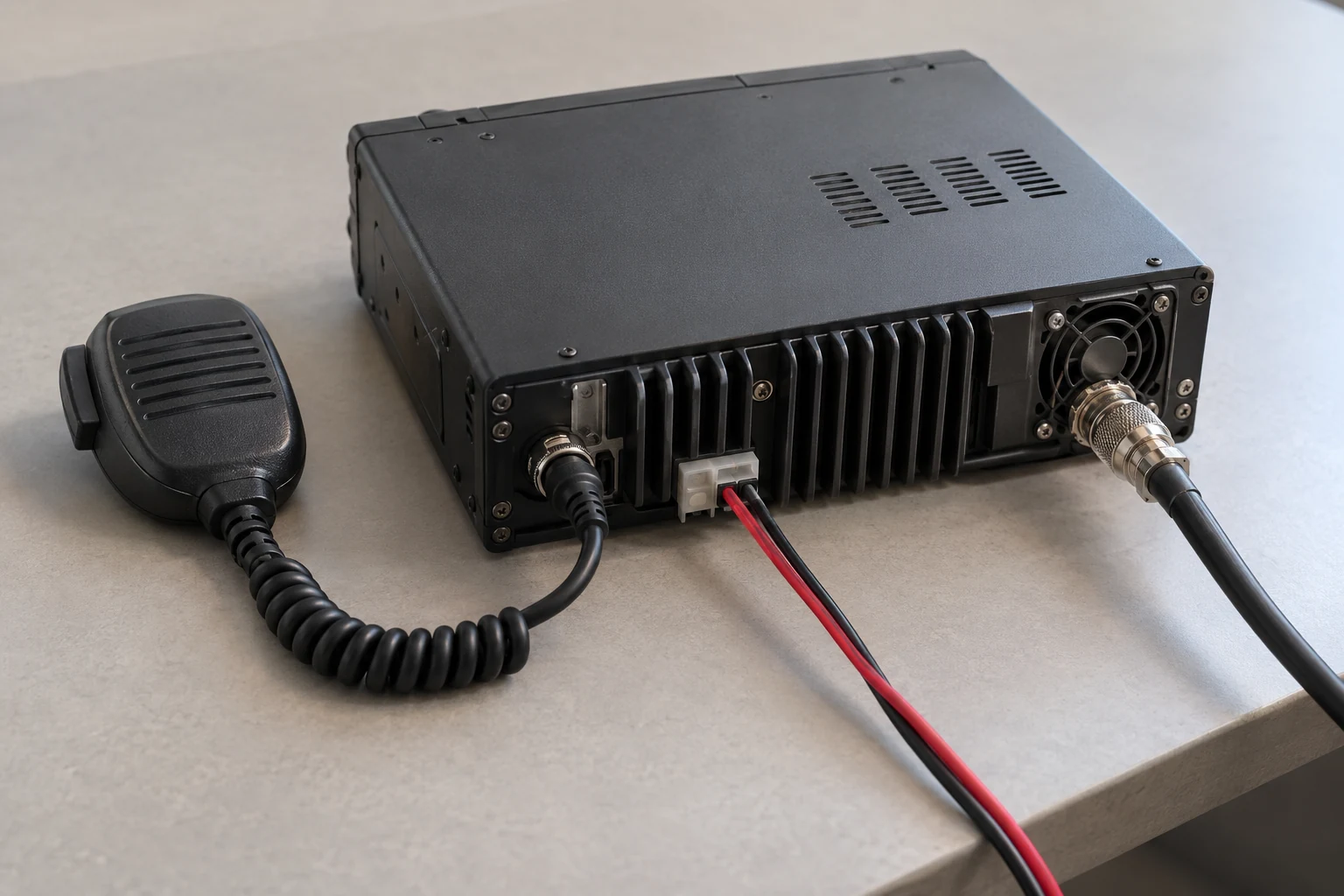
Once you have a lawful choice in mind, give the station a modest inspection. Check that the antenna—the part of the station intended to radiate and receive signals—and its feed line, the connection running to the radio, are connected as your equipment instructions require. Check the radio’s selected mode and power setting rather than relying on what you used last time. If you have not tested the station, treat these as preparation, not as proof that it transmits successfully.
If your station uses a manual antenna tuner, follow the radio and tuner manuals for their controls and limits. ARRL advises adjusting a tuner at low power while watching the standing-wave-ratio, or SWR, meter. Its published example mentions a small amount of power, but that example is not a setting to apply to every radio, tuner, antenna, or situation. Do not invent a target SWR, tune-up power, or adjustment sequence for equipment whose instructions you have not checked. If you cannot carry out the matching check safely, stop and get help from an experienced operator or the manufacturer’s instructions.
For SSB, also look at the radio’s ALC indication while speaking as its manual directs. ARRL advises reducing microphone gain or speaking more softly if your voice drives the indication beyond its appropriate range; a high reading can mean that the radio is being overdriven and that transmitted audio may be distorted. There is no microphone-gain number that suits every voice and radio. Use the indication and the manual, not a copied setting from another station.
These checks answer different questions. Connections and matching concern the antenna path; mode and power concern the radio’s configuration; ALC concerns SSB audio. None guarantees that another station is listening, that conditions support the path, or that your signal has been heard. With permission and the station preflight in hand, the next useful test is to listen.
Listen for Activity and Choose How to Start
HF is not a schedule of guaranteed long-distance openings. ARRL notes that, at certain times of day, some bands will not be open for long-distance contacts. Listen for activity now instead of assuming that a particular band or hour must work. An audible station gives you more to go on than a predicted opening, though hearing one signal does not establish that you may transmit on its frequency or mode.
On a frequency and emission you have already checked as permitted, listen before transmitting. Are you hearing a CQ, an ongoing exchange, or a station that may be finishing? If you plan to call CQ, ARRL advises finding a frequency that sounds unoccupied. When it seems clear, its practice is to ask whether the frequency is in use, give your own call, and wait for a reply. For example, you might say, “Is this frequency in use? This is [your call sign],” then leave time to hear an answer. A moment of silence is not a guarantee of vacancy; if someone replies that the frequency is in use, choose another clear, permitted place instead.
You now have two straightforward ways to begin:
- Answer a CQ you can hear. The other operator has invited a reply, so this offers an immediate opportunity to attempt a contact. Listen closely enough to copy their call before you transmit. Answer only if your own transmission there is permitted.
- Call CQ on an apparently clear frequency. This invites someone who hears you to answer. It is useful when you do not hear a suitable CQ but have found a place to call after listening and checking occupancy.
ARRL presents answering a CQ and calling CQ as the two starting choices. Neither guarantees a response, and neither changes your operating privileges.
Keep your first attempt short enough that another station has room to answer. If you are answering, be ready to say their call and then your call. If you are initiating, be ready to give your own call in the CQ. The point of listening first is not to find a theoretically perfect opening; it is to identify a lawful, presently plausible opportunity without talking over someone you can hear. Once another operator replies, slow down enough to copy who answered before moving into the exchange.
Make the Two-way SSB Exchange
On SSB, CQ means you are inviting a contact. ARRL’s model is a short CQ followed by the calling station’s identification. Here is an illustrative version using invented call signs: “CQ, CQ, calling CQ. This is K7MNO, K7MNO.” Use your own authorized call, not the sample call. Pause and listen after the call; a longer uninterrupted CQ does not help you hear an answer.
If instead you heard K7MNO calling CQ, an illustrative answer from station W2PQR would be: “K7MNO, K7MNO, this is W2PQR.” ARRL advises saying the station being called once or twice, followed by your own call. K7MNO is the station you are addressing in that reply; W2PQR is your identification in this example. Saying only the other station’s call would not identify your station.
The first job after an answer is to establish who is speaking to whom. Listen for the full call, including characters you may have missed, rather than guessing from the strongest syllables. Then take turns. The following brief exchange is illustrative; its call signs, names, places, and signal reports are invented, not prescribed wording or values:
> K7MNO: “W2PQR, this is K7MNO. I copied W2PQR. My name is Sam, and I’m in Oregon. Your signal report is five-seven. Back to you, W2PQR.”
>
> W2PQR: “K7MNO, this is W2PQR. I copied your five-seven report. I’m Lee in New York. Your report is five-five. I’m using an HF radio and an outdoor antenna. Back to you, K7MNO.”
>
> K7MNO: “W2PQR, K7MNO. I copied five-five, Lee in New York. Thanks for the contact.”
In that example, each station has supplied its call, passed information, and acknowledged information from the other. A signal report says what the reporting station received; K7MNO’s report about W2PQR is not W2PQR’s report about K7MNO. The exact reports in a real QSO come from what the operators can assess, not from this script. ARRL suggests name, location, signal report, and a brief station description as ordinary first-conversation material. You can use those as prompts instead of trying to deliver a memorized speech.
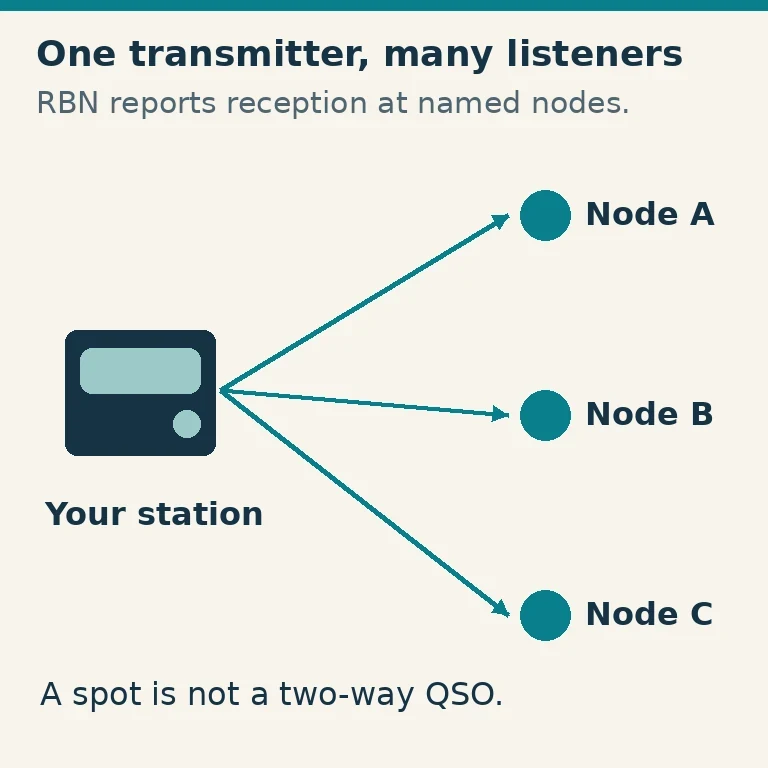
If a character in the other call did not come through, ask for the call again. If you missed a report or location, say which item you need repeated and listen for the answer. That makes the exchange more useful than pretending you copied it. Equally, if you call CQ and hear nothing, you have not completed a QSO: nobody has exchanged and acknowledged information with you. Save a report of “contact made” for an actual two-way exchange. WSJT-X describes the traditional minimum in terms of exchanged calls, a report or other information, and acknowledgments; that is a useful distinction even when thinking about a simple voice contact.
Not every answering station wants the same pace. If a distant DX operator is making rapid report-and-goodbye contacts, match that short pattern: give the report and location they seek, and do not start a long account of your station. ARRL specifically recommends following that operator’s brief pace.
A contest is a different condition. Contest contacts may call for particular information, such as a state or county, rather than just the ordinary introductory conversation. Listen for what the station is requesting and supply the applicable exchange; a name and friendly chat alone may not be the information sought.
In an unhurried contact, leave room for the other operator’s questions and ask for repeats when necessary. In a rapid contact, be concise. Both paths depend on copying the other station and making the information flow in both directions. Once that has happened, close courteously and give your required final identification as described below.
Use CW or FT8 If That Is Your Chosen Mode
If you choose CW, the voice script is not another task you must perform first. When answering a CW CQ, ARRL advises zero beating the calling station: set your transmit frequency as close to that station’s as possible. This is a practical way to place your answer where the caller is listening. ARRL also advises sending no faster than you can copy and no faster than the station calling CQ. Speed that you cannot follow may make a reply hard to understand even if your signal is heard.
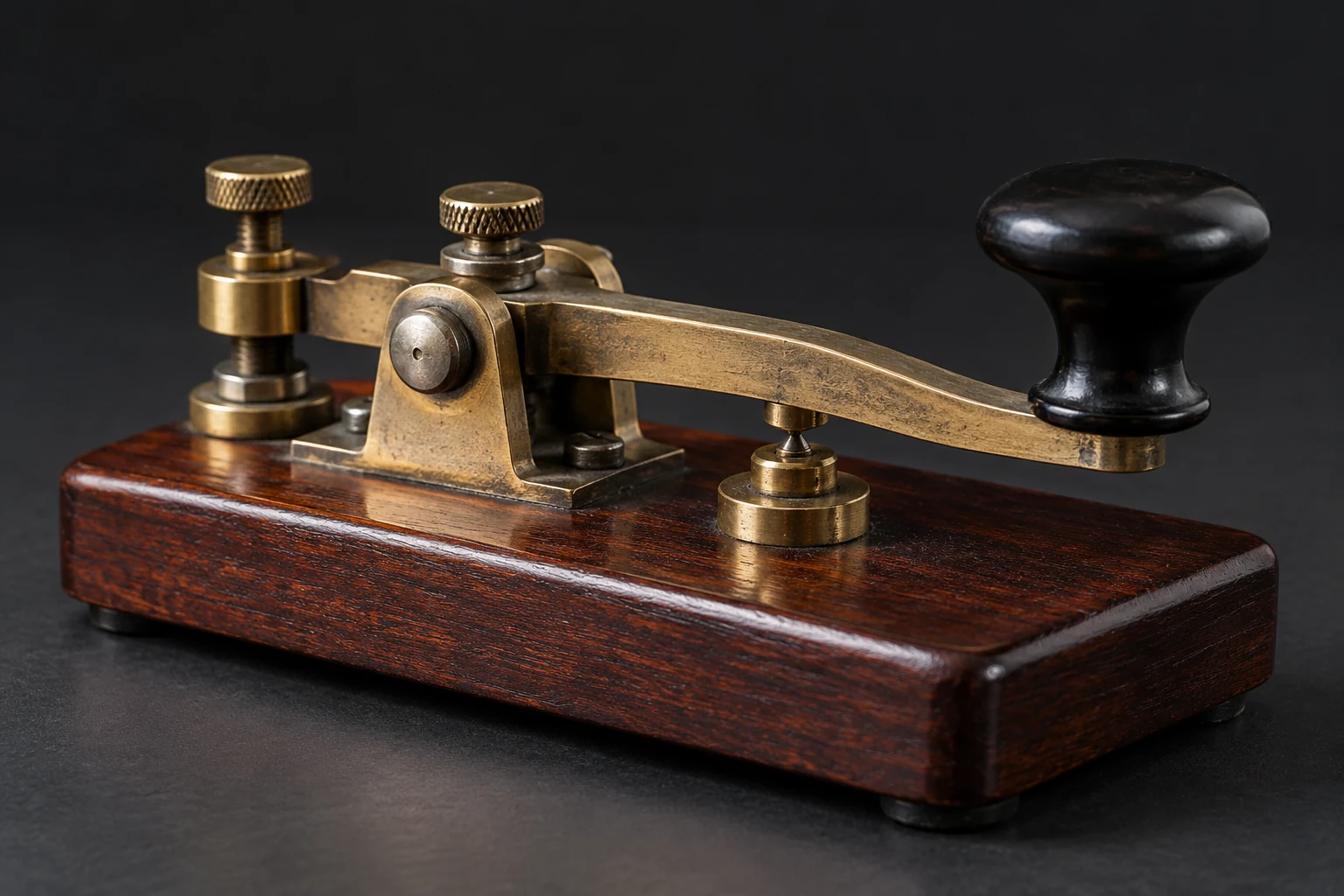
Listen for the calling station’s call, send an answer at a copyable pace, and allow time to receive its response. If part of a call or report is missing, request or wait for a repeat rather than filling in a guess. Zero beating and suitable speed improve the chance of being heard and understood; sending your call once still does not establish a completed two-way exchange. For an illustrative CW contact, W2PQR answers K7MNO’s CQ with both calls. K7MNO replies with both calls, a signal report, and its location. W2PQR acknowledges the report and sends its own report and location; K7MNO acknowledges what it copied. They close by sending their own calls. These are steps to follow, not prescribed wording or reports: copy each reply before sending the next.
If you choose FT8 with WSJT-X, make the software’s own pre-QSO checks before calling. The WSJT-X documentation specifies correct values for your call sign and grid locator; properly configured and tested PTT and CAT control, if used; a computer clock synchronized to UTC within ±1 second; selected audio input and output devices configured for 48,000 Hz and 16 bits; and the radio set to USB, or upper sideband. These are WSJT-X checks, not a claim that every digital program or mode has the same setup. Follow the equipment and software instructions for the rest of your station configuration.
FT8 uses short, structured messages. The following is the WSJT-X documentation’s example, with its actual example call signs and reports; it is not a set of values to reuse for your own contact. Read each line from left to right. In messages addressed to a particular station, the first call is the recipient and the second is the sender. The initial CQ is a general invitation from K1ABC.
| Message | What happens |
|---|---|
CQ K1ABC FN42 |
K1ABC calls CQ and includes its grid. No one has answered yet. |
K1ABC G0XYZ IO91 |
G0XYZ answers K1ABC and supplies its grid. |
G0XYZ K1ABC -19 |
K1ABC sends a report to G0XYZ. |
K1ABC G0XYZ R-22 |
G0XYZ acknowledges the previous report and sends its report to K1ABC. |
G0XYZ K1ABC RRR |
K1ABC acknowledges G0XYZ’s report. |
K1ABC G0XYZ 73 |
G0XYZ sends the closing message to K1ABC. |
The direction matters. In G0XYZ K1ABC -19, K1ABC is the sender, even though its call appears second; the -19 is the report K1ABC sends to G0XYZ. In K1ABC G0XYZ R-22, G0XYZ is the sender; the R acknowledges receipt, and the report goes to K1ABC. The later RRR is K1ABC’s acknowledgment. Reading the calls backward would reverse who reported what and obscure whether an acknowledgment was actually sent.
A decoded CQ K1ABC FN42 tells you that K1ABC is inviting replies. It is not evidence that K1ABC received your call, sent you a report, or acknowledged anything. WSJT-X describes a minimally valid QSO as an exchange of calls, a signal report or other information, and acknowledgments. Use that distinction when judging whether a contact progressed beyond a decoded CQ or an unanswered transmission.
CW and FT8 therefore have different practical checks: on CW, pay close attention to transmit-frequency placement and copyable speed; with WSJT-X FT8, verify its clock, controls, audio, identity, and radio-mode setup, then follow the direction of its messages. Neither branch is mandatory for an SSB operator, and neither makes a sent call alone into a QSO.
Close the Contact and Keep a Useful Record
When you have copied the other station’s call and exchanged and acknowledged information, close in a way that fits the conversation. A brief “Thanks for the contact, goodbye” is enough for an ordinary short voice QSO; a fast-moving station may need an even shorter finish. If you are still unsure of a call or a necessary piece of exchanged information, ask before treating the contact as complete.
Identify your own station when closing. For covered US amateur stations, FCC § 97.119(a) requires transmission of the station’s assigned call sign at the end of each communication and at least every ten minutes during a communication. The provision states exceptions for space stations and telecommand stations and prohibits unidentified transmissions or using an unauthorized station call sign as the station’s identification. As a practical way to identify on US phone, say your own authorized call in English. Saying the other station’s call to address them does not replace your own identification. Operators elsewhere should check their regulator’s identification rules.
Afterward, make a record while the details are fresh. ARRL recommends recording the date, frequency, mode, and power for your operation; the other station’s call; the contact’s start and end times; and the other station’s report, name, and location where known. It highly recommends UTC for the time record. A usable entry might therefore put the UTC date and start/end times first, followed by frequency, mode, power, the other call, report, and any name or location copied. Do not turn each recommended field into a universal legal requirement, and do not invent details you did not receive.
A log can also help if you later deal with a QSL card, a confirmation of a contact; ARRL notes its usefulness even when a DX card arrives months afterward. But the order matters: the on-air exchange makes the QSO, and the record documents it. Neither a log entry, a QSL, nor an award can retroactively turn an unanswered CQ or an incomplete exchange into a completed contact.
If Nobody Answers, Change One Condition and Try Again
One silent CQ is a result, not a diagnosis. It does not prove a failed radio, poor propagation, an occupied frequency, or anything else by itself—and it is not a completed QSO. Separate the questions before changing settings:
- Receive: Can you hear current activity on a lawful operating choice, or have you found no station to answer?
- Permission: Is the frequency and emission still permitted for you where you are operating?
- Transmit control: Does the station operate as its manual says it should when you attempt to transmit?
- Audio: Is the intended SSB or WSJT-X audio path configured as intended?
- Antenna and conditions: Can you complete the equipment’s matching checks safely, and might time-varying HF conditions make another attempt more promising?
That order prevents a quiet band from being mistaken for evidence of a broken device. If little relevant activity is audible, listening again at another time is reasonable: ARRL notes that some bands are not open for long-distance contacts at certain times of day. If you have called CQ several times without an answer, ARRL advises trying a different frequency. First listen there and check whether it is in use; choose only a frequency and emission you may use.
Let an observation determine the next station check. If manual matching is in question, return to the tuner and radio manuals; ARRL’s supported approach is low-power adjustment while watching SWR, not an improvised power recipe. If SSB’s ALC indication shows overdrive while you speak, revisit microphone gain or how softly you speak, because distorted audio is possible. If a WSJT-X FT8 attempt is not progressing, recheck your own call and grid, the UTC clock, tested PTT and CAT if used, the specified audio-device configuration, and USB radio mode. Any one of these checks can reveal something to correct; none, by itself, proves what propagation was doing.
Listen, make one justified adjustment, and try again so you can tell what changed. If you cannot complete station checks safely or cannot establish what your equipment is doing, stop transmitting and consult its manufacturer’s instructions or an experienced operator. The goal is not to force a reply; it is to make the next lawful, understandable call—and be ready to complete the exchange when someone answers.