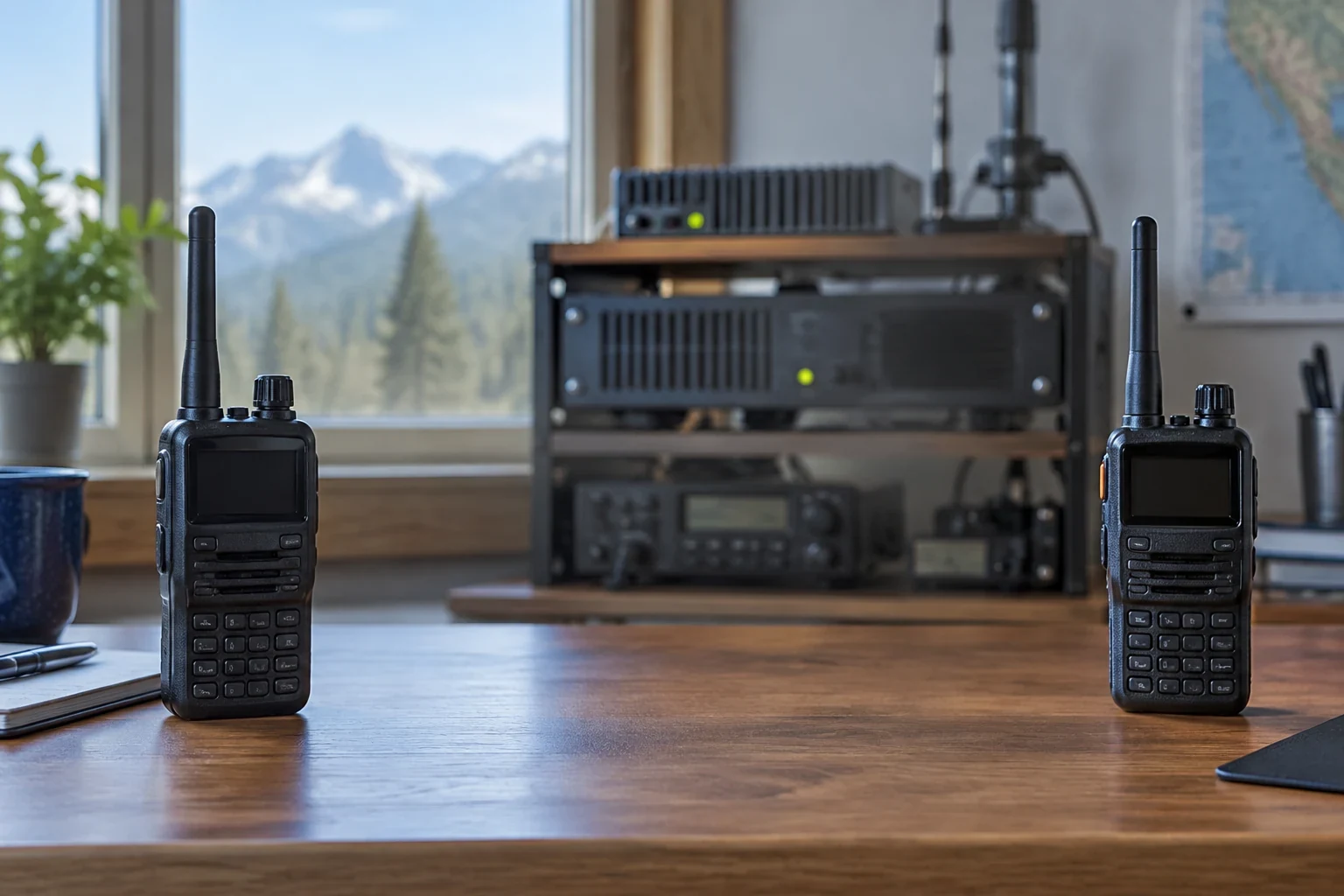
In a direct simplex conversation, two radios use the same frequency and their users take turns speaking. Full duplex means a station can transmit and receive at the same time. A conventional repeater does that while relaying a signal, but an ordinary push-to-talk radio using the repeater does not become full duplex: its user still speaks, releases the button, and listens for a reply.
Follow the Signal, Not Just the Frequency Count
On direct simplex, one person’s transmission travels to the other person’s receiver without a repeater in between. Both radios use the same frequency for transmitting and receiving. If both users try to speak at once, they are not having a two-way, simultaneous conversation; each needs a turn to listen.
A conventional repeater has a different job. It receives a user’s signal on its input frequency and simultaneously retransmits it on its output frequency. The other user listens to that output, then transmits a reply on the input. ARRL describes this simultaneous receiving and retransmitting as duplex operation by the repeater. Many repeaters use a duplexer so one antenna can serve both functions at once.
| Part of the conversation | Frequency arrangement | Who takes turns? |
|---|---|---|
| Direct simplex | Each radio transmits and receives on the same frequency | The users |
| Ordinary repeater user | Radio transmits on the repeater input and listens on its output | The users |
| Conventional repeater | Receives on its input while transmitting on its output | It relays simultaneously; the users still take turns |
The distinction is what each station can do at one instant, not merely whether two frequencies appear in its settings. A push-to-talk radio may be configured with separate transmit and receive frequencies yet still switch between transmitting and listening rather than doing both simultaneously.
What an Offset Tells You—and What It Does Not
For an imaginary calculation, call a repeater’s output frequency F and the magnitude of its negative offset Δ. A user radio listening at F would be configured to transmit at F − Δ, the repeater’s input. These letters illustrate the subtraction only; they do not identify an operating frequency or a recommended repeater pair. ARRL notes that local and regional band plans take precedence over its suggested national offsets.
Hearing activity on the output proves that you can hear that signal. It does not prove your radio is set to the right input frequency or access method, or that your signal will reach the repeater. Check the published repeater settings rather than treating reception as a successful transmit check.
For a direct local contact, simplex avoids the repeater path; when the task calls for a repeater, use its published settings. Neither choice by itself promises a particular range. One naming wrinkle is worth knowing: ARRL also describes a “simplex repeater” that stores a transmission and plays it back later on the same frequency. Unlike a conventional repeater, it does not receive and retransmit that signal simultaneously.