A battery lasts approximately as long as its usable amp-hours divided by your station's average battery current. For example, if you plan to use 8 Ah and the station averages 2.24 A, the estimate is about 3.6 hours. The same battery allowance lasts only about 1.8 hours at 4.4 A. The radio, transmit time, accessories and battery limits matter more than the POTA label.
POTA, or Parks on the Air, is an amateur-radio activity built around making contacts from designated parks. Its rules require at least ten contacts within a single UTC day for a successful activation; they do not guarantee that ten contacts will take a particular number of minutes. Budget for the operating session you intend, including unsuccessful calling and listening.
Collect Four Numbers Before Choosing a Battery
Write down the battery's rated capacity and nominal voltage, the radio's current while receiving, its current while transmitting at your chosen setting, and the proportion of time you expect to transmit. Use amperes of DC input current, not watts of RF output. Add any accessories powered by that battery.
Amp-hours, abbreviated Ah, describe charge capacity. At a constant 2 A, a genuinely available 8 Ah corresponds to four hours. “Genuinely available” matters: start charge, age, temperature, discharge conditions and your own reserve affect how much capacity you can plan to use. A label is an input to a planning model, not a timed promise.
Watt-hours, abbreviated Wh, let you compare stored energy across different voltages. Approximate rated energy is nominal volts multiplied by amp-hours. A hypothetical 12.8 V, 10 Ah pack is about 128 Wh. A 3.7 V, 10 Ah power bank is about 37 Wh before conversion losses; equal Ah labels do not make them equivalent radio supplies.
For a direct battery-to-radio system at compatible voltage, the Ah/current calculation is convenient. For converters, USB supplies or multiple voltage rails, use Wh and average power at the battery side, or measure the combined battery current. Do not add 5 V USB amperes directly to 12 V radio amperes.
Calculate Average Current and Runtime
For a two-state approximation, use:
Average current = (transmit current × transmit fraction) + (receive current × receive fraction) + battery-side accessory current.
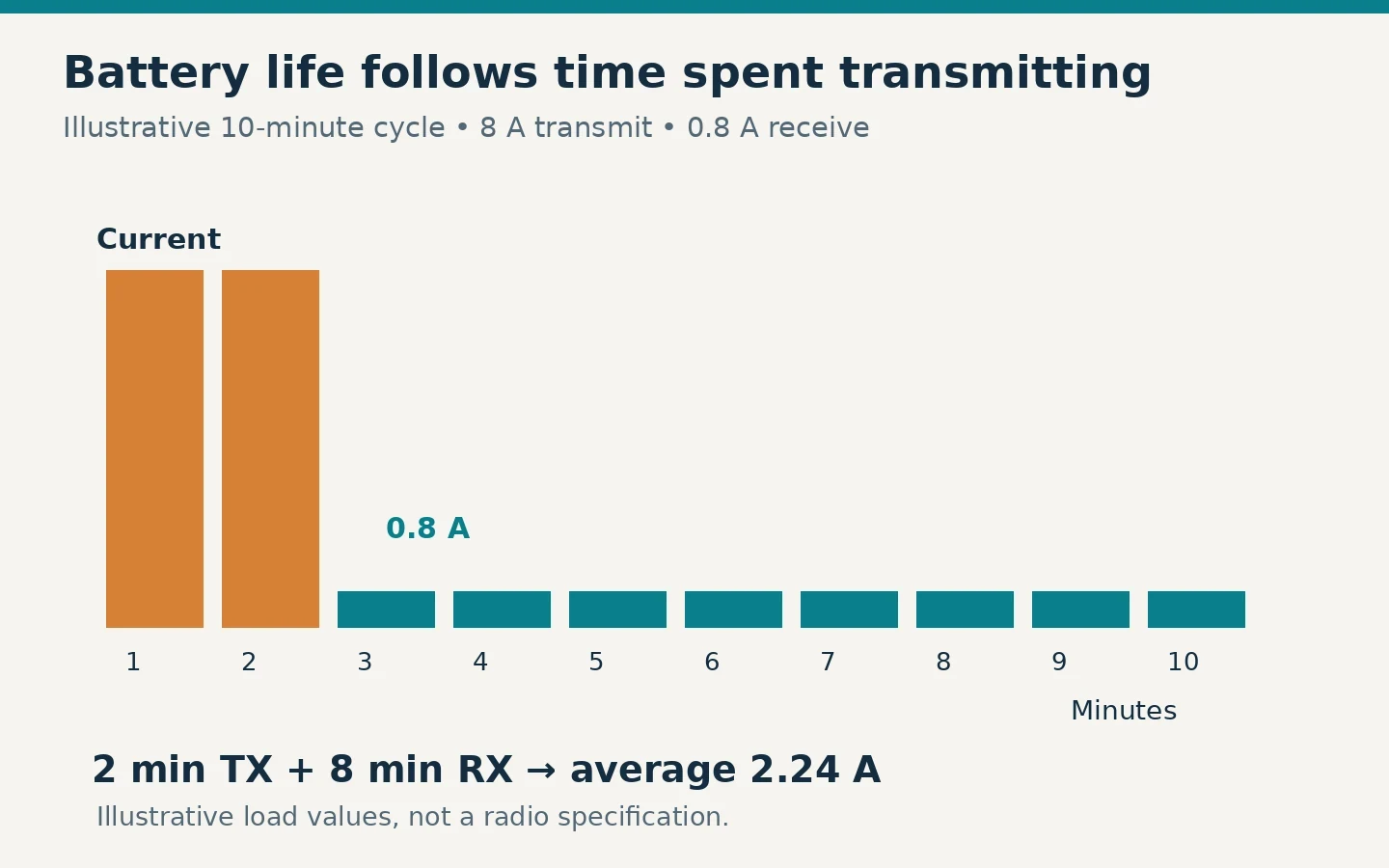
The fractions must add to one. If you transmit for two minutes and receive for eight in a ten-minute interval, your transmit fraction is 0.20 and your receive fraction is 0.80. A battery manufacturer's duty-weighted approach follows this same principle: weight each load by the time it operates.
Here is an illustrative station, using chosen planning values rather than a particular radio's test results:
| Input | Illustrative value |
|---|---|
| Battery rating | 10 Ah at a compatible nominal voltage |
| Capacity allowed in the plan | 8 Ah, leaving 20% of the label capacity unallocated |
| Transmit current at the chosen RF setting | 8 A |
| Receive current | 0.8 A |
| Time transmitting | 20% |
| Additional battery-side load | Zero for this first example |
Average current is (8 × 0.20) + (0.8 × 0.80) = 2.24 A. Estimated runtime is 8 ÷ 2.24 = 3.57 hours, about three hours and 34 minutes. For a two-hour activation, expected consumption is 2.24 × 2 = 4.48 Ah, leaving room within the 8 Ah planning allowance.
The 20% unallocated capacity is an example of a planning reserve, not a universal safe depth of discharge. If the battery manufacturer permits less use, or cold and aging reduce available capacity, lower the allowance accordingly. If you start with a partly charged pack, do not subtract a reserve from a full-charge assumption and then treat the result as available.
Change the Duty Cycle Before Trusting the Answer
An activator repeatedly calling CQ may transmit much more than a hunter who spends most of the session listening. Some digital operation alternates long transmit and receive periods. During an individual transmission the radio may draw sustained current, so both battery capability and the radio's permitted duty cycle need checking.
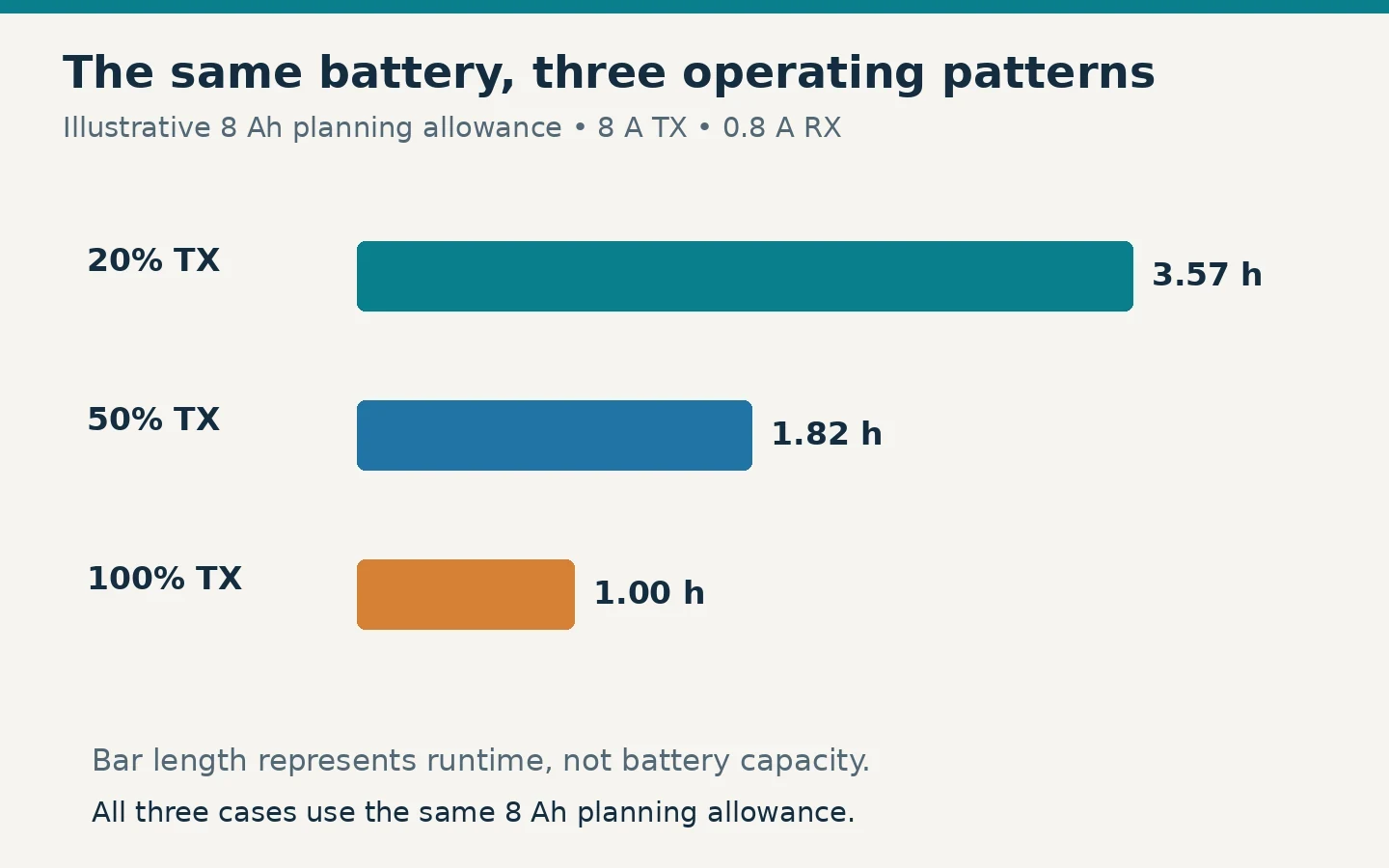
Keep the illustrative radio's 8 A transmit draw and 0.8 A receive draw, with an 8 Ah allowance:
| Time transmitting | Average current | Calculated runtime |
|---|---|---|
| 20% | 2.24 A | 3.57 hours |
| 50% | 4.40 A | 1.82 hours |
| 100%, a calculation boundary | 8.00 A | 1.00 hour |
The last row shows the arithmetic limit, not a recommendation to key a transmitter continuously. A radio may have thermal or mode-specific restrictions that prevent it from sustaining that operating condition.
SSB speech is also different from a steady carrier: current changes during speech and pauses. A maximum transmit-current specification can provide a cautious starting point, but measuring consumption over a representative operating interval gives a more useful planning average. Count CQ calls, unsuccessful attempts and time receiving; counting only completed contacts misses real load.
Do Not Divide Battery Capacity by the RF Power Setting
A 100 W transmitter does not necessarily take only 100 W from its battery. Some electrical power runs the receiver and electronics, and some becomes heat. Icom specifies 21 A transmit consumption at 100 W output for the US IC-7300, with 0.9 A typical standby consumption and 1.25 A at maximum receive audio. Its specified supply is 13.8 V DC ±15%. Those are manufacturer figures for that model and conditions, not measurements of your portable station.
At nominal 13.8 V, 13.8 × 21 is approximately 290 W of DC input. That is why using 100 W in the denominator of a battery-energy calculation would be misleading. Reducing RF output may reduce transmit current, but do not assume that halving RF watts halves total DC draw. Consult the manual or measure the intended setting.
If you have no current measurement yet, use the manufacturer's specified maximum transmit draw and a suitable receive figure to make a conservative provisional estimate. After a short trial, replace those assumptions with a measured operating average while retaining the peak-current check.
Check Voltage and Peak Current Separately
A battery can have enough Ah for the outing and still shut down on the first strong transmission. Its continuous-discharge rating, protection electronics, connectors and wiring must all support the actual load. A battery management system, or BMS, may disconnect a pack when a limit is exceeded. Do not treat a short-duration peak rating as permission for a sustained high-current transmission.
Check the radio's allowed input-voltage range against the pack at full charge as well as near the end of discharge. Nominal “12 V” is not a complete compatibility specification. Confirm the manufacturer's charging requirements too; a charger that fits the connector can still be wrong for the chemistry.
Long or undersized leads can drop voltage under load. If the radio resets when you speak but looks normal while receiving, inspect the supply path before concluding that all the stored capacity is gone. Turn off and disconnect the system before checking connectors or polarity. Stop using damaged, swollen, wet or unusually hot equipment and seek qualified help rather than bypassing protection.
US operating privileges also remain a separate check. POTA does not expand a Technician license into unrestricted HF voice privileges. Use bands and modes authorized for your class, and follow park access and antenna rules. The US rule and program references for this article were checked October 29, 2026.
Validate the Plan on a Short, Controlled Outing
Use a commercially assembled, suitably rated power lead and battery protection arrangement consistent with the battery and radio instructions. Wiring protection belongs near the battery source, not only at the far end of an exposed cable. Confirm polarity before connecting anything. If selecting the fuse, cable or connector rating is outside your experience, have a competent radio club member or technician help with the actual assembly.
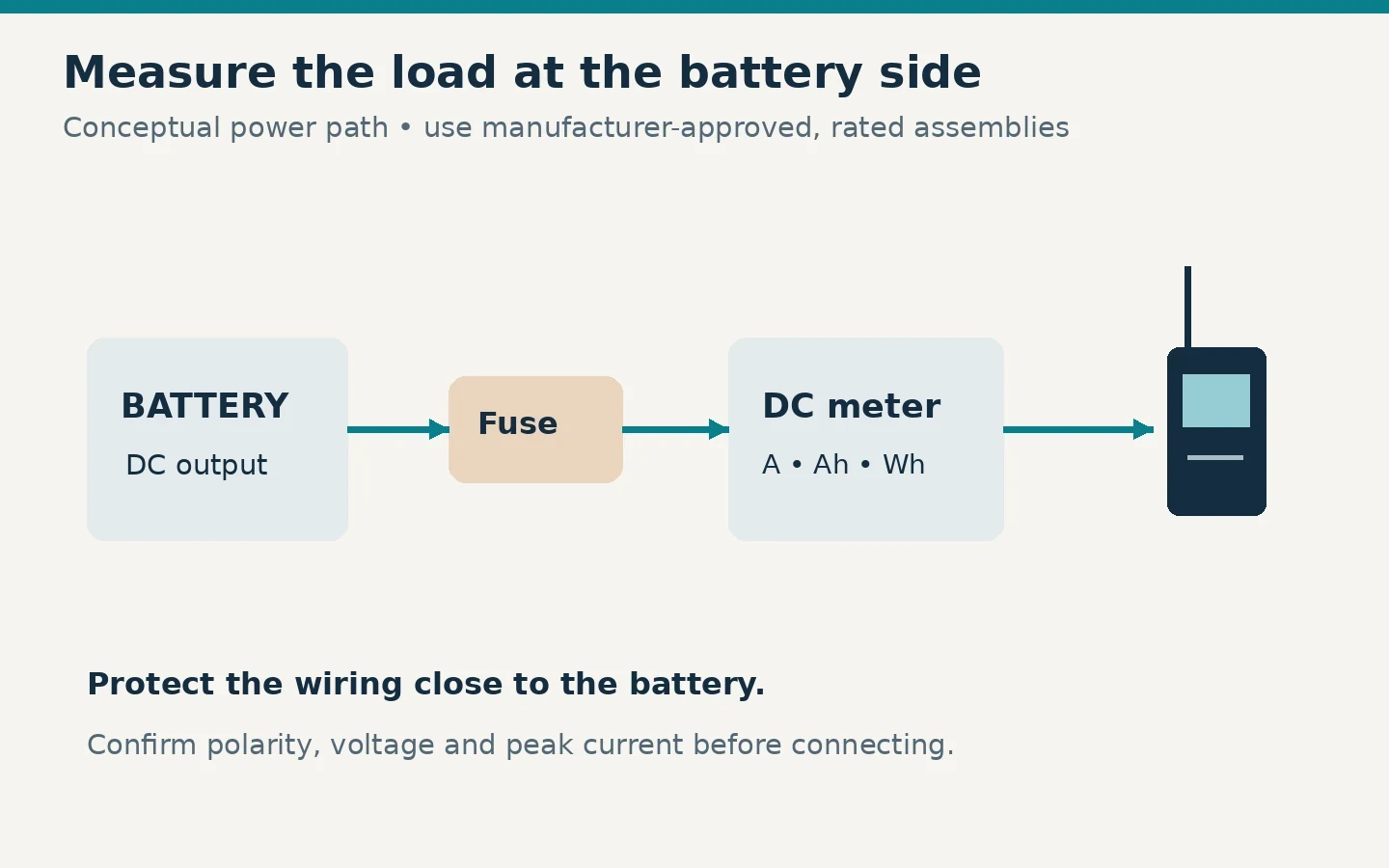
A compatible inline DC meter can show current and accumulated Ah or Wh. Check its voltage/current limits and connector polarity first, then install it according to its instructions. Keep your radio's specified protection in place. Do not use a handheld multimeter's current input as an improvised high-current supply link.
For a useful trial:
- Start with a correctly charged, known battery and reset the meter's accumulated-energy reading.
- Record the pack, temperature, RF output, mode and accessories. Operate the station as you expect to at the park.
- After a representative interval, note elapsed time and consumed Ah. For example, 0.70 Ah in 15 minutes means an average of
0.70 ÷ 0.25 = 2.8 A. - Recalculate the plan: an 8 Ah allowance at that observed average gives about
8 ÷ 2.8 = 2.86 hoursunder comparable conditions. - Finish before your planning allowance or the manufacturer's limits are reached. Retain the log for the next outing.
This does not require deliberately running the pack to cutoff. For some LiFePO4 packs, terminal voltage stays relatively flat through much of discharge; a reassuring voltage reading alone is a poor remaining-runtime gauge. Bioenno specifically recommends an inline meter for tracking consumption of its packs.
Allow for Accessories, Cold and Solar Realistically
In the first example, adding a constant 0.4 A battery-side accessory load changes the average from 2.24 A to 2.64 A. Runtime becomes 8 ÷ 2.64 = 3.03 hours. A logging computer, screen, tuner or converter can therefore change the answer without changing the radio's power setting. Measure converter-fed accessories at their input or include conversion efficiency in the energy budget.
Use the battery maker's actual temperature and charging limits rather than applying a generic percentage penalty. For a colder outing than your trial, keep a larger planning margin until you have appropriate data. Do not charge a cold battery unless its instructions allow charging at that temperature.
Solar can extend an outing, but panel nameplate power is not assured charging power throughout the day. Shade, orientation and weather change the contribution. Use a compatible charge controller and a permitted charging arrangement; never connect an unregulated panel directly to the battery or radio. For a first dependable plan, budget enough battery for the intended session without solar, then treat measured solar input as additional capacity.
Before leaving, write one sentence in your station notes: “I have ___ usable Ah, expect ___ average A, and will stop by ___ hours or sooner if equipment limits require it.” That turns a vague battery size into an operating decision you can check at the park.