A ham radio band is a range of frequencies, usually named for an approximate wavelength: “2 meters,” “70 centimeters,” or “10 meters.” The name helps you find a neighborhood on a frequency chart, but it does not tell you which contacts are possible today—or give you permission to transmit throughout that neighborhood. For a new U.S. Technician, choosing a band involves two separate questions: What path might carry the contact you want, and what frequencies and emissions does your license allow? Current FCC Part 97 answers the legal question; propagation and local activity help answer the practical one.
Reading Meter Names and Frequency Ranges
A frequency is a particular place on the radio dial, expressed here in megahertz (MHz). A band covers a range of those places. Its meter or centimeter name refers approximately to wavelength, not to one exact frequency. Thus, saying “I’m on 2 meters” is less specific than giving a frequency within the 2-meter band.
For a U.S. reader using the Region 2 column of FCC § 97.301, the 2-meter entry runs from 144 to 148 MHz, while the 70-centimeter entry runs from 420 to 450 MHz. These are examples of band ranges, not instructions to use every frequency or every emission between their endpoints. The same FCC table is organized by both ITU region and control-operator license class. Read those headings along with the band name: a number copied from another region or another class’s entry may answer a different question.
The 10-meter example shows another important distinction. Section 97.301(e) gives a Technician control operator a 28.0–28.5 MHz slice on 10 meters. That is the Technician slice identified in the rule—not a statement that the slice constitutes the entire 10-meter band. Even within it, separate rules determine which emissions may be transmitted in its different parts. A chart that prints only “10 m” or only “28.0–28.5 MHz” has not finished the permission check for you.
A useful way to read any band chart, then, is to keep three labels distinct: band name, frequency range, and who may transmit what there. The first two help you locate a possible operating area. The third requires the applicable FCC rules, not an inference from the wavelength printed beside the range.
How Bands Change the Contacts You Can Expect
Bands differ in the kinds of paths they commonly support. In ARRL’s instructional discussion, VHF and UHF support line-of-sight regional contacts, and longer-distance contacts by other propagation means. That makes “VHF/UHF is only local” too absolute. It is more useful to think of a nearby path as a plausible starting expectation, while leaving room for conditions that carry a signal farther.
Two meters and 70 centimeters offer a concrete beginner comparison. ARRL says most repeaters operate on those bands. A repeater is a station that receives a signal and relays it, giving two operators a path through that station rather than requiring a direct path between them. You can also consider a direct station-to-station contact, called simplex; “2 meters” does not itself mean “through a repeater.” Whether a particular contact works depends on the usable path and on someone being active to answer.
Consider what you learn by hearing a nearby repeater. You have evidence that its signal reaches your receiving location; that is useful when deciding whether a local contact might be plausible. It does not by itself establish that your transmitted signal will reach the repeater, that another operator is present, or that every frequency near it is available for your transmission. This is a practical inference from the difference between receiving a signal and completing a two-way contact, not a range prediction.
Ten meters presents a different possibility. It is among the shorter-wavelength HF bands that ARRL describes as opening for long-distance contacts through the day. If you hear a distant station on 10 meters, you are hearing evidence of a usable path to you at that time. That is different information from hearing a local repeater: the distant signal suggests that HF propagation may be helping, but it does not promise that your station can make the return trip or that the opening will persist.
Neither comparison supplies a fixed mileage figure. Terrain and geography can affect a regional path; changing propagation conditions can affect an HF path; and activity matters on either band because a contact needs another station. Those are reasons to treat “local” and “long-distance” as useful expectations, not guarantees. ARRL’s description allows both regional VHF/UHF operation and occasional longer paths, just as its account of daytime HF openings describes an opportunity rather than a schedule for every day or location.
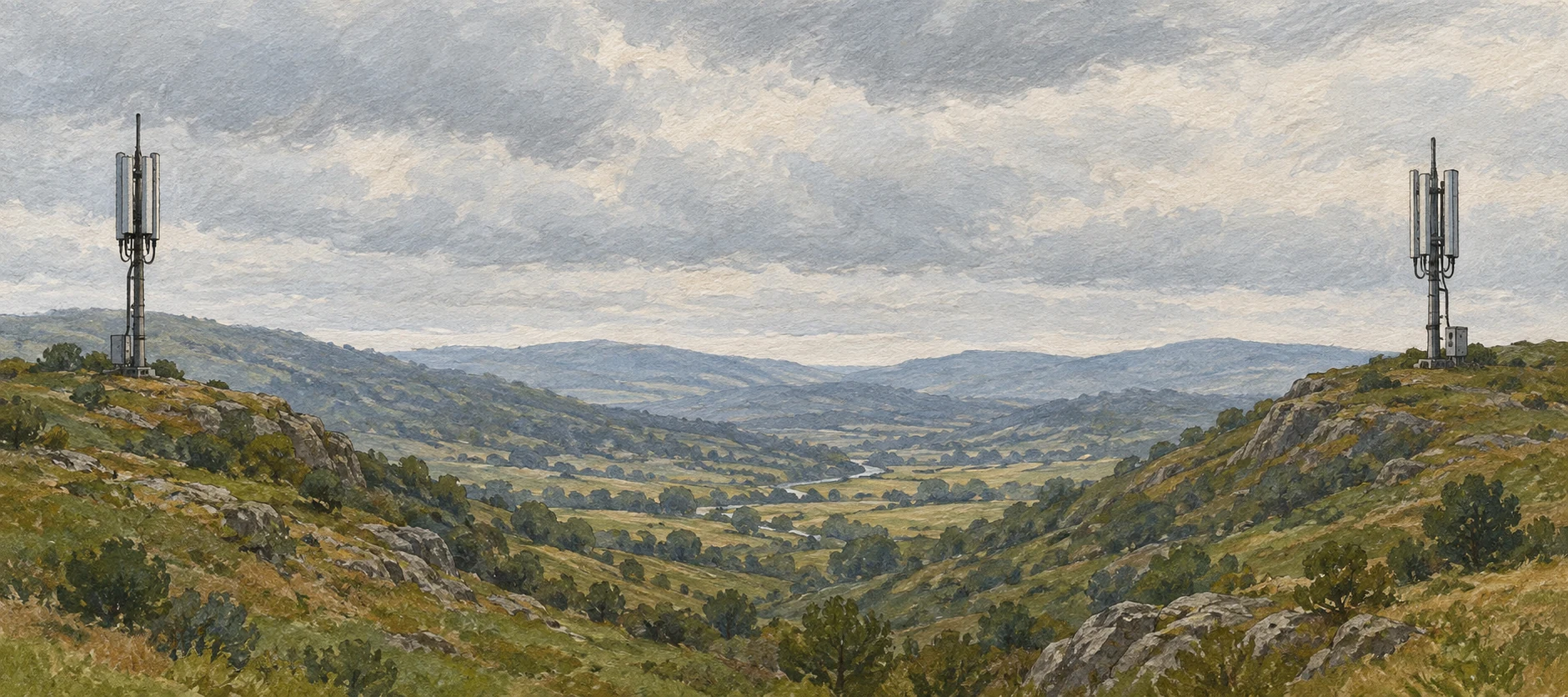
The distinction matters when you choose what to listen for. A local-contact goal makes 2 meters or 70 centimeters worth investigating, especially where repeater activity is available. A distant-contact goal makes an HF path such as 10 meters worth investigating when conditions cooperate. In either case, hearing a signal is a clue about a path, not a substitute for checking whether your own proposed transmission is authorized.
What a U.S. Technician Can Transmit—and Where
For U.S. transmitting privileges, use current FCC Part 97, not an older instructional description of the bands. The eCFR’s current-text pages for §§ 97.301, 97.305, and 97.307 are the rule sources for the examples below. Check the current text for your location and proposed operation before transmitting. Section 97.301 identifies frequencies available to the control operator; 97.305 identifies emission types on specified frequencies; and 97.307 supplies standards and restrictions that the emission entries reference. Receiving a station on a frequency establishes none of those transmitting permissions.
In Region 2, § 97.301(a) includes 2 meters, 144–148 MHz, and 70 centimeters, 420–450 MHz, in a table applicable to Technician and higher control operators. The separate Technician/Novice table in § 97.301(e) identifies these limited HF slices:
| Band name | Technician frequency slice |
|---|---|
| 80 meters | 3.525–3.600 MHz |
| 40 meters | 7.025–7.125 MHz |
| 15 meters | 21.025–21.200 MHz |
| 10 meters | 28.0–28.5 MHz |
These ranges answer where to begin checking, not “any mode goes.” For the applicable Technician slices on 80, 40, and 15 meters, § 97.307(f)(9) restricts transmission to a CW emission using international Morse code. For example, a frequency inside the listed 40-meter slice is not thereby a Technician phone frequency: a Technician contemplating CW there is considering the kind of emission specified by that restriction; a Technician contemplating phone there cannot turn the frequency listing into phone permission. The same CW-only point matters when comparing the listed 80- and 15-meter slices with a possible voice contact elsewhere.
Ten meters requires a closer reading of subranges. Section 97.305 lists RTTY and data in its 28.0–28.3 MHz entry, subject to the referenced standards. Its 28.3–28.5 MHz entry lists phone and image, but the entry also references § 97.307(f)(10). For a Technician or Novice control operator, that restriction permits there only international-Morse CW or J3E/R3E phone emissions. In particular, the broader “phone, image” wording in the § 97.305 entry is not blanket Technician permission for image transmissions, or for every kind of phone emission, in that subrange.
The distinction appears even on the familiar 2-meter band. Although § 97.301 gives its Region 2 boundaries as 144–148 MHz, the § 97.305 entry listing phone and several other emissions begins at 144.1 MHz, not at 144 MHz, and runs to 148.0 MHz subject to its referenced standards. Thus, “inside 2 meters” is not enough to place a proposed phone transmission inside that particular phone entry. Section 97.305(a) separately provides for CW on frequencies authorized to the control operator except as specified elsewhere; that general CW provision should not be mistaken for permission to use every other emission at every band frequency.
These are illustrative comparisons, not an exhaustive operating-permission checklist. They show why a lawful decision needs the control operator’s frequency authorization, the emission entry, and its applicable standards together. The § 97.301 frequency tables also specify their regional and regulatory setting, so verify the current provisions and any restrictions applicable to your location rather than assuming that a band name settles them. No power limit or location-specific sharing rule is inferred from the examples here.
Where a Band Plan Fits After the Legal Rules
Once you have established that a frequency and emission are available to you under Part 97, a different question remains: Where within what is allowed will your transmission fit sensibly alongside other activity? ARRL describes a band plan as a voluntary division of a band intended to avoid interference between incompatible modes. It helps operators organize common use; it is not the FCC frequency-allocation or emission rule.
That order matters. If Part 97 does not authorize a Technician to transmit a particular emission at a particular frequency, finding that emission shown on a community band plan cannot grant permission. Conversely, a legal frequency-and-emission combination does not tell you where other operators in your area customarily gather. The rules establish the legal boundary; a band plan helps you interpret operating practice inside it.
A repeater search illustrates the separate jobs. Because ARRL says most repeaters operate on 2 meters and 70 centimeters, a newcomer interested in local contacts has a reason to look for current local repeater information on those bands. That information can point toward activity, while a current band plan can explain customary divisions of use. Neither source replaces the Part 97 check for your own transmission, and the presence of a repeater listing does not promise that the station is reachable or busy when you listen.
Think of the band plan as an aid to sharing space, not as an additional license class or an exception to one. Its value is especially clear after you know what you may do legally: it helps turn a broad permitted area into a more informed choice of where to look for compatible activity. Local information adds another layer, because a national description of customary use cannot tell you who is on the air near you right now.
Choosing a First Band for the Contact You Want
Start with the contact, not with the most appealing band name. Are you hoping to speak with someone nearby, or hoping for a possible distant contact? Then compare that goal with your Technician privileges, the radio and antenna you actually have available, activity you can find, and current conditions. An antenna is the part of the station that sends or receives the radio signal; having a band named on a chart does not mean your available station is set up to use it. This is a decision framework, not a recommendation to buy particular equipment.
For a local-contact goal, 2 meters or 70 centimeters is a plausible first place to investigate. A repeater path uses a station that relays signals; a simplex path is direct contact between the two stations. A repeater may offer a useful path where a direct contact is difficult, but availability, terrain, your equipment and another operator’s activity all affect the result. Simplex may be appealing when a direct path and an active station are available. Neither choice follows automatically from the words “2 meters” or “70 centimeters.” ARRL’s account of regional VHF/UHF contacts and its observation that most repeaters use those bands explain why they are reasonable places to look, not guaranteed solutions.
For a possible distant contact, a Technician can consider the authorized 28.0–28.5 MHz 10-meter slice when a suitable station and propagation cooperate. The shorter-wavelength HF openings ARRL describes make the idea plausible, while the FCC’s subrange and emission rules determine what the Technician may transmit. Someone equipped and willing to use international-Morse CW can also consider the specified 80-, 40-, or 15-meter Technician slices, subject to their CW-only restriction; those slices are not an alternative route to unrestricted HF phone.
Here is the choice in compact form. If the goal is a nearby conversation, first investigate whether there is reachable 2-meter or 70-centimeter activity, through a repeater or on a direct path. If the goal is a distant contact, investigate 10-meter conditions, then check the exact frequency and permitted emission for the transmission you have in mind. If neither path appears active, listening further or asking local operators about activity is more informative than assuming the band name guarantees a contact. Hearing a signal can help identify a promising path, but the legal check still applies before you transmit.
The lasting rule is simple: choose a band because its likely path suits the contact you want, verify your frequency and emission against current Part 97, and then use band-plan and local-activity information to find an appropriate place within what the rules allow. A band name starts that decision; it never completes it.