You can attempt a voice contact with an ISS crew member when a licensed astronaut is operating, or make a contact with another ground station through the ISS amateur-radio repeater when it is available. These are different activities. Your first practical step is to check the active mode, predict a pass over your location and receive the correct downlink before transmitting.
For a US beginner, listening through a pass is a useful first success. A dual-band amateur station can then support a brief repeater contact, provided your license, equipment and current station status permit it. Hearing the repeater does not mean an astronaut is waiting to answer, and a predicted pass does not mean any radio aboard the station is switched on.
Choose the Contact You Actually Want
A crew voice contact is a conversation with an astronaut or cosmonaut using the station's amateur equipment. Casual contacts happen around crew availability; they are not an on-demand calling service. A scheduled school contact is an organized ARISS educational event, with its own participating station and arrangements. Listen to such an event without trying to join its exchange.
An FM repeater contact is usually a conversation between two Earth stations whose signals are relayed by the ISS. The spacecraft receives on an uplink frequency and retransmits on a downlink frequency. You can make this kind of contact without a crew member at the microphone.
Packet/APRS involves short digital packets rather than voice. SSTV, or slow-scan television, lets you receive images during announced events. These activities need appropriate decoding equipment and current mode information. They are worthwhile alternatives, but a decoded image or repeated packet is not a spoken conversation with a crew member.
Use the activity's own settings. An ordinary terrestrial APRS configuration, an FM repeater memory and a crew-voice split are not interchangeable.
Check Status Before Programming an Outing
The operational check for this draft was October 29, 2026. ARISS's status page, dated October 27, listed an expected spacewalk-related shutdown: Columbus from October 28 at 19:20 UTC until October 30 at 07:45 UTC, and the Service Module from 19:25 UTC until 07:50 UTC over the same dates. These were planned times, subject to change, not a guarantee that either radio would be available immediately afterward.
This is why the useful operating habit is to open ARISS → Current Status of ISS Stations before each attempt, then compare recent AMSAT satellite status reports. A permanent frequency chart is insufficient. The same status page identified APRS testing on 437.825 MHz; copying an older guide's 145.825 MHz packet setting could put you on a presently inactive channel.
For the FM repeater, the checked ARISS and AMSAT listings agreed on nominal 145.990 MHz uplink, 67.0 Hz transmit tone, and 437.800 MHz downlink. This identifies the mode's channel pair; it does not override an outage or a different announced configuration.
Write the checked date, intended mode and status result in your pass notes. If the service is unavailable, use the session for receive practice or choose another day instead of transmitting repeatedly at a silent spacecraft.
Confirm US Privileges and Prepare a Modest Station
For US amateur transmission, a Technician or higher license provides relevant VHF/UHF band privileges under FCC §97.301, subject to the other Part 97 rules and applicable restrictions. This article's US rule check was October 29, 2026. Receive-only listening does not require you to transmit, and owning a programmable handheld does not establish transmission authority.
For a receive-first session, use an FM receiver that covers the selected downlink, a suitable antenna, pass predictions and a way to note what you hear. For a repeater attempt, you also need an authorized 2-meter FM transmitter, a way to receive the 70-centimeter downlink, and independently set transmit and receive frequencies. “Dual band” alone does not prove a radio can do those operations together.
Full duplex means you can hear the downlink while you transmit. It lets you confirm that your own signal is actually reaching the relay. A suitable full-duplex radio or a carefully configured two-radio station can provide that feedback. Two receivers displayed on one screen, sometimes called dual watch, are not necessarily full duplex.
A handheld directional antenna can make aiming practical. Follow its connection instructions, especially if one feed line, separate radio ports or a diplexer are involved. Keep the receive equipment protected from your own transmitter. If pressing PTT wipes out reception, stop and resolve receiver desensitization, isolation or cabling with an experienced satellite operator. Do not overcome an unknown connection problem by increasing power.
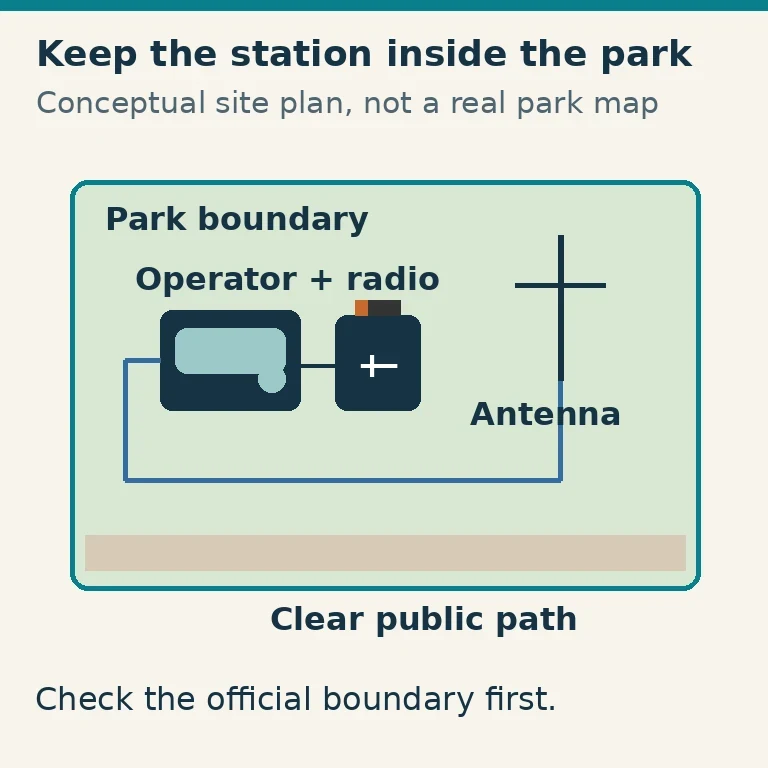
Operate from a place with a clear view of the useful sky, stable footing and space to turn the antenna safely. Keep antennas away from power lines and people, follow the equipment's RF-exposure guidance, and avoid looking into the Sun while tracking. You can learn the pass and antenna movement entirely in receive mode first.
Predict a Pass You Can Follow
Use a satellite pass predictor with current orbital data, select ISS/ZARYA, and enter your actual location. Confirm the date, time zone and whether the displayed times are UTC or local. An old screenshot for another city is not a usable prediction.
Read these fields before going outside:
| Field | What it tells you |
|---|---|
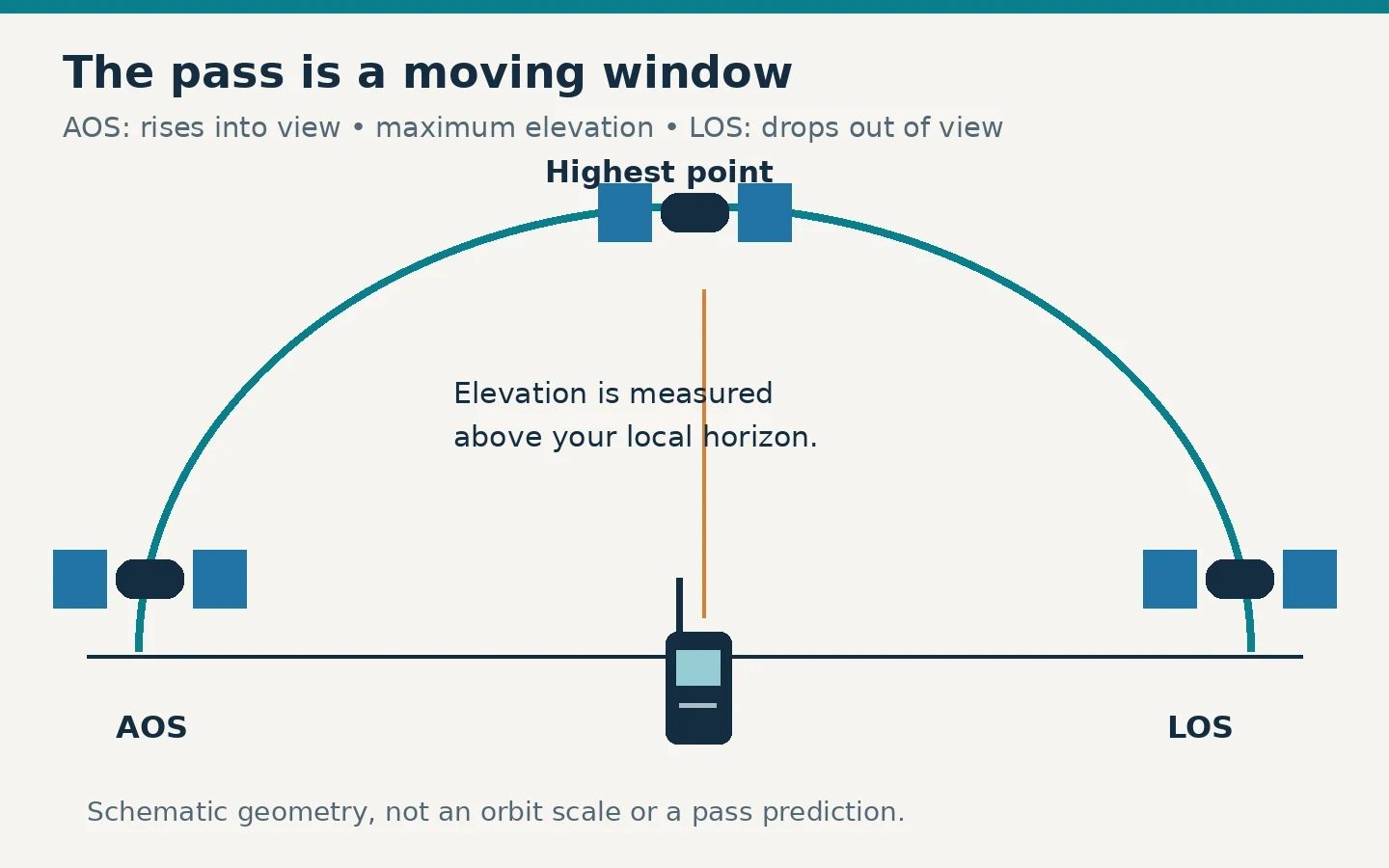
| AOS, acquisition of signal | When the ISS rises into the predicted usable view |
| LOS, loss of signal | When that opportunity ends |
| Azimuth | Compass direction in which to point |
| Elevation | Angle above your local horizon; 0° is the horizon and 90° is overhead |
| Maximum elevation | The highest point of this pass from your location |
A predicted geometric horizon is not your actual clear horizon. A building, hill or trees can hide the low portion of a pass. Choose an early practice pass whose path crosses open sky, rather than one mostly behind an obstruction. Read the start, peak and end directions, then rehearse the antenna sweep before AOS.
Use an accurate clock and be ready before the predicted start. Radio reception does not depend on seeing a sunlit spacecraft, so a visible-pass forecast is not the only relevant list. Keep the predictor available offline if your operating location has poor mobile-data service, and verify that the saved prediction is for the correct date and location.
Program the Repeater Pair and Follow Doppler
For the checked FM configuration, your transmitter sends up on 145.990 MHz with a 67.0 Hz CTCSS tone. CTCSS is a low-frequency tone accompanying your transmission; it is a channel-access setting, not a voice pitch you make into the microphone. Your receiver listens down around 437.800 MHz. Do not transmit on the downlink.
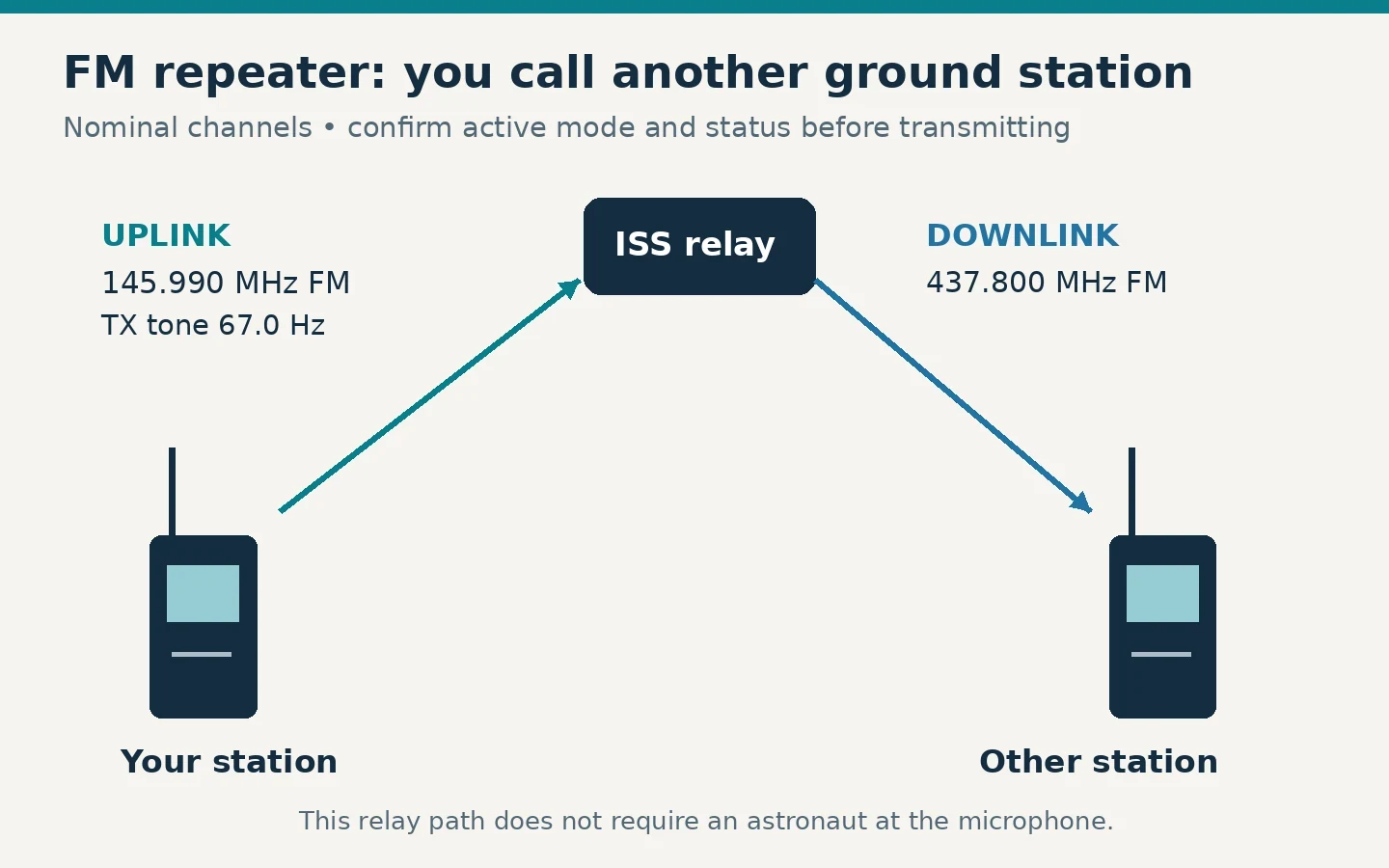
Program the independent transmit and receive values using your radio's satellite or split-memory instructions. An ordinary terrestrial repeater offset may not produce this cross-band pair. Read the saved memory back before using it. For initial listening, keep receive tone decoding off so it does not hide otherwise audible signals.
Follow the Changing Downlink Through the Pass
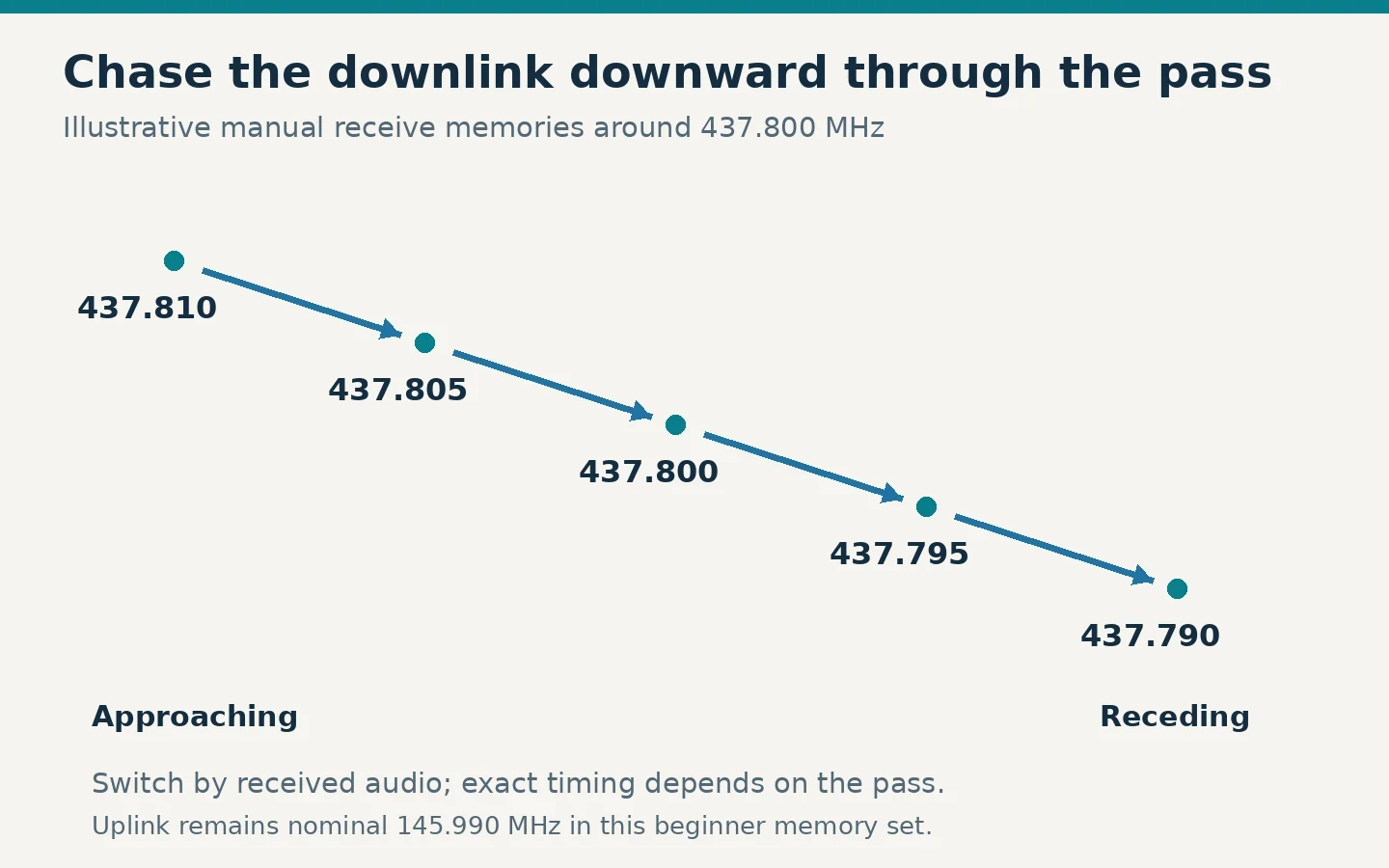
The moving ISS produces Doppler shift: the received downlink is higher as the station approaches and lower as it recedes. The effect is more noticeable on 70 centimeters than on 2 meters. An illustrative manual receive-memory sequence is:
| Approximate progression | Receive memory | Nominal transmit setting |
|---|---|---|
| Approaching | 437.810 MHz | 145.990 MHz, 67.0 Hz tone |
| Closer to the middle | 437.805 MHz | Same |
| Near zero radial speed | 437.800 MHz | Same |
| Receding | 437.795 MHz | Same |
| Farther receding | 437.790 MHz | Same |
These are listening aids, not five equal time slots or predictions of the exact frequency throughout every pass. Switch according to received audio or use properly configured tracking control. The 2-meter uplink also has Doppler; this beginner memory set keeps it nominal while you learn to track the larger downlink change.
Test memory changes in receive mode. Keep ordinary scan functions from pulling you away from the downlink while the pass is underway. If your radio cannot store the independent frequency pair, solve that limitation with its manual or a mentor before attempting a transmission.
Listen, Then Make One Brief Repeater Contact
Start receiving before AOS, follow the predicted direction and adjust the antenna orientation for the best copy. Do not transmit to “wake up” the ISS. First establish that the advertised mode is present and that you can hear other stations clearly enough to follow the conversation.
When there is a genuine opening, give your call sign and grid square briefly. Use your own information in this example: “[your call sign], [your grid].” A Maidenhead grid is a compact geographic locator; determine yours from a reliable locator tool before the pass rather than inventing one while calling. If someone answers, exchange the information you can actually copy, acknowledge their call sign, and release the channel for others.
Avoid a long terrestrial-style CQ or a prolonged conversation on a busy single FM channel. If you hear a particular station you can copy, a short directed call can be more useful than a general monologue. Use the minimum power needed for the contact rather than assuming that more power will solve timing, pointing or receive problems.
Monitor your own downlink when the station supports full duplex. If you cannot hear the relay or lose it during your attempt, stop transmitting and recover reception. You may still be reaching the satellite and interfering with contacts you cannot hear. FCC §97.119's call-sign identification requirements still apply; a short satellite exchange is not an exemption.
Log UTC date/time, the other station's actual call sign, your location/grid, the mode and the ISS relay. Record an uncertain call as uncertain until you resolve it; hearing a fragment is not a completed contact.
Attempt a Crew Contact Only When the Crew Is Operating
For conventional direct crew voice, ARISS lists 145.800 MHz downlink worldwide, with 144.490 MHz uplink for ITU Regions 2 and 3, including the continental US, and 145.200 MHz uplink for Region 1. These are different from the cross-band repeater settings. Confirm the announced operation because ARISS also notes occasional crew activity using the repeater.
Listen for what is actually happening. During an open casual operation, wait for a suitable gap and give your call sign briefly. If called, respond to that operator, exchange a short greeting or requested information, then leave room for the next station. Do not assume that a familiar ISS call sign alone proves the channel is open for random callers.
During a school event, the scheduled ground station and students have a limited opportunity. Listen without transmitting into it. If your school or organization wants its own educational conversation, use ARISS's hosting/application process; repeatedly calling during somebody else's event does not create an appointment.
If the Pass Produces No Contact
Separate the outcome into useful observations. If the predicted pass occurs during a listed outage, the missing signal may be expected. If other operators hear the ISS and you do not, check location/time, selected mode, receive frequency, Doppler, squelch and obstructions. If reception works until you transmit, investigate your station's isolation. If reception is good but nobody answers, congestion or crew availability may be the limiting factor.
Keep the successful receive settings and your pass notes. A confirmed downlink, a correctly tracked pass and a courteous unanswered attempt are real progress. The next attempt should change one identified weakness, with a fresh status check, rather than repeat an unverified transmission sequence.