SOTA, or Summits on the Air, is an amateur-radio awards program built around contacts with portable stations operating from listed hill and mountain summits. An activator takes a station to an eligible summit; a chaser contacts that station from elsewhere. You can begin as a chaser from home, then plan a modest summit outing when your radio and outdoor skills are ready.
The program's appeal is the combination of a real place, a portable station and a limited operating opportunity. It does not require a difficult climb for every activation, but neither a scenic hilltop nor a car parked near a summit automatically meets its rules. Verify the actual summit reference, operating position and station arrangement before treating the outing as SOTA.
Understand the Roles and the Points
An activator makes contacts from a valid operating position associated with a listed summit. A chaser makes a qualifying contact with the activator and records the summit reference. A summit-to-summit, or S2S, contact connects two activators on different summits; it can also be relevant to chaser credit. Short-wave listeners have a separate participation route that does not require transmitting.
A summit has an assigned points value under its Association Reference Manual. The value is not a measurement of how hard your particular route was, the radio's output or the number of contacts you made beyond the qualifying minimum. Association manuals and current listings also identify applicable seasonal bonuses and local program details.
For the main activator score, an individual can claim a particular summit's points once per calendar year, with the rules describing how a later seasonal bonus may be added. A chaser can claim a given summit once per UTC day. More QSOs are welcome as genuine contacts, but repeating the same summit does not generate unlimited points within those periods.
These rules were checked against the current official site's linked General Rules version 1.21 on October 29, 2026. Always recheck the current listing and association guidance when choosing an actual summit; references, validity and access can change.
Choose a Listed Summit, Not Just a High Place
Find your region's SOTA association and its current summit list. Record the complete reference, summit name, location, points and validity information. The reference identifies the program summit; a similar place name or a nearby high point can refer to something else.
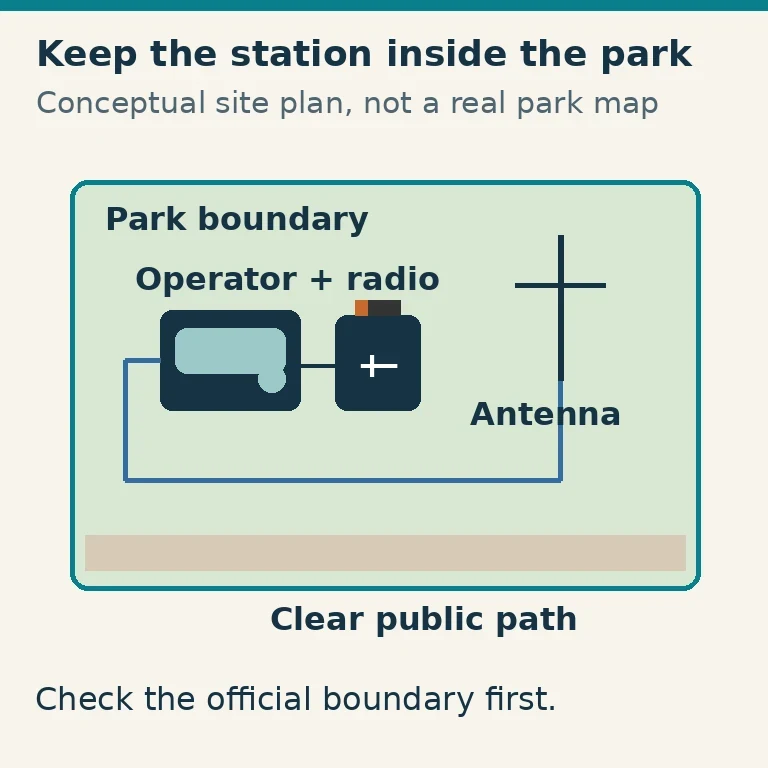
Next, consult the Association Reference Manual and a suitable topographic map. Separately check legal access, land ownership, opening restrictions, parking and seasonal conditions. A program listing does not grant access rights or override the land manager. A popular hiking description is useful route information but is not proof that radio operation or a particular antenna arrangement is permitted.
For a first activation, choose an uncomplicated route and a location suited to your actual fitness and navigation skills. Look for enough safe operating space away from crowds, with a clear plan for weather changes and descent. An experienced local activator can help identify a suitable first outing without turning it into a test of mountaineering ambition.
Find the Activation Zone Using Vertical Height
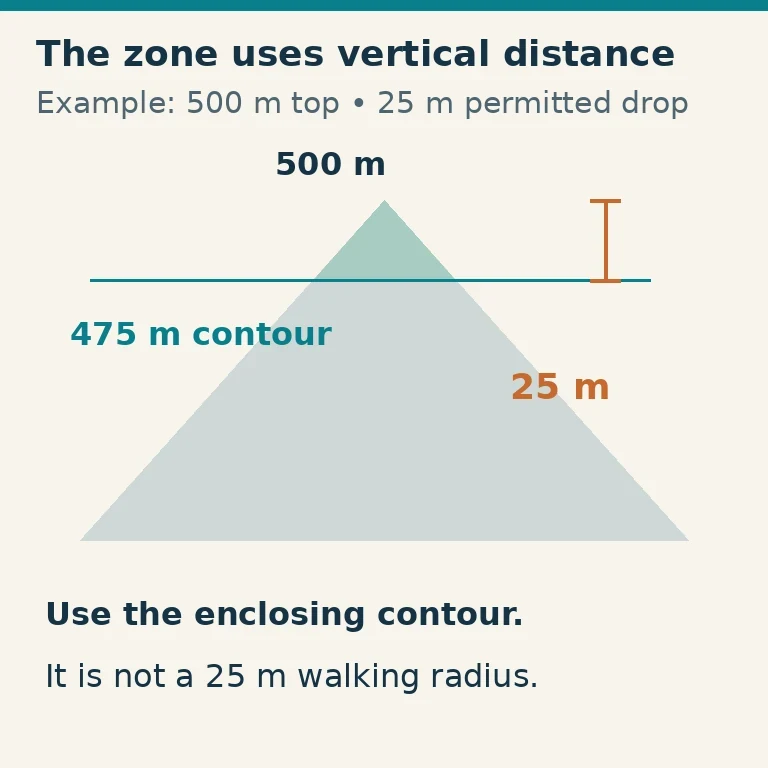
The operating position must lie within the summit's activation zone. This is defined by a closed contour at the association's permitted maximum vertical distance below the summit, typically 25 meters. It is not a 25-meter walking radius, and it is not permission to stand on a neighboring hill at a similar elevation.
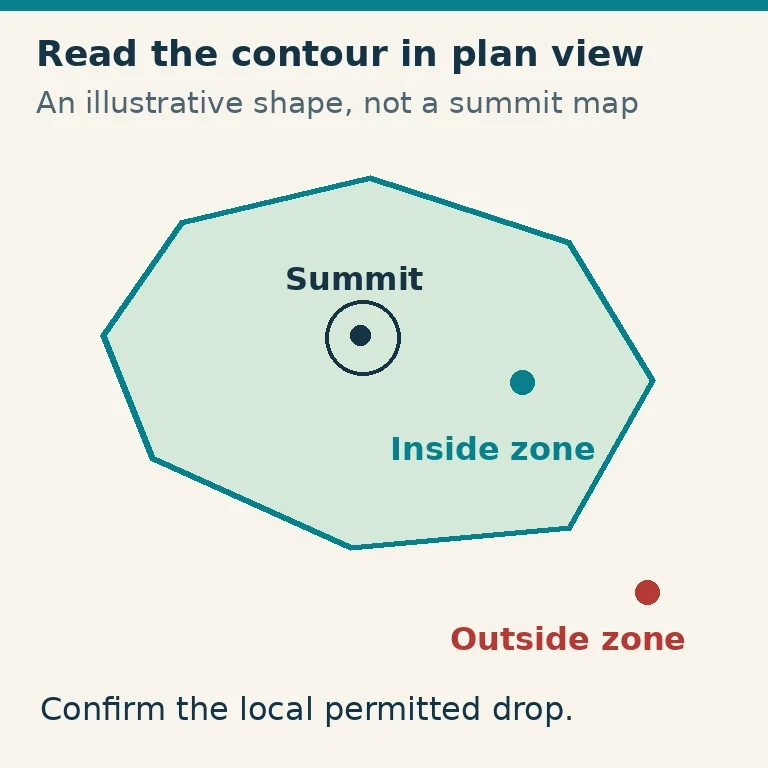
For an illustrative summit whose top is 500 meters and whose permitted vertical distance is 25 meters, the relevant contour is 475 meters. Identify the closed 475-meter contour enclosing that summit on a sufficiently detailed map. A ridge can extend the zone horizontally, while a steep slope can end it quite close to the top.
Check the contour rather than subtracting an uncertain handheld altitude reading and declaring the result valid. Map resolution, GPS vertical error and the shape of a saddle can all matter. If your intended position is near the limit or the map is ambiguous, choose a clearly valid position or ask the association manager for clarification before the outing.
There is no requirement to crowd onto an exposed summit marker when a safer compliant operating position is available. Keep the operator within the actual zone, respect the program's station rules and site restrictions, and avoid occupying a viewpoint or path that other visitors need.
Keep the Station Independent of a Motor Vehicle
SOTA's rules prohibit operating in or close to a motor vehicle, and no part of the station may be connected to it. The activation team must carry the equipment to the operating site. Portable power, such as batteries or solar cells, is allowed; permanently installed supplies and fossil-fuel generators are excluded.
This is different from assuming that a convenient summit parking area makes a vehicle-mounted station eligible. A battery in the car, a coax cable back to it or use of the vehicle as part of the station conflicts with the independent portable arrangement.
Plan a genuinely separate operating position and equipment package. The rule does not become a universal requirement for a particular hiking distance or elevation gain; do not invent one. The practical questions are whether your actual position and equipment meet the published rules and whether the outing respects the spirit of portable summit operation.
Plan the Radio Session Before Climbing
For a US beginner, choose bands and modes authorized by your own license. A Technician can plan suitable VHF/UHF contacts, while HF choices depend on the class and segment. SOTA additionally forbids relying on supervision by a higher-class operator to use privileges beyond your own for qualifying participation. The call sign must be one you are individually entitled to use.
A small VHF FM station can work well when there are reachable chasers, but an elevated site does not guarantee four contacts. Ask local operators about realistic coverage, announce a plan and practice the antenna and calling procedure. An HF station can reach different audiences but adds antenna, mode and portable-power decisions.
Pack the complete station you tested: radio, antenna, feed line/adapters, power, microphone or key, logging method and essential spares. Keep the total load appropriate to the route. Reserve room for navigation, water, clothing, food, a headlamp and the other equipment your outdoor plan requires. A better radio is not a substitute for a safe return plan.
Set a turnaround time before leaving, tell someone your itinerary where appropriate, and check a credible local weather forecast. Do not operate on an exposed summit during a developing thunderstorm. Leave before conditions become dangerous, even if the log is one contact short.
Make Contacts That Meet the Program Rules
At a valid, permitted operating position, place the station without damaging the site or creating wire and guy-line hazards. Check the antenna and power connections before enabling transmission. Listen, find an available frequency in your authorized segment and call briefly with your actual call sign and summit reference.
An alert announces a planned activity; a spot reports where the station is actually operating. Use the current SOTAwatch facilities as appropriate, or arrange a spot from a chaser. An alert is not evidence that you reached the summit, and a spot is not a reservation of the frequency.
For a valid activation, at least one QSO is required. To claim the summit's main activator points, make at least four QSOs with different stations. Exchange call signs and signal reports, and give the summit identifier during contacts or repeat it frequently as the rules describe. Do not count four repeats with the same station as four different stations.
Contacts with people inside the same activation zone do not count toward the total. Terrestrial repeater contacts also do not count; the rules permit artificial-satellite and certain airborne repeater contacts, but ordinary direct operation is the simpler beginner choice. Never accept a call or report you did not actually copy merely because another person supplies it.
If only one, two or three valid contacts are made before your safe departure time, retain them honestly. The distinction between an activation and earning its points exists precisely so a shortfall does not need to become a false log or an unsafe stay.
Log the Activator and Chaser Activities Correctly
Record the UTC date/time, other station's call sign, band, mode, signal-report information and correct summit reference. Back up your notes before transcribing them. Keep uncertainty visible until it can be resolved; do not silently turn a partial call into a confident record.
To claim activator points, submit the expedition log through the SOTA database's current entry or supported file-upload procedure. Select the correct summit and actual operating date, enter or import the contacts, and review the resulting log and score. A logger's export needs to match SOTA's supported format; a file accepted by another awards system is not automatically a valid SOTA submission.
Chasers submit their own qualifying contacts for the award scheme. Log the summit you actually worked, not an unverified reference from someone else's spot. SOTA does not require a QSL card for these claims, and its database can be used to substantiate contacts. That is a different record system from LoTW or POTA.
Start as a Helpful Chaser If the Summit Outing Can Wait
From home or another lawful station, use current spots to locate an activator on a band and mode you can operate. Listen until you can copy their call sign and reference, then call briefly in a gap. If they answer another station or a partial call that is not yours, wait.
Make the exchange clear and concise. The activator may be cold, working with limited battery power or trying to leave before a weather change. Long equipment descriptions, tuning on their frequency and repeatedly calling when you cannot hear them make the activity harder for everyone. Ask for a missing reference rather than copying it from an unreliable spot.
Chasing teaches the pace and exchange without requiring an immediate outdoor expedition. When you later activate, you will know what information the chasers need and why orderly calling matters.
Decide Whether the First Outing Succeeded
Review the actual location, equipment independence, valid contacts, submitted log and return journey. Keep one useful lesson for the next trip: an antenna that was awkward to deploy, a missing adapter, an overly ambitious operating window or a logging step that needs practice.
SOTA offers a reason to combine amateur radio and the outdoors, but the points do not outrank lawful access, safe operation or consideration for other people. A well-planned modest summit, a truthful log and a safe descent provide a sound foundation for the next activation.