A radio station's wires can trip a visitor, cut skin, carry battery fault current, expose dangerous voltage or fall into utility lines. Preventing these hazards starts with the route and support of each wire, not with a warning label added after installation.
Inspect the station as someone unfamiliar with it would encounter it. Follow the walking routes, look at reachable connectors, and consider what happens if a support, cable tie or antenna pole fails. Then remove the hazard or protect the route before operating.
Separate the Different Kinds of Risk
A feedline is not harmless just because it is “only coax.” During transmission it carries RF, and some antenna arrangements place significant RF voltage at exposed points. A thin antenna wire can also be hard to see at eye or neck height.
Battery wiring is a separate concern. A nominal 12-volt supply presents a different shock situation from household mains, but a battery can deliver enough short-circuit current to overheat wiring and start a fire. Large-capacity batteries and power distribution need properly selected protection and insulated connections.
Mains wiring can present lethal shock and fire hazards. Do not open a power supply or alter building wiring as part of tidying the station. Switch off and disconnect equipment before routine external cable work, and use qualified electrical help for fixed wiring or damaged mains equipment.
Mechanical hazards exist even when every power source is disconnected. A taut guy line, unsupported coax loop or falling mast remains dangerous. ARRL's electrical-safety material provides a starting point, but a safe station also needs sensible physical layout.
Keep Antennas and Supports Away from Utility Lines
Plan antenna erection, use and removal so no part of the antenna, mast, ladder, rope or wire can contact an overhead power line. Include the whole fall and swing envelope, not just the antenna's intended final position.
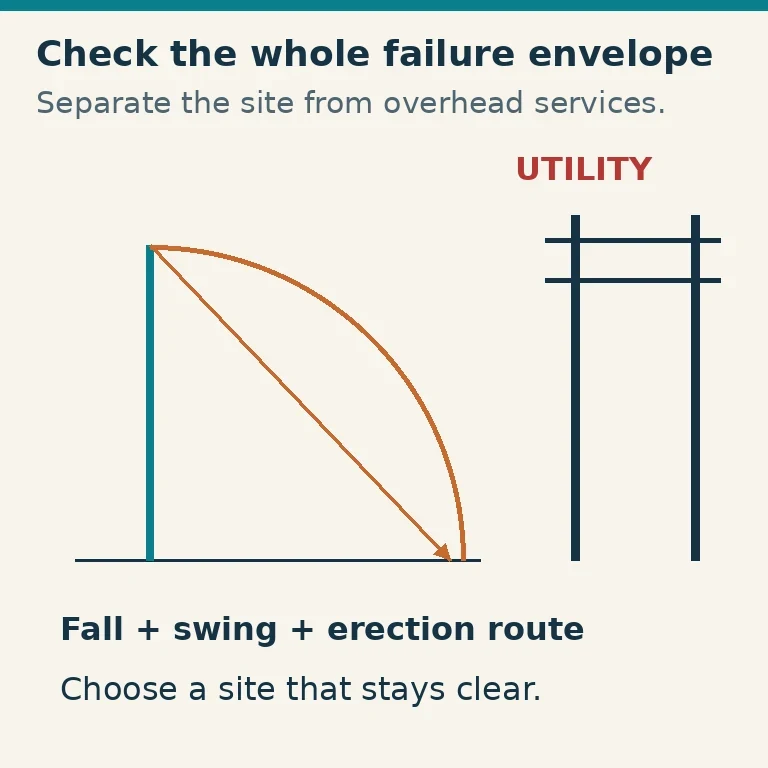
A long mast assembled horizontally can sweep a much larger area while being raised. Wind can move wires, and a dropped rope can pull a conductor into a different position. A person carrying a metal pole may create a hazard before the actual antenna installation begins.
Do not guess a line's voltage from appearance or assume a covering makes it safe to touch. Utility guidance warns that contact and nearby energized surroundings can be lethal. Required clearances depend on the installation and line; obtain appropriate utility and professional advice rather than treating a generic distance as permission to work.
If the site cannot keep the entire installation and failure envelope clear, choose another location or antenna arrangement. A spotter is useful for ordinary erection work but cannot make a fundamentally unsafe site acceptable.
Include buried services in planning before driving stakes, grounding electrodes or supports. Use the local utility-location process and required permissions. A radio operator's estimate of where a cable “probably runs” is not a utility locate.
Route Cables Around Walking Paths
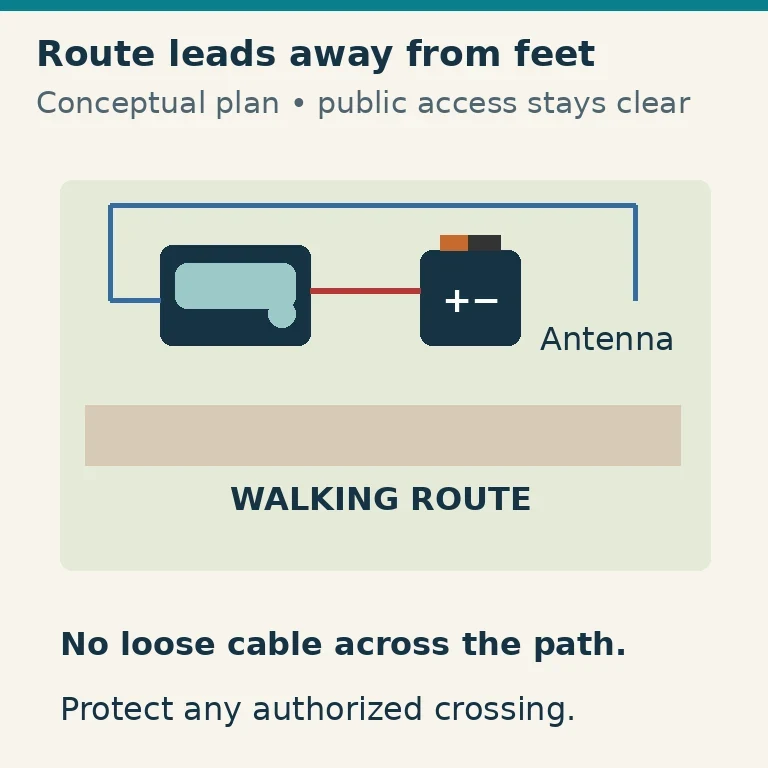
Place the operating table, battery and antenna so the normal public route does not cross feedlines or power leads. At a park, do not claim the path merely by laying a cable across it. Choose a different station footprint where practical.
Where a crossing is authorized and unavoidable, use a suitable cable protector or ramp appropriate to pedestrians, mobility devices or vehicles using that route. Bright tape alone does not prevent a foot or wheel catching the cable, and an improvised loose mat can become another trip hazard.
Keep loops and spare cable away from chair legs, doorways, steps and emergency exits. Support runs so a person cannot accidentally drag the radio or battery from the table. Maintain enough service slack for normal movement without leaving large loops underfoot.
Do not run cables where doors, windows, wheels or sharp edges crush them. Protect edges with appropriate fittings and retain weather sealing where cables enter a building. A coax shield is not mechanical armor, and damage may remain hidden under the jacket.
For a temporary event, check the route again after visitors arrive. Chairs, bags and vehicles change the useful walking space. A safe setup at an empty site can become a poor route once the net or demonstration starts.
Make Antenna Wires and Guy Lines Visible
Put antenna conductors and supports out of ordinary reach and away from public movement. RF exposure and contact risk depend on the antenna, frequency and power; comply with the required exposure assessment rather than assuming low SWR means safe to touch.
Do not place a thin wire at face height because it is easier to tension there. Raise it to a properly assessed safe position or change the layout. Mark necessary guy lines conspicuously, especially where they approach their anchors, but use placement as the first control.
Markers should remain visible from the direction people approach. A small flag facing the operator can be nearly invisible from the path. Consider low light, children and visitors focused on the radio rather than the ground.
Secure anchors and cover or remove protrusions that can injure someone. Keep supports compatible with the expected load and weather. Do not use a dead branch, damaged tree or loose fixture just because it is convenient.
When handling wire, use appropriate gloves and eye protection for the material and task. Wire ends can spring back when released. Control tension before cutting or disconnecting, and keep other people clear of the recoil path.
Protect the DC Power Path
Select wire size, connectors and fuses for the actual current, cable length, insulation and installation conditions. A fuse protects the circuit when correctly selected and located; it is not permission to use undersized wire.
Place source-side protection as required by the battery and distribution design, close enough to protect the outgoing lead. An unfused length between battery and fuse remains a fault risk. Protect branches according to their wiring and loads rather than relying only on one large source fuse.
Keep battery terminals covered and metal tools, jewelry and loose hardware away from them. Check polarity with a suitable meter before connecting a newly made lead. Never place a meter set to measure current directly across a battery.
Use insulated, properly retained connectors with strain relief. Look for loose strands, exposed copper, damaged housings and heat discoloration. A connector can fit mechanically while being wired with reversed polarity.
Disconnect the source before repairing a lead. Replace damaged components rather than wrapping a hot or mechanically weak joint in more tape. Tape can conceal deterioration without restoring current capacity or retention.
Keep Mains Leads and Power Supplies in Sound Condition
Use correctly rated equipment and retain protective earth connections where the equipment requires them. Never remove an earth pin or use a ground-lifting adapter to cure radio noise. Solve the interference through appropriate equipment and installation methods.
Inspect cords for cuts, crushed areas, loose plugs and heat damage. Remove defective items from service. Do not run extension leads through standing water or cover power supplies with materials that obstruct ventilation.
Outdoor mains use requires equipment and protective measures suitable for the environment and applicable electrical rules, including appropriate ground-fault protection where required. A plastic bag over a household connector is not a designed weatherproof connection.
Arrange the station so the power disconnect is accessible. Everyone assisting should know how to isolate ordinary station power without touching damaged wiring. Some equipment can retain dangerous stored energy after disconnection; external isolation is not authorization to open it.
Keep mains connections distinct from low-voltage distribution. Labels help prevent mistakes, but a label cannot compensate for incompatible connectors, poor enclosure design or exposed live parts.
Recheck After Weather, Movement or Changes
Inspect supports, wire tension, anchors and cable routes after strong wind, rain, frost or a vehicle movement nearby. Water can enter damaged connectors, while changing ground conditions can loosen stakes or move a support.
Before transmitting, look for people near the antenna and check that no lead has been pulled into a path. If an animal or visitor enters the wire area, stop and make the station safe before continuing the contact.
For permanent stations, inspect outdoor jackets, entry points and strain relief periodically. UV exposure, flexing and abrasion can degrade a cable long before the radio stops working. Grounding and lightning protection need their own properly designed installation; a cable-routing check does not certify them.
After a temporary activation, count stakes, ties and wire pieces during pack-down. Remove temporary lines and sharp offcuts. A wire hazard left behind remains your responsibility even after the station is off the air.
If a Wire Contacts a Power Line
Treat a fallen or contacted utility line and nearby objects as energized. Keep people away, call emergency services and the utility, and follow their instructions. Do not touch the antenna, guy, vehicle, fence or person involved in contact, and do not attempt a rescue with a pole or rope.
If you are already near a downed line, utility guidance warns about voltage differences across the ground and describes moving away with small shuffling steps, keeping feet close together. Do not approach a line to inspect it or use that movement advice as a reason to enter the area.
For ordinary station damage without a utility incident, stop operation and isolate the power safely before inspection. Repair the cause, including the routing or support failure, rather than merely restoring electrical continuity.
A safe layout is easy to walk around, easy to disconnect and difficult to mistake for harmless loose wire. Revisit it whenever the station's location, equipment or public access changes.