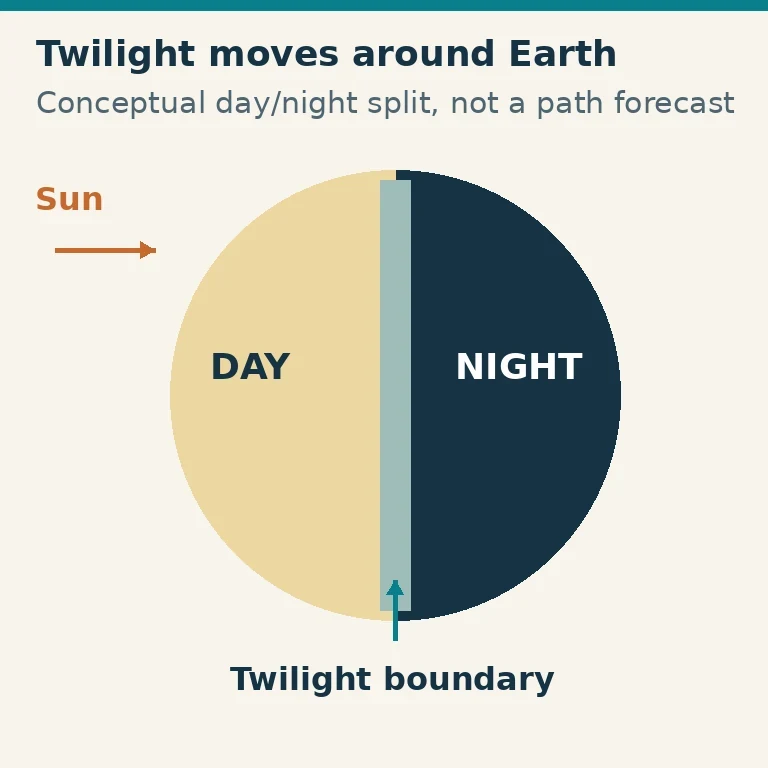
The greyline is the moving transition between daylight and darkness around Earth. Around sunrise and sunset, changing ionospheric conditions can briefly favor long-distance amateur radio signals, particularly on lower HF bands. Operators call this greyline propagation.
It is an opportunity to listen and test a path, not a guaranteed worldwide opening. Two stations near their local twilight can have a useful advantage, but the band, ionosphere, noise and geometry still have to cooperate.
Locate the Greyline on the Globe
The day-night boundary is also called the terminator. A propagation map commonly shades the night side and shows the boundary moving across the world. The greyline is a transition region rather than a physical line of zero width.
Sunrise at your station and sunset at another can place both near this transition. The reverse combination can also occur. Season and latitude change its orientation and movement relative to the places you want to work.
A flat map can be misleading. The shortest surface path between two distant stations follows a great-circle route, which may look curved or broken across the map edge. Two locations appearing close to a vertical map boundary do not automatically share a favorable radio path.
Use a map with the correct UTC and station position. A stale display or a home locator left in portable software can put the apparent opening at the wrong time. At high latitudes, prolonged twilight and seasonal daylight complicate a simple “sunrise plus a few minutes” plan.
Understand What Changes in the Ionosphere
Solar radiation creates ionization in the upper atmosphere. The resulting electron-density structure influences radio-wave absorption and refraction. NOAA describes the ionosphere as variable with solar conditions and explains its effects on radio propagation.
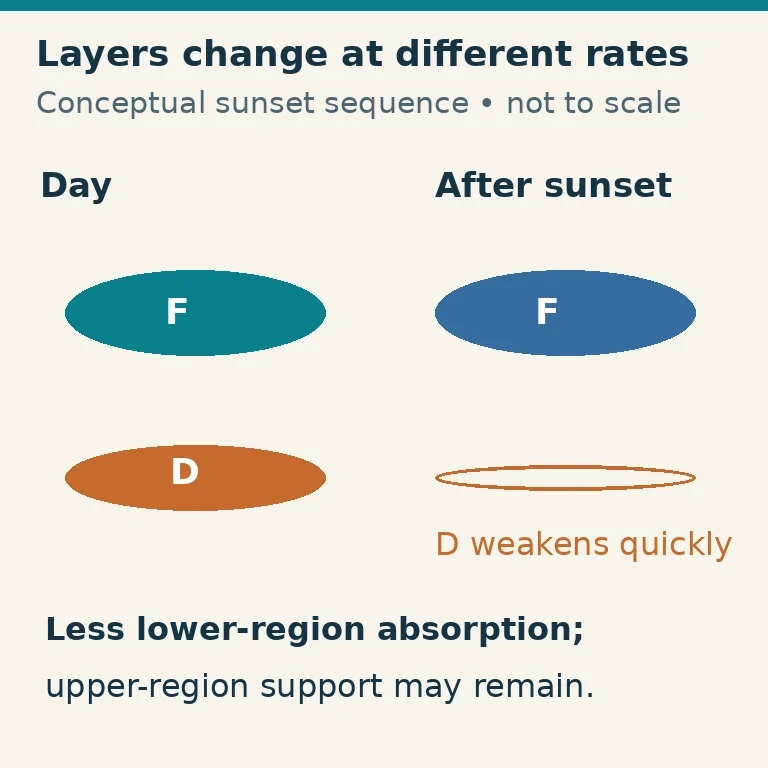
During daylight, the lower D region can absorb significant energy from lower-frequency HF signals passing through it. Higher regions, especially the F region for many HF paths, can support refraction that returns signals toward Earth.
After sunset, ionization in the lower region diminishes relatively quickly, reducing absorption. Useful ionization higher up can persist longer. This can create a period with less lower-region loss while the upper ionosphere still supports a long path.
At sunrise, the layers also develop at different rates. Favorable conditions can exist before lower-region absorption has built up fully. The details vary with frequency, season, location and solar activity; sunrise and sunset are not exact mirror-image switches.
IRTS's study guide describes these differing rates and notes that greyline propagation mechanisms are not fully understood. The layer explanation is useful, but it should not become a claim that every greyline contact follows one identical mechanism.
Why the Effect Is Often Useful on Lower Bands
Lower-frequency signals are more affected by D-region absorption, so reducing that loss can make a noticeable difference. Amateur operators often watch twilight opportunities on bands such as 160, 80 and 40 meters, within their privileges and local conditions.
That does not mean those bands always open together. The ionosphere must still support the chosen frequency over the path. A band can suffer too much absorption during daylight, while another becomes too high in frequency for the nighttime path. A lower band may remain limited by atmospheric or local electrical noise.
Higher HF bands can also change rapidly around daylight transitions, but an opening near sunset is not automatically proof of a classic greyline enhancement. Ordinary daily changes, changing noise and other propagation effects may contribute.
A quieter receiver can make a station easier to copy even if its field strength did not increase. Record both signal and noise observations when possible. “I heard it better” is a useful operational result, but it does not by itself identify the physical cause.
Both Ends Matter, but No Line Acts as a Wire
Checking local sunrise alone misses half the geometry. Look at the other station's daylight status and the route between you. A target near the corresponding twilight region may be more promising than a random station on the fully illuminated side of Earth.
The greyline is not a conducting cable that carries every signal around the planet. Paths can deviate from a simple map expectation, and signals can arrive by short or long routes under suitable conditions. Do not infer the route solely from the time of day or one strong report.
A station outside the narrow-looking shaded boundary can still be workable. The ground's visible sunrise is not identical to illumination at every ionospheric altitude along the path. That is another reason to listen before and after the map's exact line-crossing time.
Treat map alignment as a planning clue. Repeated observations, bearing information where available and propagation context provide stronger evidence than an attractive screenshot alone.
Plan a Practical Listening Session
Choose a target region and a band you are legally allowed to use. Note your local sunrise or sunset and the target area's corresponding times. Start monitoring before the expected transition so you have a baseline rather than discovering the band only at its peak.
Use the best available antenna for that path, but keep expectations realistic. A vertical may offer useful low-angle radiation; a directional antenna can help with gain or noise rejection. Neither guarantees a greyline contact, and a simple wire can still produce useful results.
Check a few known activity frequencies or beacons, then listen across a reasonable part of the permitted band. Use current spotting or reception networks as supporting evidence, checking the timestamps and locations. Old spots are not a current opening.
Record UTC, frequency, callsign, antenna and what you actually heard. If you change antennas, make short comparisons during the same interval. Comparing one antenna before sunset with another an hour later confounds the antenna and propagation changes.
For transmitting, keep calls concise, identify properly and listen between attempts. Use the minimum necessary power within applicable limits. A weak distant signal may need a quiet frequency and patient timing more than repeated long calls. The applicable US Part 97 provisions were checked on October 29, 2026.
Allow for a Short and Uneven Opening
A signal may rise quickly, fade or disappear while you are still completing an exchange. Make sure the essential calls and information were copied before adding a long station description.
There is no universal greyline duration. A useful interval may be brief, or conditions may remain favorable beyond visible twilight. Latitude, season and the length and orientation of the path change the opportunity. Do not use one successful day's timing as a permanent appointment.
Solar disturbances can disrupt an otherwise promising path. Current space-weather information helps place a result in context, but it does not forecast an individual contact with certainty. The absence of a geomagnetic disturbance also does not guarantee good propagation.
If a session produces nothing, keep the observation rather than declaring the concept disproved. Try adjacent lawful bands, another date or a different target region, changing one planning variable at a time.
Turn the Observation Into a Repeatable Experiment
For several sessions, monitor the same band and path across a similar twilight interval. Compare signal audibility, noise, reports and the timing of any opening. Keep the antenna and receiver settings stable enough to make the records meaningful.
You may discover that a particular station becomes copyable before your sunset, or that local noise overwhelms a promising low-band path. Those findings can guide antenna placement, noise reduction and future operating times more effectively than a general claim that greyline “works everywhere.”
The useful habit is to combine the map, the physics and actual listening. Greyline planning narrows the time and paths worth trying; careful observation tells you whether that opportunity reached your station today.