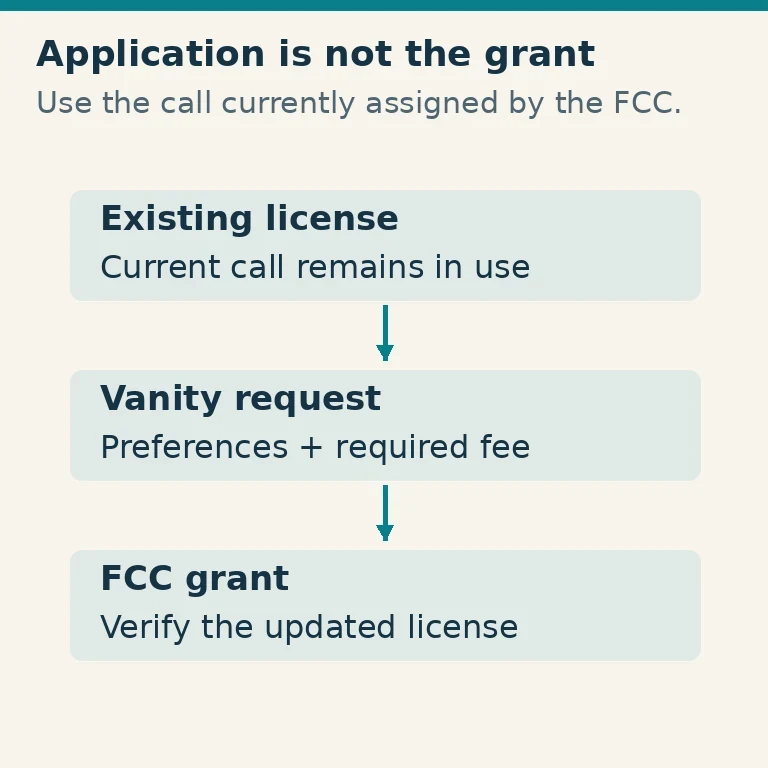
In the United States, a straightforward route to a first ham radio license is to choose the Technician class, study the question pool effective on your exam date, obtain an FCC Registration Number (FRN), and attend a license exam. If you qualify, the examination information goes to the FCC. You must then handle a separate FCC application fee and confirm that the FCC has granted your license and assigned a call sign before transmitting under your own new grant. Passing the exam is an important step, but it is not the grant.
This guide covers that U.S. path from registration through grant verification. Other countries use different licensing authorities, and this is not a guide to operating privileges or making a first contact.
Choose the First License and Understand What the Exam Does
ARRL lists three U.S. amateur license classes: Technician, General and Extra. Technician is the ordinary starting choice for a beginner following this guide. That is a practical recommendation, not a claim that every applicant is required to begin with Technician. If you have a different licensing goal, decide which class’s examination you intend to prepare for before buying materials or reserving a session. The steps below focus on a first Technician license, not on upgrades.
ARRL describes the Technician examination as a 35-question written exam called Element 2. It also says Morse code is not required for this license. Those facts make it possible to identify the examination you need without treating the exam as a demonstration that you already know every operating situation you may encounter. ARRL describes knowing the rules and being licensed as prerequisites to getting on the air. This article takes you through the license path; it does not substitute for learning the rules that apply to a particular transmission.
It helps to separate three things that can look like one process:
- Your FRN is the FCC registration number used to identify you in FCC-related steps. Obtain it before exam day and keep it available.
- Your exam result records whether you qualified through the examination. A qualifying result still has to reach the FCC through the examination handoff.
- Your license grant and call sign are the later FCC outcome you must verify before transmitting under your own new license. ARRL notes that ULS associates an individual with a call sign and FRN; the FRN you receive first is not itself a call sign.
Think of the exam as qualifying you for the application to move forward, not as a switch that turns on transmitting authority the moment you finish. That distinction will matter again when you look for a payment request or a pending application: those are intermediate records, not proof of a granted first license. Section 97.5 of the amateur rules refers to station apparatus being under the physical control of a person named in an amateur station license grant in the ULS consolidated license database. For the beginner seeking to transmit under their own new grant, the useful checkpoint is therefore the ULS grant, not the exam result.
Study the Question Pool Effective on Your Exam Date
Choose study materials by license class and exam date, not simply by whether their cover says “Technician.” ARRL lists a Technician question pool valid from July 1, 2026, through June 30, 2030. Before relying on those dates—or on a book, course or question bank—check the currently listed pool and compare its effective period with your intended examination date. Recheck the pool when you schedule, particularly if your exam may fall near a pool change.
ARRL describes the Technician exam’s subject areas as basic regulations, operating practices and electronics theory. Use those areas to organize your preparation: understand what a question is asking, review the explanation when you miss it, and return to subjects that remain uncertain. Neither a list of subject areas nor a run of good practice results is a guarantee of an exam outcome. You also do not need an invented target score to decide whether a particular explanation still needs work.
Suppose, hypothetically, you have an older Technician book and book an exam for a date within the pool period ARRL lists as July 2026 through June 2030. First, find which pool the book says it covers. Next, compare that with the Technician pool effective on your scheduled date, using the current pool listing rather than assuming that the book’s questions still match. If they do not match, switch to materials that identify the effective Technician pool. You might still find an older explanation helpful for a general concept, but it should not be your unchecked source of exam questions. If you later change the exam date across a pool boundary, repeat the comparison. This example is a way to make the date check; it is not a claim about any particular book.
A workable study cycle is to read an explanation, try questions on that material, examine the ones you missed or guessed, and then retest after reviewing the weak subject. A practice exam can help you see whether you can bring topics together rather than recognizing answers immediately after reading them; ARRL specifically advises taking one before exam day. If the practice result exposes a gap in regulations, operating practices or electronics theory, use that result to direct the next review instead of simply repeating questions until their wording is familiar.
Match the practice tool to the same effective pool as the main study material. Keep a note of topics you cannot yet explain in your own words, and revisit them after another round of reading. This is a preparation method, not a promised result or a substitute for confirming the examination you booked. The practical finish line for this stage is modest: you know which Technician pool applies to your scheduled date, your materials match it, and you have used practice questions to identify what still needs review.
Get an FRN, Then Arrange an Exam Session
If you have never registered with the FCC, do that before exam day. ARRL instructs exam candidates to register in FCC CORES and receive an FCC Registration Number (FRN) before the examination. Use the FCC’s current CORES information to complete registration, then save the FRN somewhere you can retrieve it for the session and subsequent FCC steps. This guide does not prescribe menu names or clicks: online procedures can change, and an older set of screenshots may not match what you see.
Write down or securely retain the FRN as an identifier, not as evidence that you have passed or been licensed. Later, if you need to look for an application in the FCC application search system, ARRL says you can search using your FRN. Keeping the number accessible now prevents you from having to reconstruct which identifier a session or application lookup is asking for. If you are unsure whether you have completed FCC registration, resolve that question through the current FCC registration route before treating an exam booking as fully prepared.
Next, choose a session. ARRL lists both in-person and remote-video online examination routes. Remote can be a useful alternative if a suitable session is available and its administrator confirms you can meet that session’s requirements. Otherwise, look for an in-person session you can attend. An ARRL listing of remote exams does not establish one universal set of remote-proctoring rules, so do not use a generic checklist in place of instructions from the session you actually choose.
Before committing to an appointment, contact the selected session administrator. Confirm the date and time, how to book or confirm your place, what identification and other documents to bring or supply, and the charge for that session. ARRL specifically tells candidates to ask the administrator about the applicable exam fee and required documents and to verify the session date and time. If an online listing and the administrator’s current instructions differ, settle the discrepancy with the administrator rather than assuming that an older listing remains valid.
This conversation is also the place to clarify conditions particular to a remote session. Ask that administrator what its process requires and whether your circumstances fit. If it does not, choose an in-person option instead of guessing how to comply. For either route, keep the booking confirmation and any session-specific instructions with your FRN and study plan. A search result showing a session is not the same thing as a confirmed appointment.
There are two useful final checks before exam day. On the current FCC pages, verify how to access CORES and any registration or later application information you expect to use; do not rely on a remembered menu. On the current exam sponsor or administrator pages, verify the appointment details, documents, procedure and fee. These checks address different uncertainties: the FCC manages the applicant-facing registration and application systems, while the chosen examination administrator controls the instructions for that session. Neither an FRN nor a booking confirms that the later FCC license application has been granted.
Prepare for Exam Day and the Application Handoff
Before the session, make a candidate check you can act on rather than relying on memory. Have your FRN ready in the form the administrator requests. Be prepared to supply a valid email address on the application: ARRL says it is mandatory for receiving FCC correspondence. Follow your chosen administrator’s instructions about identification and documents. ARRL’s own exam guidance lists one legal photo ID, but confirm the requirements of your selected session rather than presenting that item as a universal rule for every sponsor or remote procedure.
Check the session instructions once more if anything has changed since booking—especially the time, location or remote participation procedure, and the documents you are expected to provide. Keep contact details for the administrator so you can ask a specific question before the session instead of discovering an uncertainty at exam time. The point of this preparation is not to add an unofficial exam requirement; it is to arrive able to follow the requirements that your administrator has confirmed.
Budget for two distinct possible charges. ARRL says a volunteer exam session will likely have an examination charge set by its Volunteer Examiner Coordinator (VEC). Confirm the amount with your administrator rather than assuming every session charges the same amount. A later FCC application fee is separate: ARRL says it must be paid directly to the FCC, not to the organization or exam team. Paying for the session does not prepay that FCC fee, and handing money to an exam team is not the later FCC payment step.
After a qualifying examination result, there is a handoff. ARRL describes the FCC receiving the candidate’s examination information from the VEC; the FCC then sends qualifying candidates payment instructions. That means a result reported at the session and an application visible in FCC systems are not necessarily the same event. Nor does a qualifying result immediately create a first call sign. Keep whatever result or session information the team provides, and be ready to identify your session if a later step needs investigation.
If you are uncertain whether your exam record was recorded correctly or passed along, ask the session team or its VEC about that examination handoff. If an application is already visible but its FCC payment or application status is the problem, use FCC channels for that issue. Do not infer a guaranteed submission time from either route. The useful question is which handoff is unresolved, not whether an expected number of hours has elapsed.
Pay the FCC Fee and Verify the License Grant
ARRL lists a $35 FCC application fee that applies to a new amateur application. This is separate from any VEC-set examination charge and is paid to the FCC. Recheck the fee amount and the FCC’s current payment procedure before paying; a fee figure in a saved guide is not a substitute for the current FCC instructions presented for your application.
The sequence matters. According to ARRL, when the FCC receives examination information from the VEC, it emails qualifying candidates a link with payment instructions. ARRL says the candidate has 10 calendar days from the date the application file number is issued to pay. That clock is tied to the file-number issuance—not to the day you took the exam and not to the day you happen to open an email. The application file number identifies the application at this stage; it is neither your FRN nor an assigned call sign. Because the payment window and online procedure affect what you must do, verify current FCC and ARRL instructions rather than relying indefinitely on these stated details.
If no FCC payment email arrives, do not conclude that there is no application. ARRL says applicants need not wait for the email to look for their application: they can search the FCC application system using their FRN. If you find a pending application, note its file number and follow the FCC’s current instructions for payment and for resolving any application or payment difficulty. Check the email address supplied on the application as part of diagnosing correspondence trouble, but do not treat a missing message as permission to ignore a visible application or its payment deadline.
If you cannot find an application using your FRN, the next question is whether the examination information reached the FCC. Ask the exam team or VEC about its submission or record; they are the relevant contact for the exam-side handoff. If the application is present and the difficulty concerns its status or payment, pursue that through FCC channels instead. These are conditional next steps, not a promise that either office can resolve a case within a set time. Keep the exam result, FRN and any application file number distinct when describing the issue so the person helping you knows which record you mean.
After the fee is paid and the FCC processes the application, ARRL says the examinee receives a second FCC email linking to the official license. Do not use payment alone as your final checkpoint. Confirm in the Universal Licensing System (ULS) that the license has actually been granted and that a call sign is assigned to you. ARRL notes ULS’s association of an individual with a particular call sign and FRN. The email may direct you to the license, but it is the verified grant—not merely the arrival of a message—that resolves the question for this guide.
The regulatory reason for this caution is concrete. 47 CFR §97.5 describes station apparatus as being under the physical control of a person named in an amateur station license grant in the ULS consolidated license database. For someone waiting to operate under their own first grant, a passed exam, an issued application file number, and a paid fee are all short of confirming that grant. If ULS still shows the application as pending, or you cannot verify a grant and assigned call sign, wait. Investigate the exam handoff with the team or VEC if the application is absent; investigate an existing application or payment problem through FCC channels if it is present. Do not substitute an assumed processing turnaround for the ULS check.
Follow One Candidate from Registration to Grant
Consider Maya, a fictional first-time U.S. candidate. She chooses Technician as her starting class, checks which Technician question pool will be effective on her planned exam date, and uses matching materials to study. When practice questions expose a topic she cannot explain, she reviews it before trying again. Nothing about that preparation is itself an FCC registration or a license.
Before booking, Maya registers through FCC CORES and saves her FRN. She then confirms a Technician session with its administrator, including the time, documents and exam charge. At the session she supplies the requested identification and a valid email address. Her qualifying result is an exam result; she keeps the session details because the VEC must pass examination information to the FCC before the later application and payment steps can proceed.
Now suppose Maya does not see the expected FCC payment email. She does not take its absence as proof that nothing was filed. Using her FRN, she searches for a pending FCC application. If it appears, she records its application file number, checks the current payment instructions and addresses any application or payment problem through FCC channels. If it does not appear, she asks the exam team or VEC about the examination handoff. The reported payment period begins with issuance of the file number, not with her exam date or her discovery of an email.
Finally, Maya pays the separate FCC fee according to the current FCC procedure. She treats that payment as another completed step, not as a call sign. Only after FCC processing does she check ULS for a grant and a call sign assigned to her. If the grant is still pending or cannot be verified, she waits and follows up on the unresolved step. Her route to operating under her own new license is complete only when that ULS grant and call sign are confirmed—not when she passed, received a file number or paid.