HF radio covers 3–30 MHz, but the name describes a frequency range, not a set of frequencies anyone may transmit on. An HF signal may travel along Earth’s surface or take a path through the ionosphere; that second path can make long-distance communication possible. Whether it works for a particular contact changes with the path, frequency and conditions. For a beginning amateur operator, the useful question is therefore not simply “Which HF band reaches farthest?” It is “Which permitted band and mode might serve the contact I want to make at this time?”
What Counts as HF—and Which Bands Amateurs Can Use
The International Telecommunication Union’s ITU-R defines high frequency (HF) as 3–30 MHz. That is a classification of radio frequencies. Within that range, amateurs refer to bands by approximate wavelength names such as 80 meters, 40 meters, 20 meters and 10 meters. A band name helps identify an operating area; it does not mean an amateur may transmit everywhere in the surrounding HF spectrum.
The American Radio Relay League (ARRL) publishes transmitting-band tables that provide useful examples. In one cited table row, 80 m is 3.50–3.60 MHz. The table lists 40 m as 7.0–7.2 MHz in two specified ITU regions and 7.0–7.3 MHz in another, while its 20 m row is 14.00–14.35 MHz and its 10 m row is 28.0–29.7 MHz. These are examples from that table, not a worldwide list of everyone’s permissions. In particular, the cited 80 m row is separate from the table’s 75 m material: it should not be read as a statement that every license class can use an entire 3.5–4 MHz span. Nor does a band-edge row, by itself, say which emissions an individual operator may use there.
You may also encounter 160 m in discussions of operating on the longer amateur bands. ARRL places its roughly 1.8 MHz row under medium frequency (MF), and ITU-R defines MF as 300–3000 kHz. Thus 160 m can belong in a practical discussion alongside HF amateur activity without becoming formally HF: approximately 1.8 MHz is below the 3 MHz HF boundary.
There is a further distinction between recognizing an amateur band and having authority to transmit on it. ARRL scopes the cited transmitting table to stations in specified ITU regions under FCC jurisdiction. The particular table section used for the rows above specifies an Amateur Extra control operator or the stated CEPT or Class 1 IARP authorization; ARRL has other provisions for other operator classes. Those qualifications matter more to an actual transmission than the convenient meter name does. The final section applies that distinction to a beginner’s possible choice; first, it helps to understand what a signal must do after it leaves the station.
Two Ways an HF Signal Reaches a Receiver
ITU-R identifies two basic propagation modes for MF/HF transmissions: groundwave and skywave. Think of them as two different paths between a transmitting station and a receiving station, not as two settings selected on the radio. The ITU handbook describes groundwave as propagation along Earth’s surface and skywave as propagation involving Earth and the ionosphere.
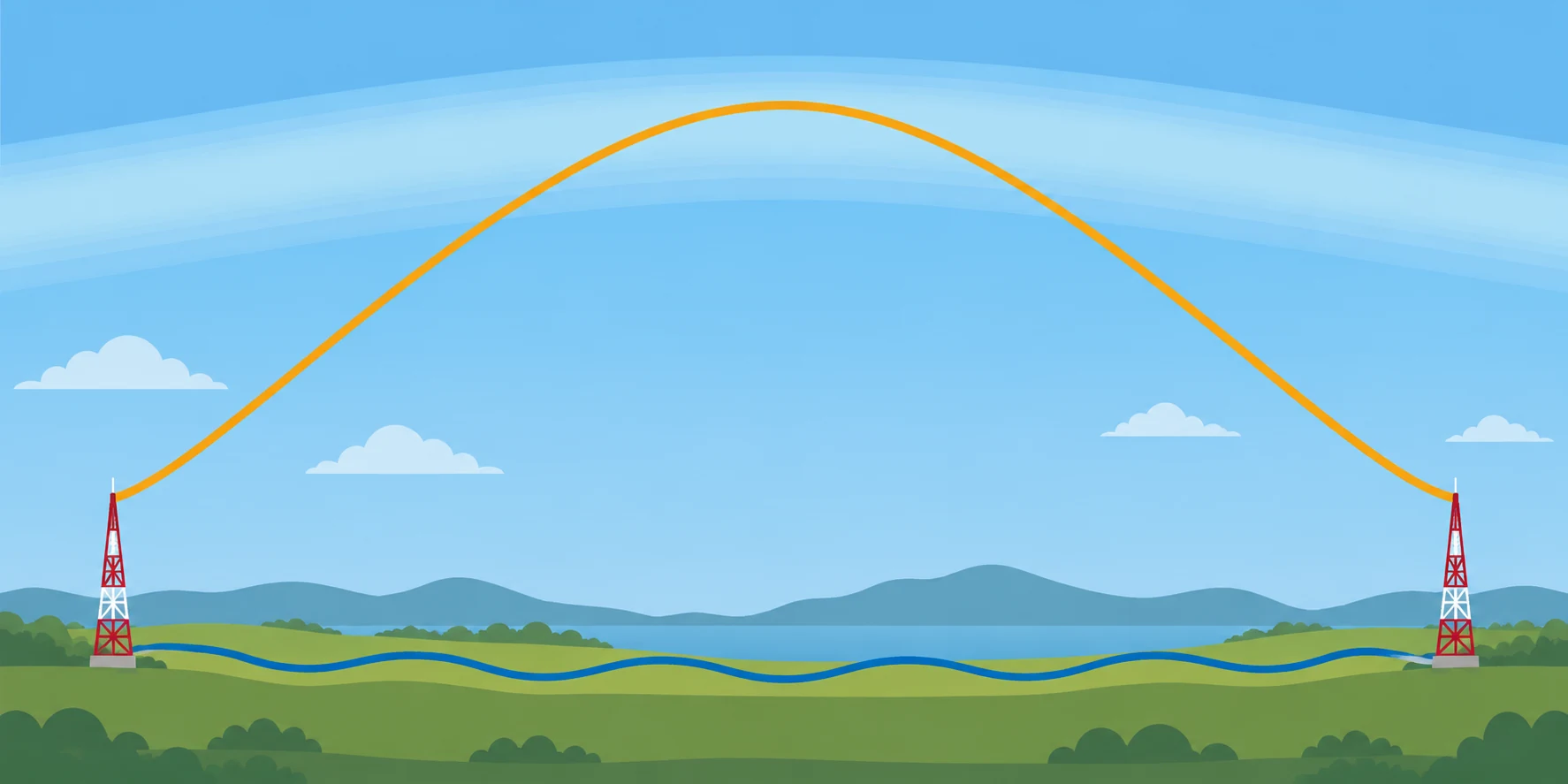
A groundwave follows the surface rather than relying on a distant ionospheric path. That makes it a way to understand nearer reception: the receiver gets a signal that has traveled along the Earth, not one that needed to return from overhead. Its usefulness is not unlimited. The ITU handbook notes that groundwave has limited range at higher frequencies and over land. It would therefore be misleading to imagine that a surface-following path can simply be extended to any desired distant receiver by choosing an HF frequency.
Skywave provides a different possibility. NOAA explains that, under normal conditions, HF waves can support long-distance communication through refraction in the upper layers of the ionosphere. A signal traveling upward can consequently reach a receiver beyond the distance a surface-following path might usefully serve. The ITU handbook also describes skywave in terms of successive paths between Earth and the ionosphere. Together, those descriptions give a useful picture of how distant stations may communicate without requiring an unobstructed surface path between them. They do not describe the ionosphere as a fixed, perfectly reflecting ceiling that always returns every frequency to the desired place.
Consider an illustrative, invented pair of stations: one operator hopes to contact someone relatively nearby, then hopes to reach someone much farther away. The first receiver might obtain a useful surface-following signal. For the second goal, a usable ionospheric path might make the distant receiver reachable. The example is a way to distinguish paths, not a report of either contact or a promise that either path exists at the chosen time. In particular, “farther away” alone does not specify a band, a dependable distance or an identical skywave route for every contact.
The receiver completes the picture. What matters is not just that a signal was transmitted, but whether it arrives in a usable condition relative to what the receiver hears. ITU-R notes that received mean signal or noise power, or both, can vary substantially with time on MF/HF systems. A station might therefore sound different later even though the intended contact has not changed. That observation is a reason to treat propagation as a changing path between two stations, rather than as a permanent range printed on a band name. The next question is what makes one band a plausible choice now and a poorer choice at another time.
Why a Band Opens—and Why It May Not
Operators say a band is “open” when conditions allow a usable path for the contact they have in mind. That is practical shorthand, not a claim that every station everywhere can communicate on that entire band. The ionospheric path is affected by changes in the ionosphere; NOAA notes that changes in its density and structure can alter an HF transmission path or even block transmission. A workable path for one pair of stations need not settle what another pair will hear.
Time of day offers a starting clue because illumination and the ionosphere’s condition change. ARRL’s 2014 amateur-radio guide describes a broad pattern: its longer-wavelength grouping, 160–30 m, is generally used for local or regional contacts during the day and can support long-distance contacts—often called DX—at night. The same guide says its shorter-wavelength 20–10 m grouping can provide daytime DX but tends to close at night. This is a dated operating guide’s generalization, not a frequency-by-hour schedule. Its grouping includes 160 m for operating discussion even though 160 m is formally MF under ITU-R’s definition.
Why can a time-of-day pattern be useful without being a rule for every contact? Skywave depends on whether the ionospheric path works for the frequency and the route between the particular stations. If that path changes, a frequency that supported communication earlier may no longer serve the same goal, while another candidate may be more useful. NOAA’s account of changing ionospheric density and structure supports that path-based view. The ARRL patterns give a beginner a sensible hypothesis—for example, consider shorter bands for daytime DX—rather than evidence that a named band is open to a named destination right now. Route, season and solar conditions can all qualify a day/night starting guess; “higher bands close at night” should not be treated as a universal cutoff.
Solar conditions add more than one kind of change. On a longer timescale, NOAA notes that near a solar-cycle peak, higher frequencies can be supported for HF communication. That helps explain why a broad expectation about which frequencies are useful need not remain equally useful across different solar conditions. It does not identify a currently open band or guarantee a path to a particular receiver.
Disruption is a separate issue from that longer-term pattern. NOAA explains that a sufficiently strong solar flare can increase ionization in the lower, denser D layer. HF waves interacting there can lose energy, degrading signals or absorbing them altogether. NOAA also states that radiation storms caused by energetic solar protons can disrupt HF communication. Those are reasons an expected path may fail; the cited radiation-storm statement alone does not specify where a disruption will occur. It would be a mistake to turn either statement into a live forecast for an operator’s chosen route.
A quiet or unsuccessful attempt is consequently ambiguous. The desired route may not have a useful path at that moment; a signal may have changed; noise at reception may have changed; or the attempt may simply not have produced a contact. ITU-R specifically notes that received MF/HF signal and noise levels can vary over time, while NOAA describes ionospheric changes that can modify or block transmission. Neither observation proves that an entire band is closed because one station heard nothing useful. The practical value of an “opening” is narrower and more helpful: it describes an opportunity to try a particular contact, while leaving room to reassess the route, time or frequency if it does not work.
What People Use HF for—and How They Communicate
Amateur HF activity can aim at different kinds of contact. One operator may want to speak with someone in a local or regional area; another may hope for DX, meaning a long-distance contact. ARRL’s discussion of longer amateur bands includes both daytime local or regional contacts and nighttime DX as broad uses. The goal matters because it tells the operator what sort of path they hope to find. It does not, on its own, select a frequency or guarantee that a station will be heard.
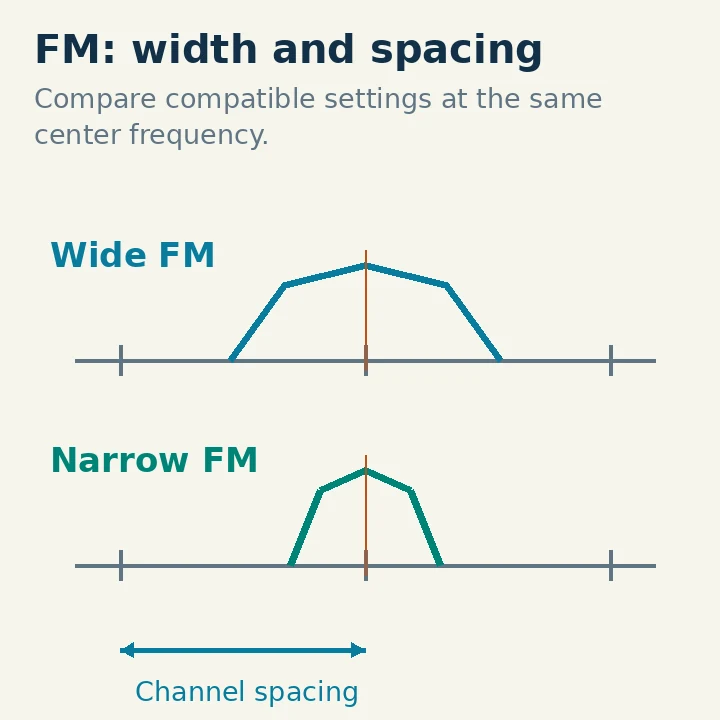
The mode is a different choice from the band. A band is the frequency area in which the operator is considering a contact and a propagation path. A mode is how the operators communicate on an allowed part of it. Keeping the questions separate prevents a common mix-up: saying “20 meters” does not say whether the intended contact is voice, Morse code or digital data, while choosing voice does not establish that a particular band will reach the intended receiver. The band examples and ARRL’s separate voice, CW and data discussions illustrate those distinct choices.
For voice, SSB—single sideband—is a common HF amateur choice: ARRL says most amateur voice activity on HF has moved to SSB. CW refers to Morse-code contacts; ARRL describes amateurs making HF CW contacts. Digital data is another category of amateur communication. In its 2025 discussion of digital data modes, ARRL mentions FT8 in the context of award chasing and working DX. That dated example shows one use of a digital mode, not a claim that every digital contact has the same purpose or that a particular mode is the best present choice for every beginner. None of these category names, without the applicable rules, supplies transmit permission on a frequency.
Imagine two illustrative goals. For a regional conversation, a beginner might seek a usable regional path and want voice. For a distant contact, another operator might seek a DX path and prefer CW or a digital data mode. The path question and the communication question remain separate in both cases: a desired mode cannot create an ionospheric opening, and an apparent opening does not decide what mode is permitted or compatible with the stations. These are explanatory choices, not reports of contacts or instructions to use a specific frequency.
Nor is the entire HF range an amateur-only space. NOAA names both amateur operators and industries such as commercial airlines among users of these frequencies. Their presence in the broader range does not mean they operate under the same amateur allocations. For an amateur, recognizing an HF signal, finding a possible path and having authority to transmit remain separate matters.
Making a Conditional First Band Choice
Here is a clearly invented beginner’s decision, meant to show how the pieces fit rather than prescribe a band that is open now. Suppose the operator wants a long-distance contact during the day. ARRL’s 2014 pattern makes one of the shorter 20–10 m amateur bands a plausible initial candidate for that goal. If the same operator instead wants a local or regional contact during the day, the guide’s longer-band pattern suggests investigating a lower-band candidate. For nighttime DX, that longer-band pattern offers another starting hypothesis. Each suggestion remains conditional on the actual route and changing conditions; none is a promise that the intended station can be reached. The guide’s 160 m operating grouping also does not override 160 m’s formal MF classification.
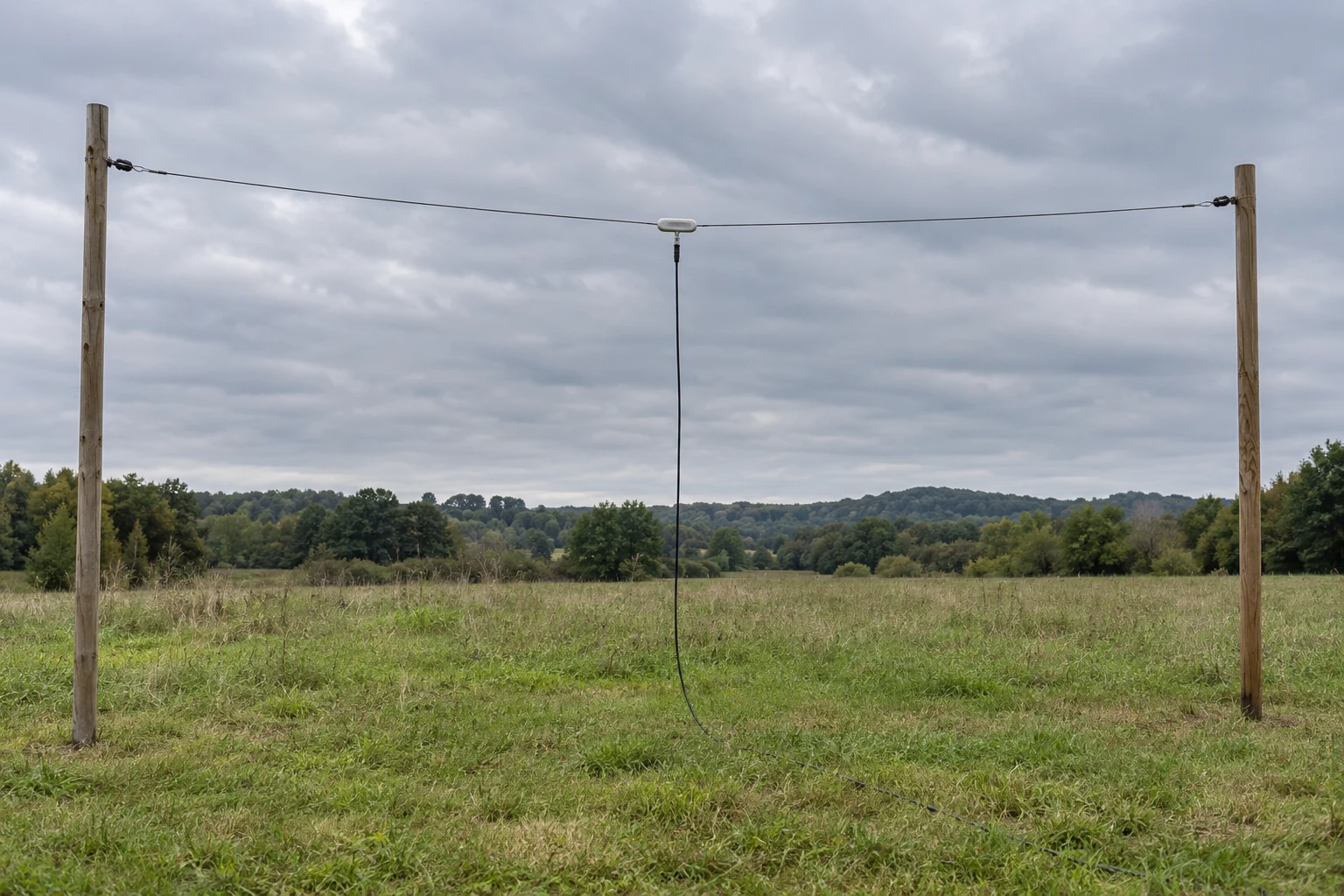
Next comes a separate mode decision. Does the beginner hope for an SSB voice conversation, a CW contact, or a digital data contact? ARRL identifies all three kinds of HF amateur activity, but a preferred way to communicate must still fit the station and what the operator is permitted to transmit. The operator would need to check the actual radio’s manual, whether the radio and antenna—the station component used to send or receive radio signals—are suitable for the proposed band, and whether the desired mode is compatible with that station. This example assumes no particular equipment, antenna design, tested setup or present band opening.
Before transmitting, the legal check is decisive. The operator must consult the current national frequency and emission rules applicable where the station operates, along with their own license privileges. In a US case under FCC jurisdiction, that means checking the provisions for the operator’s actual license class and intended emission, not copying an ARRL row for an Amateur Extra, CEPT or Class 1 IARP-qualified control operator as though it applied to every US amateur. ARRL’s cited table is expressly scoped by jurisdiction and ITU region; its differing 40 m limits illustrate why even a familiar band label is not a worldwide transmit authorization. A suitable receiver setting is not a substitute for that check: ARRL’s discussion of HF radios distinguishes broader general-coverage reception from transmission confined to amateur bands.
Once the candidate is both compatible and legally usable, the modest test is to listen, then try the chosen permitted band and mode if appropriate. If no contact results, the operator need not conclude that HF has failed or that every frequency on that band is closed. They can reconsider the intended route and time, listen for a better opportunity, or try another permitted, station-compatible band or operating time. NOAA’s description of changing ionospheric paths and ITU-R’s warning that received signal or noise can vary explain why a first attempt cannot settle every alternative.
A workable HF choice is therefore conditional in four ways: the desired path, the changing conditions, the station’s compatibility and legal authorization. The meter name gives a place to begin thinking. It is the checks—and what the receiver actually hears for the intended route—that turn a plausible starting idea into a responsible attempt.