You can hunt Parks on the Air (POTA) from home with a portable transceiver. You do not need to visit a park: a hunter contacts an activator who is operating from one. The practical job is to set up your equipment safely, find a plausible station, confirm its identity by listening, and make a brief contact within your license privileges. Keep your own record afterward, but do not upload a hunter log to POTA; hunter credit comes from the activator’s submitted log.
What Counts as a Hunt from Home
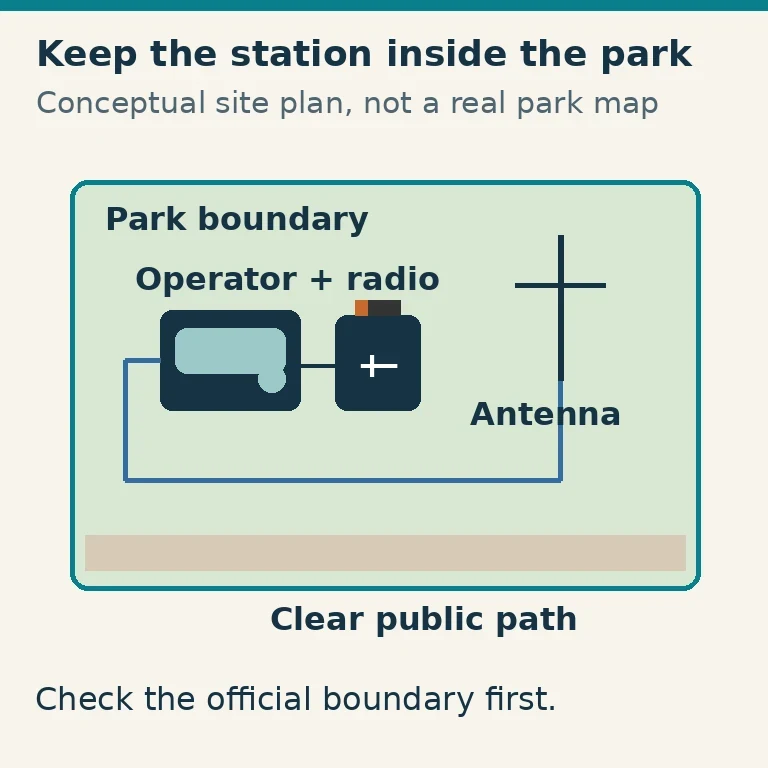
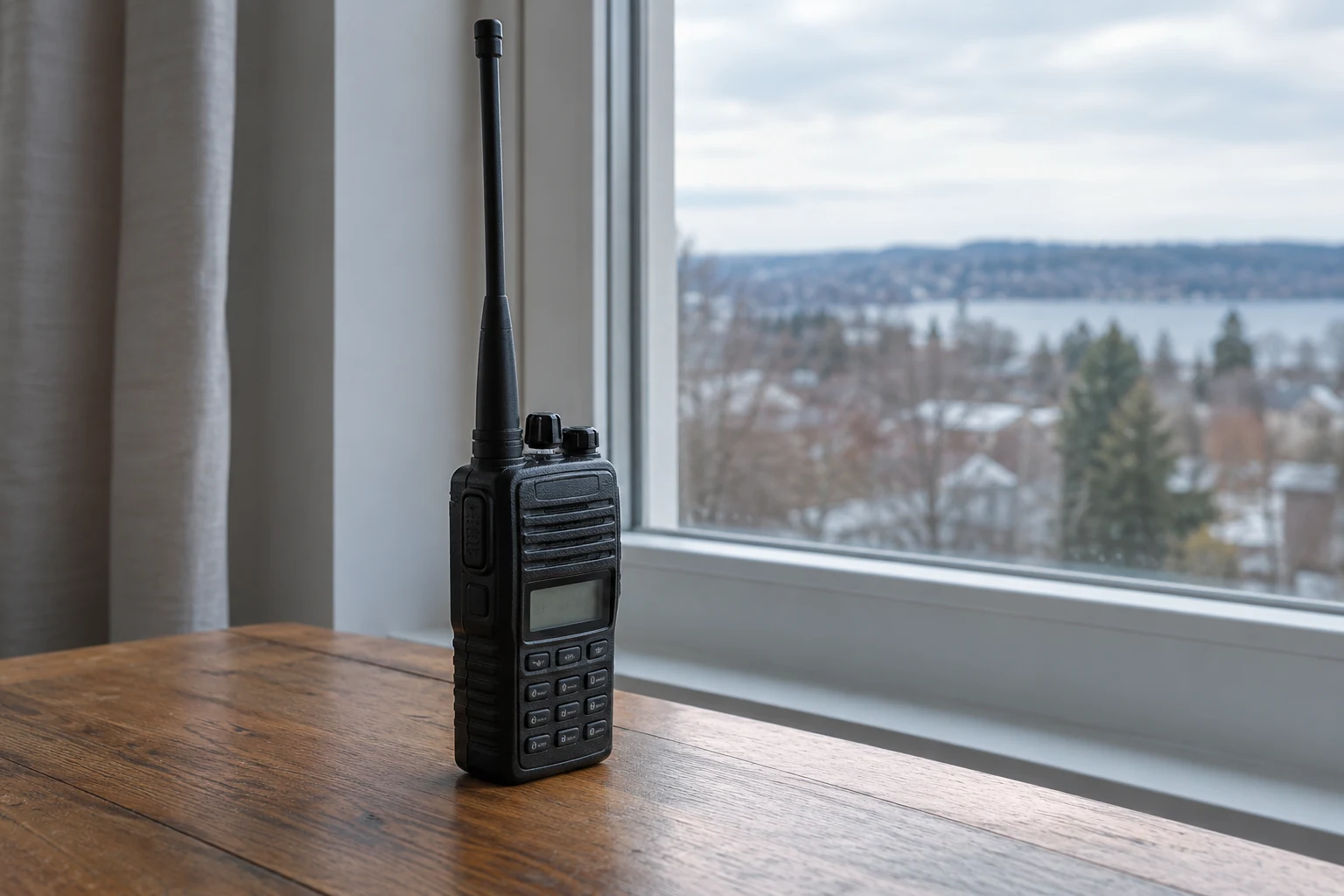
POTA calls the operator in the park an activator and the operator contacting that person a hunter. Its rules explicitly allow a hunter to contact an activator from home or another property or station. That means your kitchen-table radio, temporary backyard antenna, or battery-powered portable setup can be a home hunting station. The equipment’s portability does not turn your home into a park or turn you into an activator. POTA requires an activator and all their station equipment to be within the park boundary.
Likewise, a park-to-park contact is not simply a contact made with portable gear. POTA uses that description when the hunter is also at a designated POTA park. If you are operating from home, record the contact as a hunt, even if everything in your station could be packed into a bag. You do not need to learn park activation procedures to try this first home contact.
For this guide, aim for a direct contact: your station and the activator communicate without a terrestrial repeater carrying the contact between them. A repeater is a separate station that receives a signal and retransmits it, commonly to extend coverage. Simplex means the two operators communicate directly rather than through that repeater. POTA does not permit contacts made via land repeaters for program credit, so hearing an activator on one is not a reason to make a repeater contact and expect it to count. Choose an authorized direct path instead.
Your role is established by where the operators are, not by how small the radios are or whether they run on batteries. Once that distinction is clear, the next question is operational: can your particular station safely and lawfully transmit on a frequency and mode where an activator can hear you?
Prepare Your Portable Station Before Calling
Check authorization first. Your amateur license, its applicable jurisdiction, and your radio’s manual—not the fact that you own a portable transceiver—determine what you may transmit and what the equipment can do. If you are licensed in the United States, check the FCC rules that apply to your license class and the intended band, frequency, mode, and station operation. Elsewhere, use your own licensing authority’s rules. If you cannot establish that the planned transmission is authorized, remain on receive until you can. Do not infer a power limit, band privilege, or mode capability from a POTA spot.
A modest temporary station has a radio, a suitable battery or power supply, an antenna, and a feed line with sound connections. The antenna is the part of the station that sends and receives radio signals; the feed line connects it to the radio. Check the manual for the intended radio and antenna arrangement rather than assuming that two connectors that fit together make a suitable installation. ARRL emphasizes both a good antenna for making contacts with reasonable ease and the importance of feed-line quality at HF, VHF, and UHF. Neither point promises a particular range from your location.
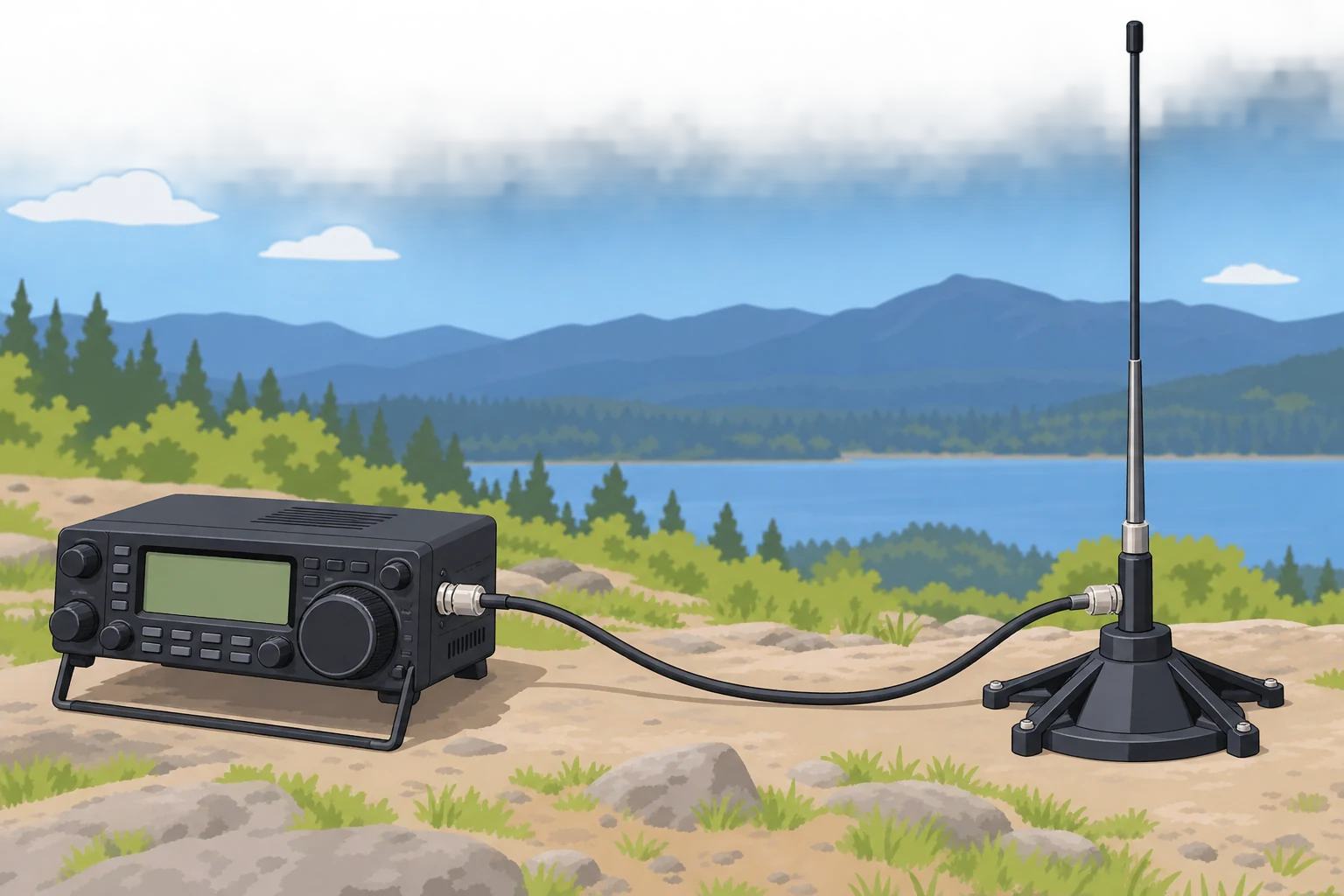
Power deserves a check before you call, because receiving alone does not show that the system can support transmission. ARRL advises checking the radio’s specified maximum input current and required voltage. A power supply and its connecting cables must deliver the required current at the proper voltage; for a supply, examine its continuous-current rating, not just an intermittent rating. Follow the radio manual’s guidance on cable length and wire size so adequate voltage reaches the radio under full load.
A battery is an option, not a guarantee that any portable battery will suit any transceiver. ARRL notes that QRP transceivers can be powered from batteries, but you still need to check your radio’s requirements and the proposed power system against them. Nor does POTA require you to operate QRP—low power—merely because you brought out portable gear. Choose equipment and settings that meet your license, manual, and safe operating conditions rather than treating “portable” as a technical specification or a special POTA status.
Keep the installation within work you can assess safely. Place the antenna and route the feed line so people will not encounter an avoidable electrical or physical hazard; follow applicable antenna and RF-exposure requirements. Do not improvise around overhead wires, uncertain grounding, damaged cables, or an installation you cannot evaluate. Stop and seek help from a qualified operator or professional when electrical work, antenna placement, or RF exposure is beyond your competence.
Before transmitting, inspect the connections, confirm the intended band and mode on the radio, and listen on a permitted direct path. Receiving a station is a useful setup check: it tells you something is coming through the receiver. It does not establish that you are licensed to transmit there, that the power system is adequate at full load, or that the activator will hear your signal. If an equipment, authorization, or safety check fails, correct it before calling. If those checks pass but no activator is audible, keep listening or try another suitable candidate rather than transmitting into an uncertain situation.
Find a Spot, Then Confirm the Station on Air
Open POTA’s official active-park spotting site, pota.app, as a place to find a lead. The POTA hunter guide describes spots showing a callsign, frequency, park information, and comments; POTA’s spotting information also identifies operating modes. Note those details so you know where to listen and what station you are trying to identify. These interface details follow the POTA hunter guide as last modified October 4, 2026; a displayed listing is still not an on-air verification.
Start with a candidate whose band and mode your station supports and your license permits. Then consider whether the proposed path is plausible from your location now. There is no universally reliable band to prescribe for a home hunt. For HF, the International Telecommunication Union lists both stations’ locations, the month, time of day, frequency, and both antennas among inputs to circuit prediction. As a practical inference, a spot for a particular park may be worth trying at one time and inaudible at another; the spot cannot promise a completed contact.
Treat schedules and active spots differently, but trust neither as proof that the operator is waiting for you. POTA describes registered activation schedules as tentative and says stations appear on its active list for 30 minutes. In the meantime, an activator might change frequency, stop operating, or hand the microphone to someone else. POTA specifically warns that the callsign given on air may differ from the one in a spot when operators share a microphone.
Now tune to the listed frequency and listen before deciding to call. Give yourself time to hear more than a fragment: an activator’s identification, an exchange with another hunter, or a fresh invitation for calls can establish what is happening. Compare the callsign you actually hear with the listing, and listen for park information when the activator gives it. POTA’s hunter guidance cautions operators to be sure of the station’s callsign rather than trusting a listing alone.
If you hear only other hunters calling, you have not confirmed the activator. If the on-air call is unclear, continue listening through another identification. If the listed frequency is quiet or the station is inaudible, the spot may no longer describe an opportunity you can use; choose another candidate or return later. A different callsign on the microphone calls for confirmation, not an automatic assumption that either the spot or the operator is wrong. The contact section below shows how to proceed once you can hear the station clearly.
This receive-first pause has two benefits. It prevents you from calling over a contact already in progress, and it gives you the details to use in your own record. The spotting site helps you find a frequency; the activator’s transmission tells you who is actually operating there.
Make a Brief, Courteous Hunter Contact
Listen through the current exchange. When the activator ends it and invites another call, send your full callsign briefly, then release the microphone and listen for a reply. POTA’s hunter guide asks operators to listen carefully, wait until the previous contact ends, and use their full callsign. In a pileup—a cluster of hunters calling at once—an unanswered call is not a cue to transmit continuously. Wait for the activator’s next opening, listen for whom they answer, and try again briefly only when appropriate.
Here is the shape of a voice contact, paraphrased from the example in POTA’s hunter guide. It is an illustration of the order, not a live contact or a required script:
- The activator identifies, mentions the park, and invites calls.
- The hunter gives their full callsign.
- The activator returns that callsign, sometimes seeking confirmation.
- The hunter confirms and gives a signal report, optionally adding their location.
- The activator acknowledges that information and gives a report back.
- The hunter acknowledges the reply; both operators close courteously.
POTA has no formal required exchange. It says activators typically appreciate a callsign, signal report, and state for their log. Use the information you can actually copy and report honestly; do not manufacture a report to match an example. The POTA guide’s voice example includes two-way reports and a courteous “73” closing, but its particular callsigns, reports, and park are examples, not a live station to call or a standard everyone must repeat.
Pay special attention when the activator returns your callsign. If it is incomplete or wrong, give your full call again so the operator has a chance to correct it. If you did not copy their call or park, ask briefly for the missing detail at a suitable opening rather than filling it in from the spot. Once you have exchanged and acknowledged the essential information, close and leave the frequency to the activator and the next hunter. Hearing an invitation and transmitting your call alone is not the same as completing a two-way contact.
If the person now on the microphone identifies with a different callsign from the listing, follow the on-air identification. Listen for a clear repeat or request clarification before proceeding; use the callsign of the operator with whom you actually exchange information in your personal record. Shared-microphone operation is one reason POTA says the on-air call and listed call can differ. If you cannot establish whom you are working, do not guess your way through the record—wait for another identification or choose another station.
You may also help other hunters after your contact by posting an accurate spot or updating one. POTA says a re-spot can be useful after you make contact or when you can reliably hear the activator even though you did not contact them. That second case is still reception, not a QSO. If you hear only other hunters and not the activator, POTA says a spot would not be very useful: you cannot verify the station for the people who follow it. Report only details you established, particularly the on-air callsign and frequency.
There is no need to win a pileup to have a successful first session. If you cannot copy the activator well enough to verify a reply, stop calling and look for a clearer opportunity. A patient, confirmed contact is more useful than a hopeful entry based on a spot and a burst of calls.
Keep Your Record and Check for POTA Credit
As soon as the contact is over, make a personal station record. Record the callsign you confirmed on air, the park reference you copied, date and time, band, mode, and the reports exchanged, as applicable. Use a consistent time reference; UTC is particularly useful when comparing contacts against POTA’s same-day repeat rule. If a detail remains uncertain, mark it uncertain rather than silently replacing it with the spot’s information. This record helps you recall what happened and check for mistakes later.
Your station record is not a POTA submission. POTA tells hunters to keep a log for their station but not to submit hunter logs to the program. Its credit system relies on logs submitted by activators. Thus a contact you completed and recorded may be absent from your POTA dashboard and hunter log for a while; visibility varies with when and how the activator submits their log. Do not create an activator log or try to upload your hunter record to repair missing credit.
If you work the same activator again on the current UTC day, decide whether it qualifies as a repeat before treating it as another POTA QSO. POTA says a repeat must differ from any earlier QSO that UTC day in at least one of these: band, mode, park reference, or park state/province/prefecture. For example, another contact that changes only the time but none of those four details does not meet that repeat condition. A contact on a different band does meet the stated difference test, provided it is a real completed QSO. Record what actually happened; do not manufacture extra contacts to improve a count.
When checking credit, separate two situations:
- No QSO appears in your POTA dashboard or hunter log. Check your personal record for the on-air call and contact details, then allow for the activator’s submission. POTA notes that activators may be traveling for days or have other obligations. If you still do not see the QSO after a month, its hunter guide directs you to email [email protected]. That is follow-up guidance, not a promised date by which every log will appear.
- The QSO appears, but statistics or an achievement have not caught up. The contact is visible, so this is a different issue from an absent QSO. POTA advises that statistics can take up to 48 hours after QSO visibility to update. Some achievements receive manual processing and take time; the guide advises checking back later rather than taking immediate action. It does not promise a date for every achievement.
A home hunt is complete through a sequence of small, checkable decisions: verify your license and station before transmitting, use a spot to find a candidate, identify the activator by listening, make and acknowledge a courteous direct contact, and preserve an accurate record. Then let the activator’s log drive POTA credit, distinguishing a contact that has not appeared from statistics that are still catching up.