Skip distance is the distance from a transmitter to the first usable return of a particular skywave path. DX means a long-distance contact in this discussion. A distant station may be reachable while a nearer one is not, because the signal can return beyond the nearer station—or reach each station by a different path. Neither a band name nor a time on the clock guarantees either contact. Ground-wave reach, the angle at which a signal travels toward the ionosphere, and conditions along the route all matter.
The useful question is therefore not “How far does this band skip?” It is “What path might connect these two places at this time, and is the received signal likely to be usable?” That distinction explains both the apparent gap before a skywave returns and why choosing a band for DX differs from choosing one for a nearby contact.
Ground Wave, Skywave, and the Meaning of DX
A radio signal need not take the same route to every receiver. Ground-wave propagation offers relatively short-range communication on amateur bands; the ARRL Radio Lab Handbook describes it as usually reaching 50 miles or less. That is a characterization of this path type, not a promised boundary around a station.
A skywave takes an ionospheric path. NOAA explains that HF signals can support long-distance communication through refraction via the ionosphere’s upper layers. In plain language, a signal travels upward and its path bends so that it can come back toward Earth. “Reflection” is also common shorthand for a return, but the ionosphere need not be imagined as a solid ceiling. Nor does the explanation require radio waves to carry an electric charge.
In this article, DX describes the long-distance contact that such a path may make possible. “DX” says something about the contact’s reach, not how many times its signal returned to Earth. One distant contact might use a single ionospheric hop; another might depend on several. The ARRL notes that several hops can permit worldwide communication when conditions are right.
Consider a hypothetical operator listening for two stations: one in a nearby town and another much farther away. The farther signal might return from the ionosphere where the distant receiver can hear it, while the nearer receiver lies beyond useful ground-wave reach but before that skywave’s first useful return. Hearing the far station would not establish that every intervening station is reachable. The International Telecommunication Union (ITU) specifically describes the possibility of a zone beyond ground-wave range that skywaves do not reach by that path.
This is why “nearby” and “easy to reach” are not interchangeable in HF operating. Before interpreting a missing contact, separate the question of where a signal goes from the question of whether a signal reaching the receiver is strong enough to use. Both questions will matter when comparing bands.
The First Return, the Skip Gap, and Multiple Hops
Picture one hypothetical outward path, labeled in order:
> Transmitter → end of useful ground-wave reach → possible skip gap → first usable skywave return → more distant receiving station
The first-hop skip distance runs from the transmitter to that first usable skywave return. The labels show an ordering, not a scale: they assign no mileage to the ground wave, the gap, or the hop. If the first return moves, the distance changes even though the operator has not changed the destination. It is a description of a path under particular conditions, not a permanent specification of 20 meters, 40 meters, or any other band.
The possible skip gap, often called a skip zone, is the region after useful ground-wave coverage ends but before a useful skywave return begins. The ITU describes one way this can occur close to the transmitter: skywaves aimed at that nearer ground range can exceed the maximum usable frequency for that range and pass through the ionosphere instead of returning there. The maximum usable frequency, or MUF, is a limit for a specified range; its fuller meaning comes in the next section. The important point for the sketch is that a signal capable of reaching farther away need not return at every shorter distance.
A skip zone is not an absolute radio blackout. The ITU reports measurements in which side scatter allowed signals to penetrate an apparent skip zone. Thus the sketch predicts a possible weakness in the straightforward ground-wave and direct-skywave paths; it does not prove that no signal can ever be heard inside the gap. If an intervening station is audible, that observation is useful, but it does not erase the distinction between the main first return and other ways a signal might arrive.
A one-hop contact reaches its receiver after one return from an ionospheric path. For a more distant contact, the signal may travel onward after a return and make additional hops. That is the multi-hop possibility behind some DX: the total reach can be much greater than the reach of the first hop. The ARRL qualifies worldwide communication by several hops with “if conditions are right,” so neither an additional hop nor a fixed distance for each hop should be assumed.
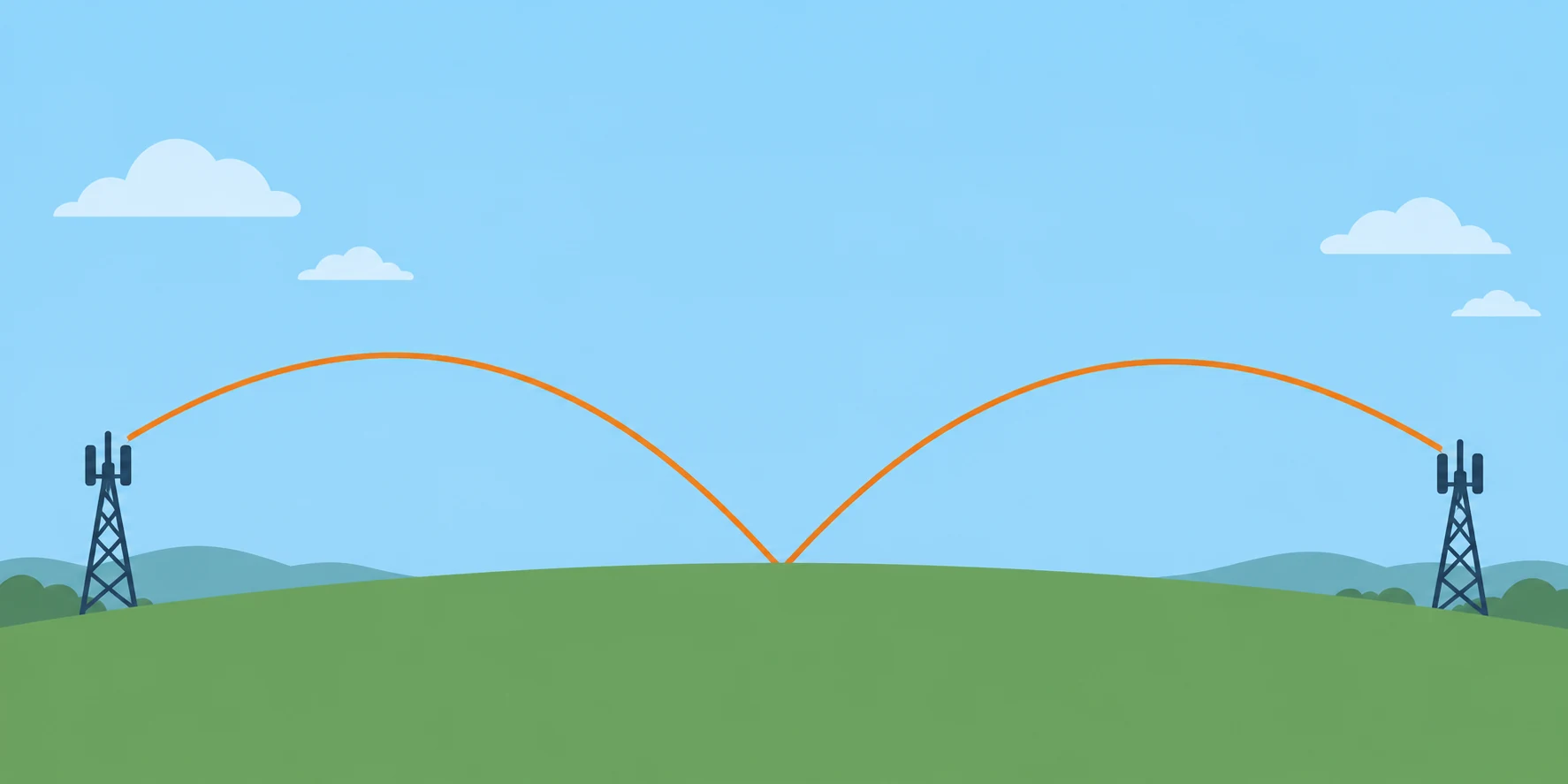
For the operator in the earlier example, this distinction prevents two opposite mistakes. A distant station does not prove that the entire stretch between the stations is covered. Equally, failure to hear a nearby station does not by itself prove that the band cannot support a distant contact. The first-return sketch offers a way to ask what kind of path would be needed; listening to actual stations remains necessary to learn what is usable.
Why the Usable Path Changes
Two frequency limits help explain why a skywave may work for one route but not another. NOAA defines the maximum usable frequency (MUF) as the highest frequency that permits reliable HF communication by ionospheric refraction over a given ground range. It defines the lowest usable frequency (LUF) as the lowest frequency permitting reliable long-range HF communication by the same means. These are not labels permanently attached to named amateur bands. They describe the usable frequency window for the communication being considered.
At a frequency above the relevant MUF, a signal may pass through the ionosphere instead of returning over the desired range—the mechanism in the ITU’s near-transmitter skip-zone account. Moving downward in frequency is therefore worth considering, but “lower” is not automatically “better.” At the lower end, the received signal still has to meet the needs of that particular circuit. The ITU notes a tradeoff: signal quality generally improves toward the MUF, while operating near the lower end of a circuit’s available range can serve a different aim, making the signal decay rapidly beyond the receiver. It says the necessary reception margins must be defined to optimize the signal.
Think of the limits as answers to a practical question rather than sharp markings painted onto a band dial: For this ground range and an adequately received signal, which frequencies are plausible? A frequency that returns toward one receiving area may fail to return toward another. Likewise, receiving a trace of a signal and sustaining reliable communication are not the same requirement. That is why an isolated contact cannot establish a band-wide MUF or LUF.
Elevation angle changes the geometry too. The ARRL’s amateur examination material gives the all-else-equal relationship: lowering the transmitted elevation angle increases the distance covered by each ionospheric HF hop. Imagine a steep path rising toward the ionosphere and a shallower one departing closer to the horizon. The shallower path can land farther away per hop; the steeper path can serve a shorter return. This is a conceptual comparison, not a promise that either signal will land at a chosen receiver: frequency and ionospheric conditions still have to support the path.
Those conditions do not stand still. The ITU says ionospheric density and structure vary with time of day, season, solar cycle, and location. It also identifies frequency, angle of arrival, receiving antenna, bandwidth, service threshold, geography, and solar activity among factors affecting HF channel behavior. Consequently, even for the same two stations, a previously useful frequency and return distance should not be treated as permanent. A change in one factor can alter the comparison between two candidate bands without establishing a new rule for either band everywhere.
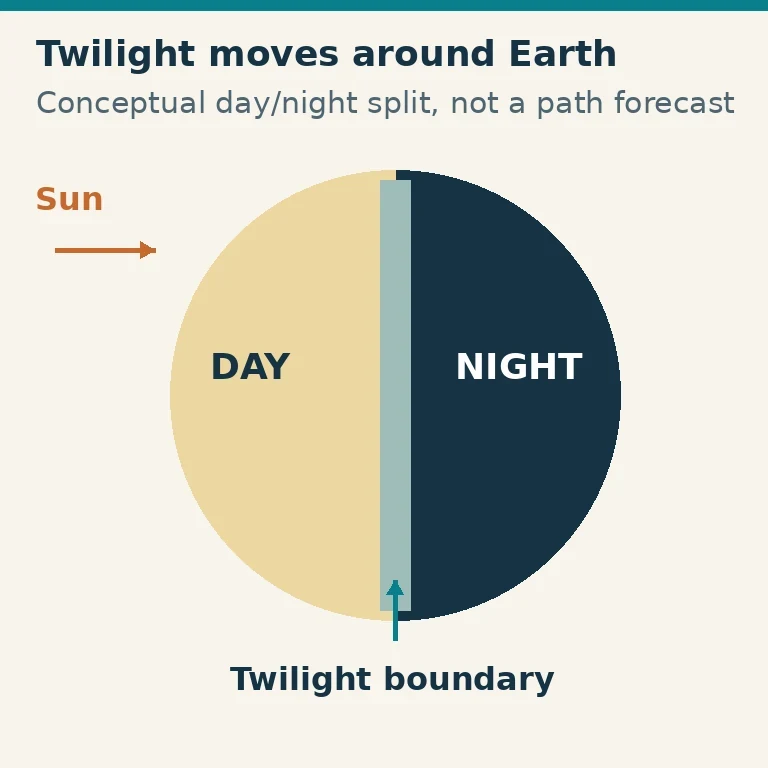
Absorption adds another reason to distinguish returning from being usable. NOAA says solar x-ray flares can significantly increase radio-wave absorption in the D region. NOAA also describes flare-related increases in lower-layer ionization on Earth’s sunlit side. These are specific space-weather effects worth bearing in mind if conditions change; they do not mean that an ordinary fade diagnoses a flare, and they are not a claim about current conditions.
Together, ground range, angle, frequency, changing ionospheric structure, absorption, and the required reception quality explain why no honest distance-by-band chart can assign a universal skip distance. A band is a set of frequencies to consider; the usable path is a question about a route at a time.
Reading the Amateur Bands as Starting Points
The ARRL’s grouping of amateur operating bands includes 160, 80, 40, 30, 20, 17, 15, 12, and 10 meters. It groups 160 meters with amateur HF operating bands; doing so here is not a claim that 160 meters lies inside the formal 3–30 MHz HF definition. The meter names provide a convenient way to compare longer- and shorter-wavelength operating choices, not a table of guaranteed ranges.
At the long-wavelength end, 160 and 80 meters are reasonable bands to consider when the operating aim is local or regional contact, especially when comparing them with shorter-wavelength daytime-DX candidates. The ARRL’s broad guidance groups 160 through 30 meters as generally used for local and regional contacts during the day and capable of DX at night. That statement applies to the group as a general pattern, not as an individual opening schedule for 160 or 80 meters. Nighttime DX remains a possibility to check, not an assured result.
40 and 30 meters sit within that same broad 160–30-meter comparison. For a regional contact, they give the operator further candidates to evaluate rather than a distance threshold at which one band must replace another. For a longer desired route, the ARRL’s general night-DX guidance makes them worth considering then as well. The deciding question is still whether a usable signal follows the intended path, not whether the route crosses an invented boundary on a mileage chart.
20 meters is a useful middle comparison point: it belongs to the ARRL’s shorter-wavelength 20–10-meter group, which the ARRL describes as providing long-distance contacts through the day but sometimes closing at night when signals cease returning to Earth by the described ionospheric path. 17, 15, 12, and 10 meters are shorter-wavelength candidates in that same broad comparison. They deserve a check for daytime DX without an assumption that any one of them is open to the intended destination, or that a nighttime contact is impossible. The ARRL’s wording is a general contrast, not a clock-setting instruction.
Historical operating impressions can make that comparison more vivid, but they cannot turn it into a timetable. In a 1984 QRP article, Bradley Wells described 20 meters as relatively consistent in his context and described 40 and 80 meters as less consistent, with seasonal effects and higher QRN and QRM. Those are impressions from that article’s operating context, not a prediction for every station today. A present-day operator should not transfer them unchanged to every location, season, or desired path.
The frequency-window model is the safeguard against overreading all these descriptions. A shorter-wavelength band might be a productive candidate for one destination while lying above the MUF for a different range; a lower candidate might return along a path yet fail to meet the needed reception margin. Time and geography can change the comparison again. Use the band patterns to decide where to look first, then judge the path actually wanted.
When the Usual Long-hop Picture Does Not Fit
Not every ionospheric return is a long hop. The ARRL’s General-class study material defines near-vertical-incidence skywave (NVIS) as short-distance HF propagation using high elevation angles. That contrasts with the all-else-equal lower-angle comparison in which each hop covers more distance. It gives a reason to consider a short-range skywave path without claiming that every local contact uses NVIS.
Suppose an operator hears a relatively nearby station by skywave while another nearby station is difficult to hear. A plausible interpretation is that the heard signal followed a higher-angle, shorter-return path, while the path under consideration for the other station differed in angle, frequency, or route. The observation does not disprove the possibility of a skip gap for that other path. Conversely, hearing a distant low-angle return does not show that high-angle short-distance coverage is available. These are alternative conceptual paths, not a way to identify a mechanism from distance alone.
An unusual higher-frequency opening also need not be an ordinary extension of the HF hop picture. The ITU lists a separate method for predicting point-to-point sporadic-E field strength from 30 to 100 MHz, distinct from its HF-circuit prediction category. If an operator describes a six-meter contact as sporadic E, treating it as evidence of a routine HF ionospheric hop would mix different propagation questions. The useful distinction here is simply to identify when the standard HF-route comparison is no longer the right model, not to turn band selection into a guide to VHF openings.
Choose and Test a Band for a Particular Route
Start the comparison with the receiving area, not the band. Is the wanted contact nearby, regional, or DX? At the intended operating time, what daylight conditions are likely along the route? Those questions make the ARRL’s broad longer-band regional and night-DX pattern, and its shorter-band daytime-DX pattern, useful as starting points. They do not settle whether an actual signal will return or arrive strongly enough.
A route-specific HF prediction can refine the choice if one is available. The ITU’s listed inputs include transmitter and receiver latitudes and longitudes, sunspot number, month, time of day, candidate frequencies, transmit power, and both stations’ antenna types. Those inputs describe a specified circuit. A result calculated for that circuit cannot sensibly be read as “this band is open everywhere,” nor can a result for one time be silently carried over to another.
Consider a hypothetical operator who wants to contact a station in a distant coastal region. There are two possible operating periods: one when the route is expected to be substantially in daylight, and another later when much of the route is expected to be in darkness. For the first period, 20 meters is a plausible initial check, with a shorter-wavelength candidate such as 17 meters to compare if a route-specific prediction and signals from the desired area support it. For the later period, 40 meters is a plausible initial check under the ARRL’s broad night-DX comparison, with another lower-frequency candidate worth comparing if reception warrants it. These are example choices, not forecast outputs or claims that either path will open.
For each period, the operator could compare the candidate frequencies in a prediction using the intended endpoints, time, and station assumptions, then listen for signals relevant to the receiving area. If the higher candidate is supported for that route and signals from the area are being heard, it is reasonable to try it. If it appears closed or reception is poor, comparing a lower candidate is more useful than declaring the whole route impossible. A neighboring band supplies another observation about current conditions; it does not prove that the first band never works. The advice in Wells’s historical QRP discussion to favor the highest frequency open to the desired area is useful in that conditional sense—open to that area is the essential qualification.
Now change the goal: suppose the operator wants a shorter-range contact rather than the distant coastal station. A band choice aimed at a long, low-angle hop may be the wrong comparison. The operator should reconsider whether a higher-angle short-distance skywave path is plausible, as in the ARRL’s NVIS definition, and assess a candidate for that receiving area. This does not promise nearby coverage; it changes the question from “Which band reaches farthest?” to “Which path could serve this range?”
Finally, keep a prediction in its proper role. The ITU says propagation models represent average behavior and have statistical limits. Listening and comparing candidate bands provide present observations against that prior estimate. If conditions seem to change, recheck rather than treating an earlier result as live certainty. Solar x-ray flares can increase D-region absorption, particularly relevant to the sunlit-side effects NOAA describes, but a fade alone does not establish that a flare occurred.
The governing rule is to choose for the specific route, time, and station conditions, then verify what can be heard and worked. Skip distance explains why the first return may leave a gap; multi-hop propagation explains how DX can extend farther; MUF, LUF, and reception requirements explain why a promising band remains conditional. A band label or a prediction can guide the next check, but neither guarantees the contact.