Upgrading to General Class in the United States means earning credit for Element 3, the General examination, in addition to Element 2. You’ll study from the question pool valid on your test date, attend a volunteer-examiner session, and need at least 26 correct answers out of 35. What happens after a pass depends on whether you already hold an FCC operator license grant. A licensed Technician may qualify for temporary General privileges while an upgrade application is pending; someone awaiting a first grant may not use that provision. In either case, check your actual authority before transmitting.
Know What the General Upgrade Changes—and What It Does Not
Under FCC Part 97, a Technician Class operator needs examination credit for Element 2. General Class requires credit for both Elements 2 and 3. The FCC allows an applicant to pass an element or otherwise receive examination credit for it; the point is to establish the required credit, not necessarily to sit both exams again.
There are two starting positions worth separating now:
- You are already named on an FCC Technician license grant. You have an existing operator class and call sign. Passing Element 3 is the examination step toward changing that grant to General. While the change is pending, a specific FCC rule may allow temporary higher-class operation—but only if all its conditions are met.
- You recently passed Element 2 but have no FCC operator grant yet. ARRL describes a recently passed Technician exam as a route toward the General exam. If you establish the required Element 2 and Element 3 credit, you can pursue a General application. But a certificate showing examination credit is not the same thing as already being named in a license grant. The pending-upgrade authority in § 97.9(b) begins with an existing grantee.
That distinction affects more than paperwork. It determines whether passing Element 3 can change what you may do before the FCC acts. Keep track of which position you are in throughout registration and after the exam; do not assume that “I passed General” answers the operating-authority question by itself.
The payoff is meaningful but bounded. ARRL describes General as including all VHF/UHF amateur bands and most HF privileges, across bands from 10 through 160 meters—not every HF privilege. A new class therefore does not authorize every frequency or emission you might find mentioned in a radio manual or hear on the air. Before transmitting, match the proposed frequency and emission to the permissions that apply to your actual class or qualifying temporary authority.
It helps to treat the upgrade as three separate achievements. First, you earn examination credit. Second, you have authority to operate—through an existing grant, a qualifying pending upgrade, or a new grant once issued. Third, you have a station capable of the particular activity you want to try. The exam settles the first question, not automatically the other two. This guide follows that order so you can plan an HF activity without mistaking a passing result for blanket permission to transmit.
Study from the Pool That Will Be Valid on Your Test Date
Start with the published General Class question pool and check its validity dates against your actual exam date. ARRL lists a General pool valid from July 1, 2023, through June 30, 2027, and notes that it contains one schematic diagram. The pool files are available to download or print. If your session falls outside that window—or you change your test date—check the then-valid pool rather than continuing to rely on an old copy or an undated practice site.
A question pool gives you identifiable material to prepare from, but it is more useful when you can explain why an answer works. Element 3 concerns General Class operator privileges, according to the FCC’s examination description. That makes it especially important not to turn a remembered practice answer into an unchecked on-air decision later. An exam answer and a proposed transmission are different situations: for the latter, you still need to verify the permissions that apply at the time.
A suggested study cycle—not an FCC-required schedule—looks like this:
- Attempt a set of questions from the pool valid for your date. Record which answers you missed and which ones you got right only by guessing.
- For each missed or uncertain answer, use a study manual or another suitable reference to work out the underlying idea. Write a short explanation in your own words rather than saving only the answer letter.
- Revisit the concepts that remain weak, then try questions on those concepts again without looking at your earlier answers.
- Take another 35-question practice test. Compare your result with the real Element 3 threshold of 26 correct, while remembering that a practice result cannot promise the same result at a session.
- If an explanation still does not make sense, ask an experienced operator or mentor about that concept. Have them walk through the reasoning rather than simply tell you which choice to memorize.
For example, suppose you miss a question that uses the pool’s schematic diagram. Instead of rehearsing a letter, locate the relevant part of the drawing, explain what you think the question is asking about it, and check that interpretation against a reference. Then retry the question without your notes. If you cannot yet explain the diagram, you have found a useful study task—not evidence that you need to guess faster. The example is a way to study the published schematic, not a claim about what your particular exam will ask.
Use practice scores diagnostically. A score below 26 out of 35 identifies work to do before the real exam; a score at or above 26 shows that you met the threshold on that practice test. Try to notice whether mistakes cluster around an idea you cannot explain or are scattered across material you thought you knew. That tells you whether to review a concept in depth or slow down and read questions more carefully. Neither pattern supplies a guaranteed outcome on exam day.
There is no need to invent a required number of study days or a quota of questions from each subject to make the plan useful. Your concrete targets are simpler: use the pool valid on test day, be able to reason through uncertain answers, and know the FCC’s passing threshold. Once you choose a session, check the pool’s date range once more; a rescheduled exam can change which version you should prepare for.
Choose a Session and Prepare the Records It Requires
ARRL directs candidates toward either an in-person exam location or an online exam. Choose a session you can actually attend, then contact its administrator before treating a published listing as your complete instructions. Confirm availability, date and time; how to register; what documents to show; the fee and accepted payment method; and how you will receive instructions or results. ARRL says Volunteer Exam Coordinator (VEC) organizations can have different candidate policies. An online team may also have its own identification, testing-space, camera, device, or connection procedures, so obtain that team’s instructions rather than applying an in-person checklist unchanged.

Settle your FCC Registration Number (FRN) before exam day. ARRL instructs exam candidates to register in FCC CORES and receive an FRN beforehand. If you already hold a Technician grant, locate your existing FRN and have it available for the session. If you recently passed Element 2 but do not yet have a grant, make sure you have an FRN for the application and follow the administrator’s directions for supplying it. Bring or be prepared to show a legal photo ID under the session’s identification procedure.
Next, assemble evidence for your examination-credit path:
- Existing Technician grant: Be ready to show proof of your current license. ARRL’s exam-day guidance says a printed license or proof in the official FCC database can serve this purpose; it also identifies possible license printouts. Ask your administrator what format and copies the team wants, especially if you will test remotely.
- Recent Element 2 pass without an issued grant: Keep the Certificate of Successful Completion of Examination (CSCE) from that session available to document the earlier examination result. ARRL’s list asks for originals and photocopies of previous CSCEs when applicable. It also says that, once the FCC has issued a license, the CSCE showing license credit is no longer needed for that purpose. Find out what your team wants you to present rather than assuming a previous pass has already appeared as a grant.
The application is part of the exam-team process, not a separate instruction to mail your paper exam results to the FCC. ARRL describes NCVEC 605 as the form used at an exam session to apply for a new or upgraded license. Its forms guidance addresses sending NCVEC and ARRL forms to ARRL, not mailing them to the FCC as a candidate. Follow the administering team’s instructions for completing the appropriate application and checking its information.
Ask about permitted tools while you confirm documents. For in-person sessions, ARRL’s preparation list specifies two number-two pencils with erasers and a pen. It allows a calculator only with memory erased and formulas cleared; it disallows bringing written notes or calculations and using a phone’s calculator function. Those are ARRL exam-day directions, not a promise that every remote administrator uses identical equipment procedures. If you intend to use a calculator—or a device is part of an online exam—get the actual team’s approval and setup instructions in advance.
A useful final check the day before your session is to put the administrator’s instructions beside your own records. Is the FRN ready? Does your identification match the application information you intend to give? Can you show an existing grant, or the earlier CSCE if that is your credit path? Do you know how to pay in a way this team accepts? If any answer is uncertain, contact the administrator while there is still time to resolve it. This check does not add a new FCC requirement; it helps keep a preventable record or logistics problem from interrupting your exam.
Take Element 3 and Understand the Two Kinds of Charges
FCC Element 3 has 35 questions, and the minimum passing score is 26 correct. On a 35-question practice test, 26 is therefore a useful threshold for interpreting that particular attempt. It does not mean that repeatedly scoring 26 will guarantee a pass at a different sitting, and it is not a reason to stop investigating answers you cannot explain. At the session, follow the team’s directions for completing the examination and receiving your result.
Volunteer examiners conduct sessions under a VEC. That organization sets the exam-session fee; ARRL says it is usually $15 or less and specifically advises candidates to check the fee with the session administrator. “Usually” is not a quoted price for the session you chose. Confirm its amount, when payment is due, and the approved payment method before you arrive or log in.
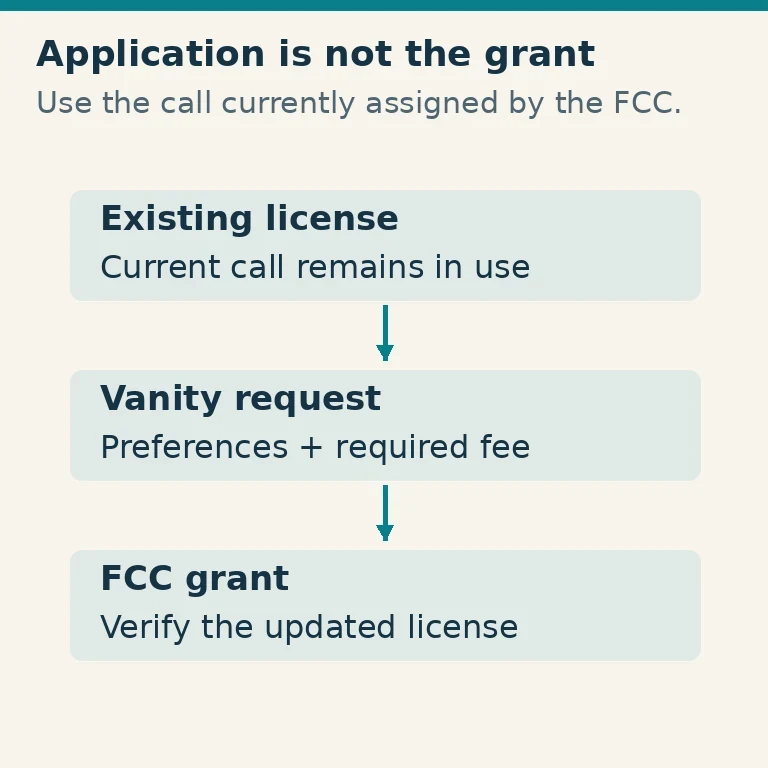
Keep that VEC charge separate from the FCC application fee. For a licensed Technician filing a modification solely to upgrade operator class, ARRL says the modification is exempt from FCC application fees. That does not waive a VEC’s exam-session charge. Conversely, ARRL’s fee guidance lists a $35 FCC application fee for a new-license application and for a modification that requests a new vanity call sign. Those are different application categories; a recent Element 2 passer who does not yet hold a grant should not assume that their first-license application becomes fee-exempt just because they also pass Element 3. Recheck current FCC fees and the category of your actual application before it is submitted or paid.
Here is the practical budget distinction:
| Your situation | Exam-session charge | FCC application-fee category described by ARRL |
|---|---|---|
| Existing Technician, class-only General upgrade | VEC sets the session fee; confirm it with the administrator | Operator-class upgrade modification is exempt |
| Applicant seeking a first license grant | VEC sets the session fee; confirm it with the administrator | New-license application is listed in the $35 category |
| Modification requesting a new vanity call sign | Confirm any session charge if you are also testing | Vanity-call modification is listed in the $35 category |
These are categories, not a price quote for every future filing. In particular, earning General does not itself require you to request a new vanity call sign.
If you take and pass more than one examination element at one session, ARRL/VEC says its usual procedure is to transmit one FCC application reflecting the highest class earned. That explains how the result can be represented in the application; it does not turn a first-license application into a fee-exempt, class-only modification. Ask the team how it will record your elements and application, and keep your own copy of the passing record you receive.
Use Your Passing Record Correctly While the FCC Processes the Application
Consider a licensed Technician who passes Element 3. Before leaving the session—or, for an online session, before treating the follow-up as complete—check the CSCE for your name, the examination element, and the date. Complete the proper application with the administering volunteer examiners, following their instructions, and retain the certificate. ARRL describes NCVEC 605 as an exam-session form for upgrade as well as new-license applications; the team and VEC handle the submission route. Passing is not a promise that the FCC database will update immediately, so plan to check the official grant later.
For that already licensed Technician, FCC § 97.9(b) provides a conditional window for higher-class privileges. All of these conditions matter:
- The person is already named in an operator license grant of one of the classes covered by the rule.
- The person has properly submitted to the administering VEs an FCC Form 605 document requesting examination for a higher-class grant.
- The person holds a CSCE showing completion of the necessary examinations within the previous 365 days.
When those conditions are met, the rule authorizes the higher-class rights until final disposition of the application or 365 days after passing the examination, whichever happens first. The certificate is part of the conditions; it is not, on its own, a substitute for an existing grant or the properly submitted application. Nor is the 365-day limit a predicted FCC processing time. Once the application reaches final disposition, assess authority from the resulting grant rather than assuming the temporary window keeps running.
Temporary operation also changes how that Technician identifies while exercising the higher privileges. FCC § 97.119(f) requires an indicator after the call sign when a control operator is exercising § 97.9(b) rights; for a requested modification from Technician to General, the indicator is AG. For example, if the existing call sign were the hypothetical K1ABC, an identification while exercising qualifying temporary General privileges would be K1ABC/AG. The suffix signals that temporary authority; it is not a newly issued call sign and is not an instruction to append /AG regardless of whether those temporary rights are being exercised.
From exam result to General operating authority
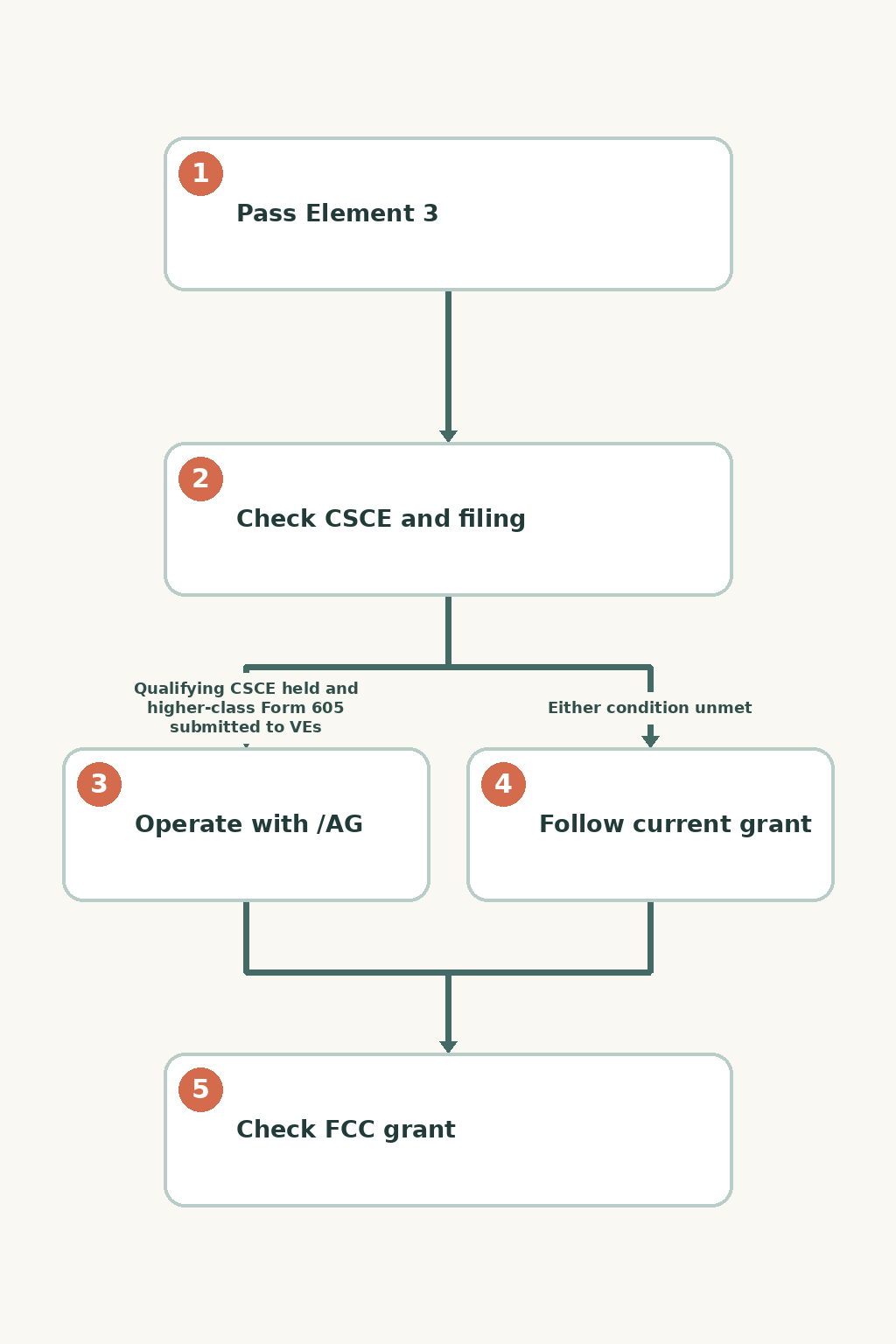
Now consider the person who passed Element 2 recently but has no FCC operator grant. Even if that person passes Element 3 and holds certificates documenting both results, they do not meet § 97.9(b)’s requirement to be already named in an operator license grant. They must await their first grant before acting as their own authorized control operator under the privileges it grants. This is not a blanket claim that they cannot speak or participate at someone else’s station: participation with another authorized control operator is a separate situation. The important limit here is that a first-time applicant cannot use a CSCE as their own pending-upgrade operating authority.
For both paths, finish by checking the official FCC license grant, not by guessing from the date of the exam. A licensed Technician should verify that the updated operator class matches the upgrade application; a first-time applicant should confirm that a grant has actually been issued and what class it shows. FCC § 97.9(a) ties a named grantee’s control-operator authority to the class specified on the grant, subject to the distinct conditional pending-upgrade rule just described. If the record does not match what you expected, contact the exam administrator or VEC with your application details and retained CSCE rather than assuming the discrepancy fixes itself or inventing a processing deadline.
Plan a First HF Activity Within the Privileges You Actually Have
Once you have a General grant—or, if you are an existing licensee, qualify under the pending-upgrade rule—choose one modest HF goal. For example, pick a band and mode you would like to try at your own station. That is a suggested planning exercise, not a claim that every frequency on the band or every emission is available to you. ARRL’s description says General brings most HF privileges. Before you transmit, check the current FCC band and emission permissions against the class or qualifying temporary authority you actually have, and select an operating choice that fits.
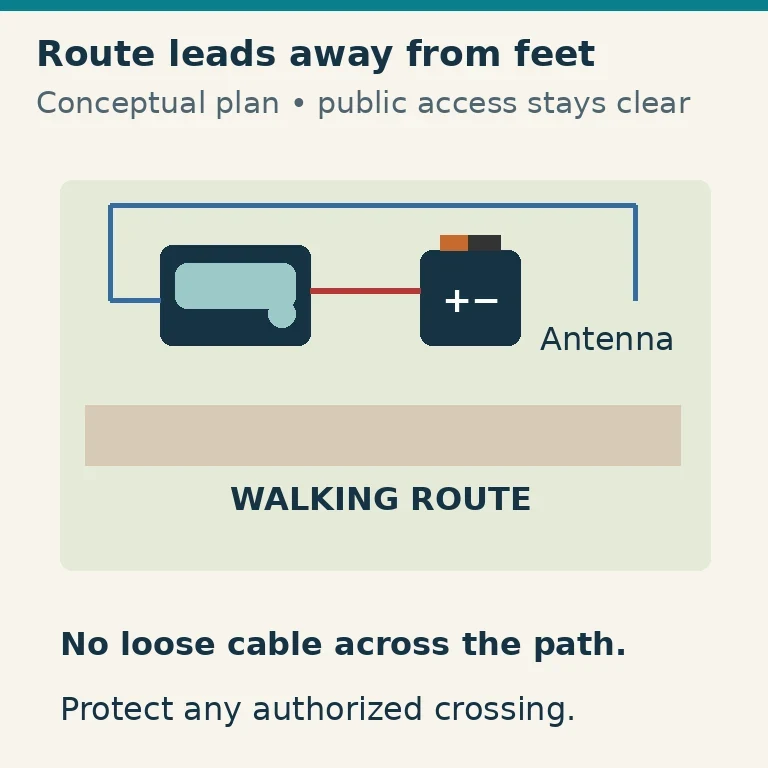
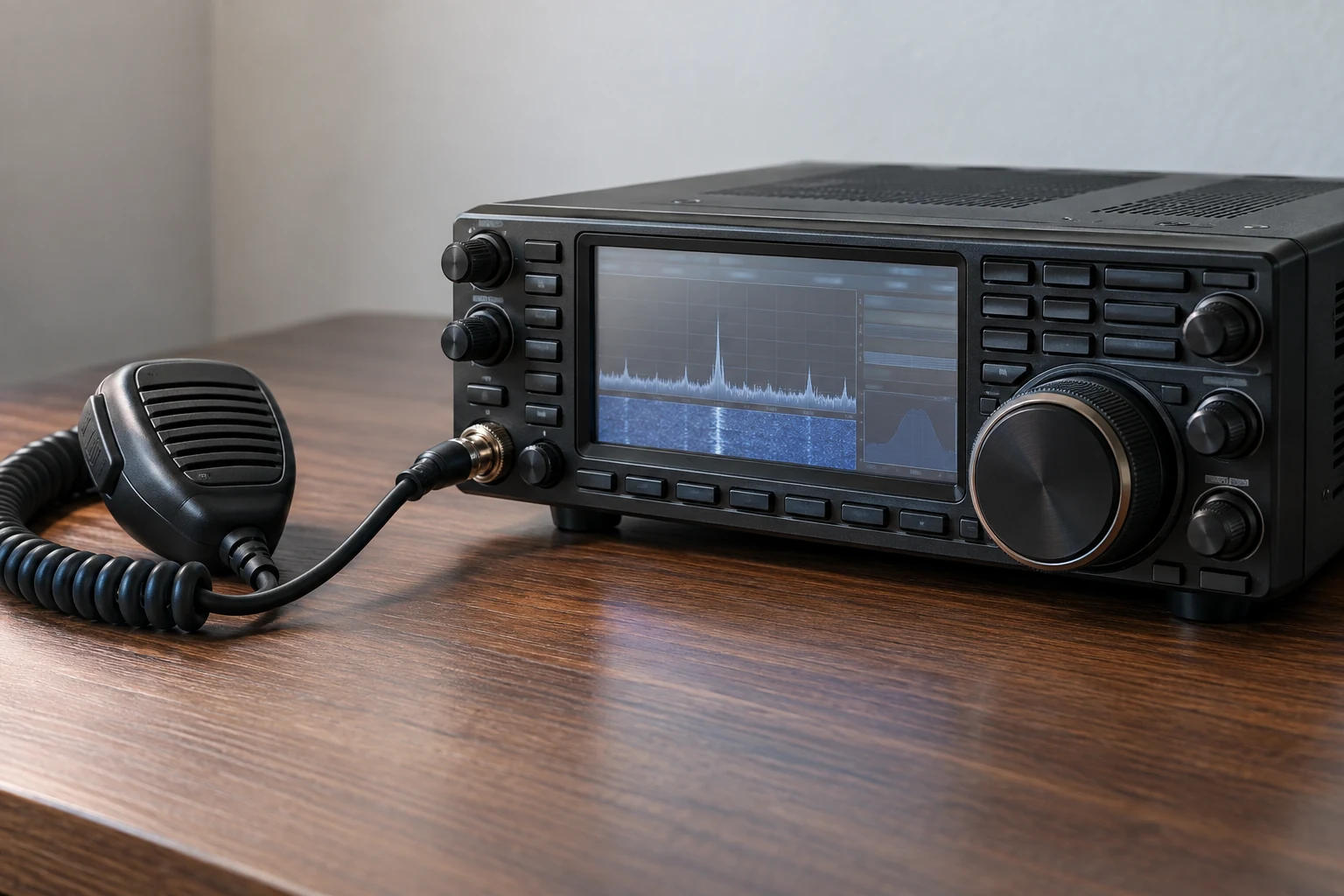
Then test the plan against your equipment rather than against the license alone. Does your actual radio support the chosen band and mode? What does its manual say about setting it up and using it? Is the antenna—the part of the station used to send or receive radio signals—ready for that activity, and do you understand the station’s existing connections and controls? Being allowed to transmit, having a workable setup, and making a contact are three separate questions. This guide has not tested your equipment, and a passing result cannot answer equipment-specific questions.
Keep the first attempt within a configuration you can check confidently. Verify the operating permissions and station settings before transmitting; listen first to understand what is happening on the frequency. If you are uncertain about the setup, its safe use, or whether your proposed transmission fits your privileges, stop and ask an experienced operator for help rather than improvising electrical or antenna work. A contact may take patience or a change of plan; it is not a guaranteed consequence of the upgrade.
The sequence is straightforward even though the two applicant paths differ: prepare from the pool valid on your exam date, confirm the session and records it requires, earn the passing Element 3 result, establish the correct post-pass authority, and verify an operating choice your station can support. Passing Element 3 does not automatically issue a new call sign, produce an immediate FCC update, or guarantee an HF contact. It gives you a result you can use—within the rules that apply at each stage.