For a first-time U.S. Technician candidate, the exam checklist has three parts: prepare for the actual session you will attend, bring identification and materials that its administrator accepts, and follow the application through FCC payment and a license grant. The Technician written exam is a 35-question Element 2 exam, but passing it is not, by itself, the point at which a new licensee should begin transmitting. The station must be under the physical control of someone named in an amateur station license grant in the FCC’s ULS database.
Use this guide to sort the common requirements from the exceptions. The identification and supply examples below come from ARRL’s exam guidance; other Volunteer Examiner Coordinator (VEC) organizations can have different candidate procedures. Your chosen session administrator’s current instructions are the final check for what to bring and how that session works.
Confirm the Pool, FRN and Session Before Exam Day
Match the question pool to your exam date. ARRL identifies the Technician written exam as Element 2, with 35 questions. Its listed Technician Element 2 pool is effective July 1, 2026, through June 30, 2030. Those dates matter more than a pool’s appearance in a search result or study material: if your exam falls outside that period, do not assume that pool applies. Check the pool effective on the date you will actually test. This is a logistics check, not a requirement to choose a particular way to study.
Get your FRN before exam day. The FCC Registration Number (FRN) is the applicant number to have ready for the exam process. ARRL tells candidates to register in the FCC CORES system and receive an FRN before exam day. Do not leave that task for the check-in table or the start of a remote appointment.
Have a working email address for the application. ARRL says a valid email address is mandatory on the application so the FCC can send correspondence. The FRN and email serve different purposes: having a number ready does not replace an address at which you can receive FCC messages. Check that you can access the email account you plan to provide, particularly because there may be correspondence to act on after the session.
Confirm the session rather than just finding a listing. ARRL lists both in-person and remote-video exam routes. Once you have chosen one, contact its administrator to verify the date and time, the fee, and the documents required; ARRL explicitly recommends making that contact. Ask for the selected sponsor’s current candidate instructions as well. A remote appointment and an in-person room may call for different materials, and VEC organizations may set different procedures.
Before exam day, you should therefore be able to answer four questions without guessing: Which pool covers my date? What is my FRN? Which email address am I using? What has this administrator confirmed about the appointment, fee, documents and permitted materials? If an answer depends on the session and you have only a general checklist, it remains an administrator question—not a reason to assume ARRL’s example applies everywhere.
Pack for an In-person Session Without Assuming Every VEC Uses the Same Rules
For an ARRL-style in-person kit, separate what you need to identify yourself from what you hope to use while taking the exam. Start with identification. ARRL’s primary route is one legal photo ID. If no photo ID is available, its guidance calls for two forms of nonphoto identification and gives a nonphoto state ID and a birth certificate bearing the appropriate seal as examples. Those examples do not establish that every other sponsor accepts the same combination. If you will rely on nonphoto ID, tell your selected administrator what you have and confirm that it meets that session’s requirements before you go.
Keep your previously obtained FRN accessible as information for the session, along with the working email address you intend to put on the application. ARRL requires the FRN before exam day and says the application must include a valid email address. You do not need to treat either as a substitute for the identification the administrator requires.
Set aside the confirmed exam fee in the payment form the administrator accepts. ARRL says the VEC sets the exam fee and that it is usually $15 or less; it also directs candidates to ask the administrator which fee applies to their particular session. Confirm the payment method rather than assuming it from the amount. This session fee is distinct from a later FCC application fee: ARRL says the FCC fee is paid online directly to the FCC, not to the volunteer exam team or the organization processing the application. Packing for one payment does not settle the other.
For an ARRL in-person session, the listed writing supplies are two number-two pencils with erasers and a pen. ARRL also permits a calculator with its memory erased and formulas cleared, while prohibiting candidates from bringing written notes or calculations into the exam session. That is a permission with conditions, not blanket permission for any calculating device. ARRL says a cell phone must be silenced or turned off during the exam session, and its calculator function may not be used. Follow your selected sponsor’s instructions for devices and materials rather than assuming every VEC uses ARRL’s rules.
A useful way to divide this kit is ready versus confirm. Have your identification, FRN information, application email, and any supplies called for by your confirmed in-person instructions ready. Confirm the exact fee and payment method, the acceptability of any less-common ID, and permission for a particular calculator before relying on them. ARRL says VEC organizations can differ in candidate requirements, so its in-person list is a concrete example rather than a universal packing rule. If your session is remote, use its own materials and procedure instructions instead of assuming that pencils, paper, identification display or devices work the same way online.
Adjust the Kit If You Are a Minor, Upgrading or Testing Remotely
Student or minor without photo ID: ARRL describes a narrower identification route when a legal guardian presents their photo ID. In that case, a student or minor without photo ID needs only one of ARRL’s listed nonphoto items; otherwise, ARRL calls for two nonphoto IDs. For example, the ARRL list includes a nonphoto state ID and a birth certificate with the appropriate seal. The practical distinction is the guardian’s participation: do not read the one-item alternative as a general rule for any candidate without photo ID. A family should confirm the planned identification and guardian arrangement with the selected administrator, since other VEC procedures may differ.
Candidate with an existing license or examination credit: A first-time applicant with no previous credit need not assemble an upgrade file. If it applies to you, however, ARRL asks for a printed copy of your current amateur license or the ability to show proof of that license in the official FCC database. It also asks for the originals and photocopies of any relevant Certificates of Successful Completion of Examination (CSCEs) from previous sessions. A CSCE establishing license credit is not needed if that credit is already reflected in a license the FCC has issued. This distinction helps an upgrading candidate decide which evidence is still relevant rather than assuming every old certificate must accompany every application. Confirm with the administrator which documents your particular credit claim requires.
Under-18 first-license candidate considering reimbursement: ARRL describes a specific benefit for new license candidates younger than 18 whose tests are administered under the ARRL VEC program. It says it will cover the one-time $35 FCC application fee through reimbursement after the ARRL VEC receives a completed reimbursement form and the FCC has issued the new license; the check goes to the fee payer. That is not a statement that every VEC offers reimbursement, or that the exam team pays the FCC fee for the candidate at the session. The ordinary payment instruction remains that the FCC fee goes online directly to the FCC. If this branch applies, ask the ARRL VEC about its current form and requirements while planning for the payment and later reimbursement as separate events.
Remote-video candidate: ARRL lists remote-video exams as an available route, but its in-person supply examples should not be turned into remote-proctoring rules. Obtain the chosen sponsor’s instructions for identification, materials and appointment procedures. If you need accessibility arrangements for either kind of session, contact the administrator beforehand and explain what you need; do not assume a particular arrangement is available without confirmation. ARRL specifically directs candidates to the exam administrator for required documents and session details.
After the Exam, Follow the Application Through Payment and Grant
At the session, the NCVEC 605 is the form used to apply for a new or upgraded license. ARRL says all applicants must answer its Basic Qualification Question concerning felony-conviction status. If your answer is yes, follow the applicable FCC procedures rather than trying to resolve that application question from an exam-day packing list. Check the application information you provide, especially the email address: ARRL says a valid one is required for FCC correspondence.
Keep the result and any application information the team gives you. That gives you a record of what happened at the session, but it does not turn an exam result into a license grant. The exam team or VEC processes the application form; the later fee payment is made to the FCC, and the FCC subsequently processes the application. ARRL expressly distinguishes the organization processing the form from the FCC as the recipient of the application fee. No particular processing time follows from that distinction, so plan to track the application rather than assume it will be finished by a given hour or day.
If an FCC application fee is due, pay it online directly to the FCC—not to the VE team or VEC. ARRL gives a precise deadline: the candidate has 10 calendar days from the date the application file number is issued to pay. The clock is tied to issuance of that file number, not to the moment you pass the exam. Keep enough of the application information to recognize and act on FCC correspondence, and do not mistake the session’s exam-fee receipt for payment of the FCC fee.
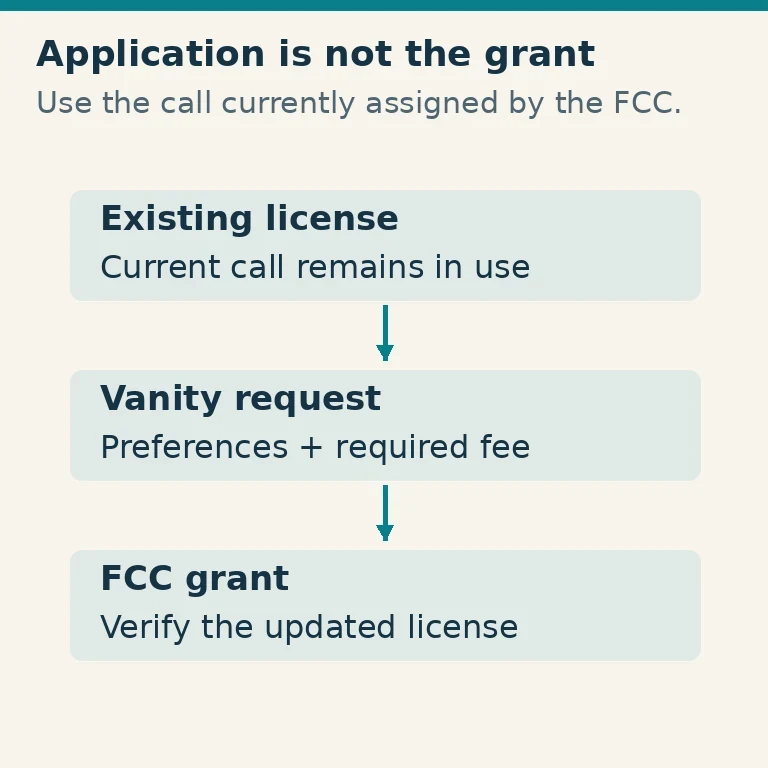
ARRL says that after the fee has been paid and the FCC has processed the application, examinees receive a further FCC email linking to their official license. For a new candidate, the decisive check is the amateur station license grant in the ULS consolidated license database. Under 47 CFR § 97.5, station apparatus must be under the physical control of a person named in such a grant. A passing result, application file number, fee receipt or message by itself is not a substitute for checking the qualifying grant before you transmit under your own new license. Receiving or reading about amateur radio while you wait is different from treating an ungranted application as authority to transmit.
Run the Checklist for Your Own Case
Consider a fictional adult taking a first Technician exam in person. They check whether the Technician pool covers their actual exam date; ARRL’s listed pool runs from July 1, 2026, through June 30, 2030. They obtain an FRN through CORES before exam day, choose a working application email, and confirm the appointment, fee, documents and materials with its administrator. If the session uses ARRL’s in-person requirements, they prepare legal photo ID, two number-two pencils with erasers and a pen. They use a calculator only within the session’s confirmed rules; ARRL’s rule requires cleared memory and formulas and disallows written notes or calculations. After passing, they keep the session information, watch for the application file number, pay any due FCC fee directly to the FCC within the stated clock, and check for the ULS grant before transmitting under the new license.
Now change one fact. If that fictional candidate is a minor without photo ID, the guardian-and-nonphoto-ID route becomes an administrator question; if they qualify for ARRL VEC’s under-18 first-license reimbursement, that is pursued after the completed form and FCC license issuance. If instead they are upgrading, existing-license and relevant CSCE evidence may belong in the kit. Neither branch belongs on every first-time adult’s packing list.
The governing decision is simple: prepare against your actual session’s instructions, distinguish the exam payment from any FCC payment, and wait for the qualifying ULS grant before transmitting under a new license.