VHF QRP is low-power amateur-radio operating, but transmitter output is only one part of a contact. Your mode must match the other station’s, your antenna and location must offer a plausible path, and someone must be listening. For a first attempt, you can take one of two routes: try a direct 2-meter FM contact with a handheld, or prepare for 2- or 6-meter SSB/CW weak-signal activity. Neither route comes with a promised distance.
Choose an Operating Route Before Choosing Gear
QRP means operating with low transmitter power. In an older ARRL discussion, the convention is 5 watts of output or less for CW and 10 watts peak-envelope power (PEP) or less for SSB. Those figures describe CW and SSB practice in that context. They do not establish a universal FM QRP limit or tell you whether your station qualifies for a particular event. They also say nothing by themselves about whether another station will hear you.
For a beginner with an FM-only handheld, the simplest aim is usually FM simplex on 2 meters. Simplex means two stations communicate on the same frequency without a repeater. A repeater can help stations communicate over a different path, but using one is not a direct simplex contact. Your first goal can be modest: find another operator, establish that you can hear each other directly, and exchange a little information.
The other route is SSB or CW weak-signal operating on 2 or 6 meters. SSB is a voice mode; CW uses Morse code. In the VHF operating context described by ARRL, most long-distance contacts use CW or SSB. That is a reason to consider those modes if weak-signal activity interests you, not a reason to assume an FM handheld is inadequate for every worthwhile contact. Choose this route only if your radio can transmit the intended mode. Hearing an SSB signal on a receiver, or entering an SSB calling frequency into an FM-only handheld, does not give that handheld SSB transmit capability.
Let the radio you have and the contact you want settle the choice. If it transmits FM only, plan an FM simplex outing and look for FM activity. If it transmits SSB or CW and you want to try that activity, plan the antenna, frequency and calls around that mode. Avoid switching routes midway through a call simply because one frequency sounds quiet: the operators listening there may be using a different mode.
Before transmitting in the United States, check that the control operator’s license class authorizes the intended station operation, and follow the applicable FCC rules. Section 97.105 limits operation to the privileges of the control operator’s license class; ARRL’s US allocation chart shows which classes have privileges on each band. An activity frequency you can receive is not, by itself, permission to transmit there. The frequencies below are US operating examples, not worldwide instructions; outside the US, check your own licensing and rules.
Put Together a Small Station for the Mode
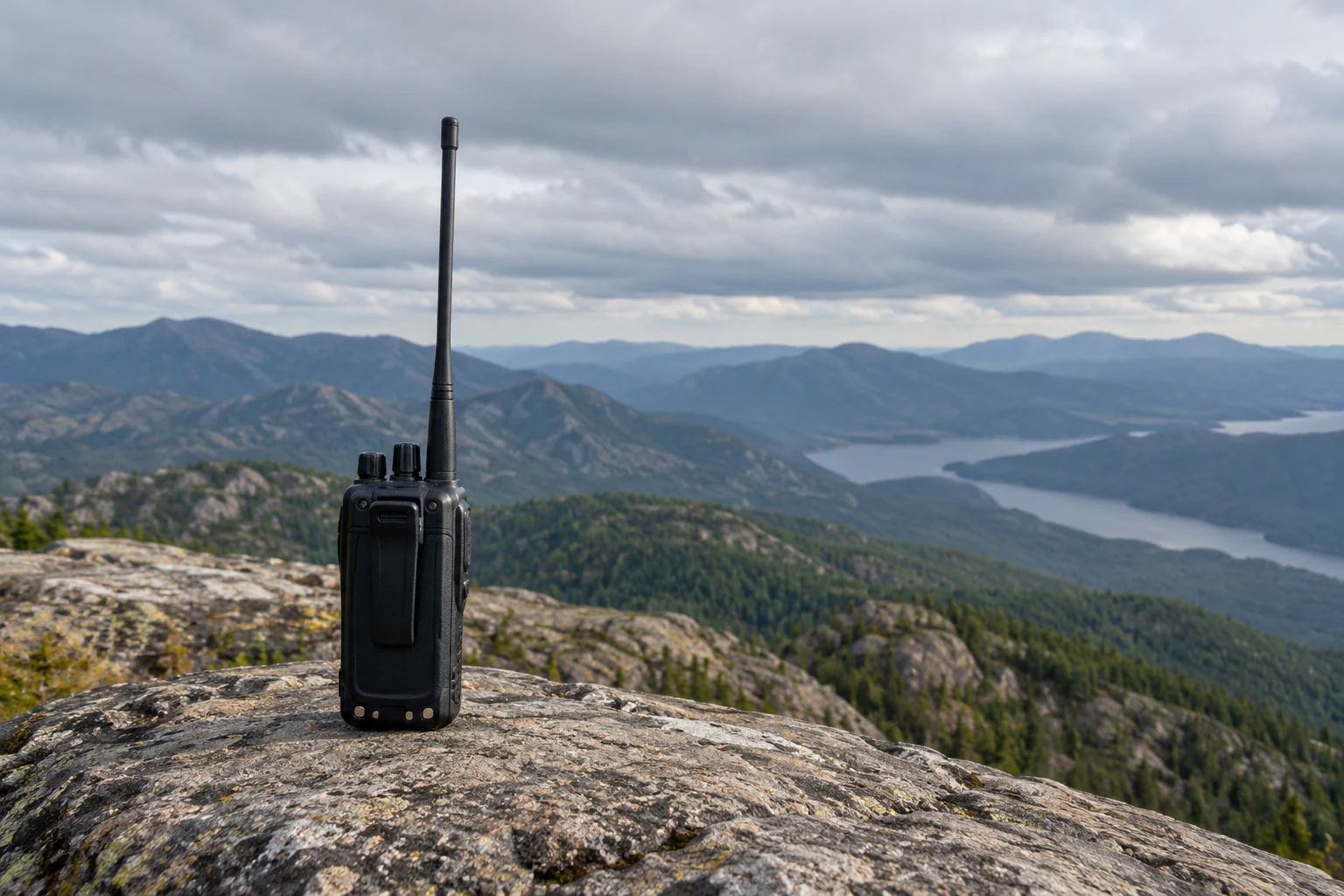
An FM handheld is a reasonable small starting station. As ARRL notes, many new operators start with a VHF handheld that includes a compact antenna and power source. For a first portable FM simplex attempt, you can use that basic arrangement rather than waiting for an elaborate station. Check that its power source is ready for the outing and that the antenna is properly connected before operating. What matters initially is having a working FM station you can use from a safe position, not finding a claimed wattage that supposedly guarantees a contact.
For the SSB/CW route, begin with a radio that transmits the mode you chose, on the band you intend to use. Plan a power source suitable for that radio and your operating session; there is no battery capacity or runtime that this guide can prescribe for every portable station. An FM-only radio does not become an SSB or CW station through a frequency change. ARRL’s VHF weak-signal advice explicitly calls for a radio capable of transmitting those modes.
The antenna’s polarization is its orientation for the signal you intend to exchange. A handheld used upright presents a typical vertical FM arrangement. For longer-haul VHF SSB/CW, ARRL prefers horizontally polarized yagis or loops. In practical terms, an operator trying to join that activity should plan for an antenna oriented to match it where that can be done safely. A vertical antenna may make it harder both to hear those stations and to be heard by them; there is no single loss figure to apply to every path and setup.
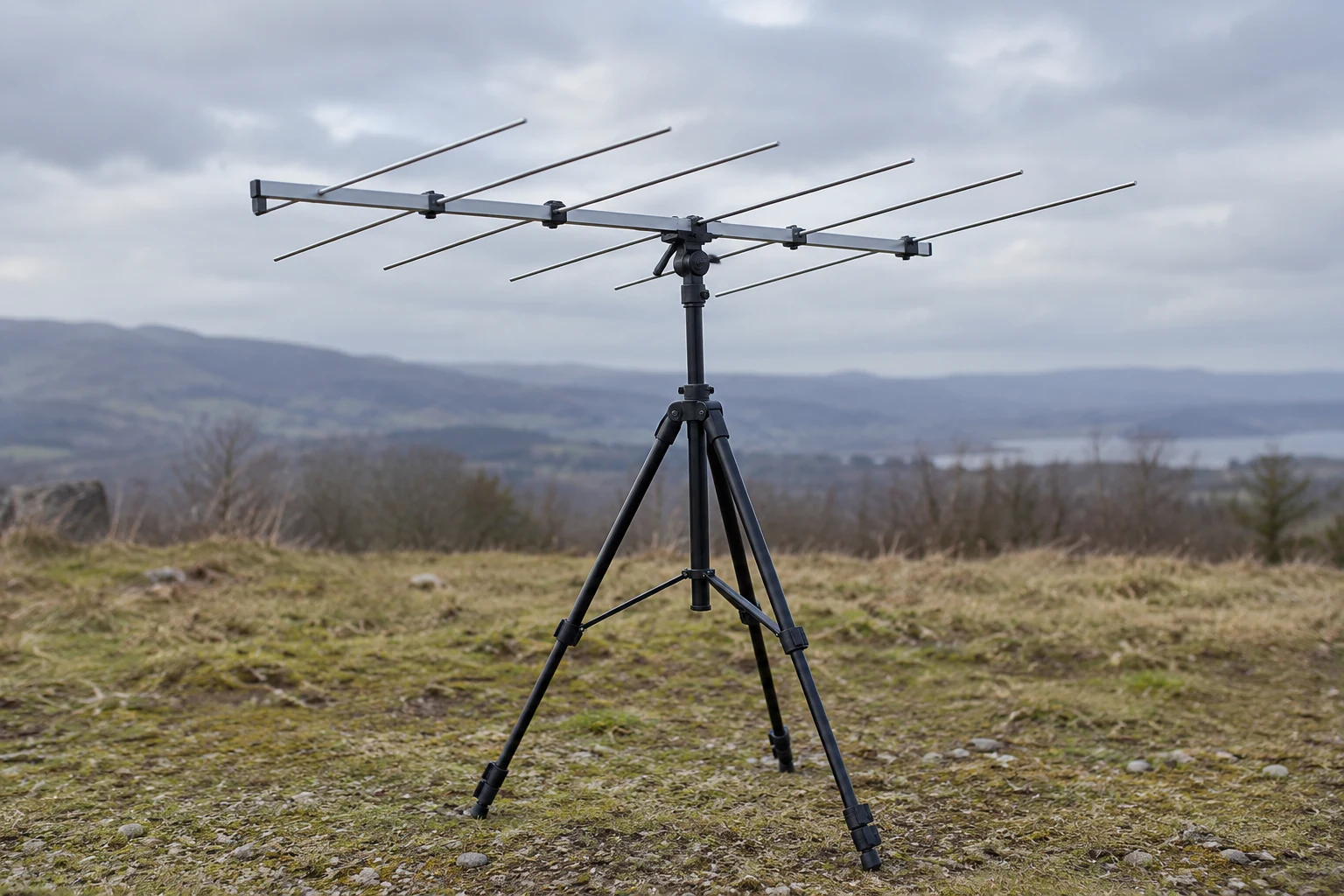
Think of antenna choice as a match to the intended correspondent, not a universal upgrade. Keeping a handheld upright is a sensible starting position for a handheld FM attempt. If your aim instead is a station using the customary horizontal SSB/CW setup, merely changing the radio’s mode while leaving the rest of the arrangement unchanged may leave you with a poor comparison. The point is not that one polarization always travels farther; it is that the two stations need a compatible arrangement for the attempt you are making.
If your antenna is separate from the radio, the feed line is the cable connecting them. Transmitted energy has to get from the radio to the antenna, and signals the antenna receives have to reach the radio through that connection. ARRL gives a cautionary QRP example: with 5 watts at the radio and a poor feed line, only a couple of watts might reach the antenna. Thus a radio’s displayed output is not automatically the power delivered at a separate antenna. Favor a sound, appropriately connected, practical cable run rather than adding avoidable cable problems to a low-power attempt.
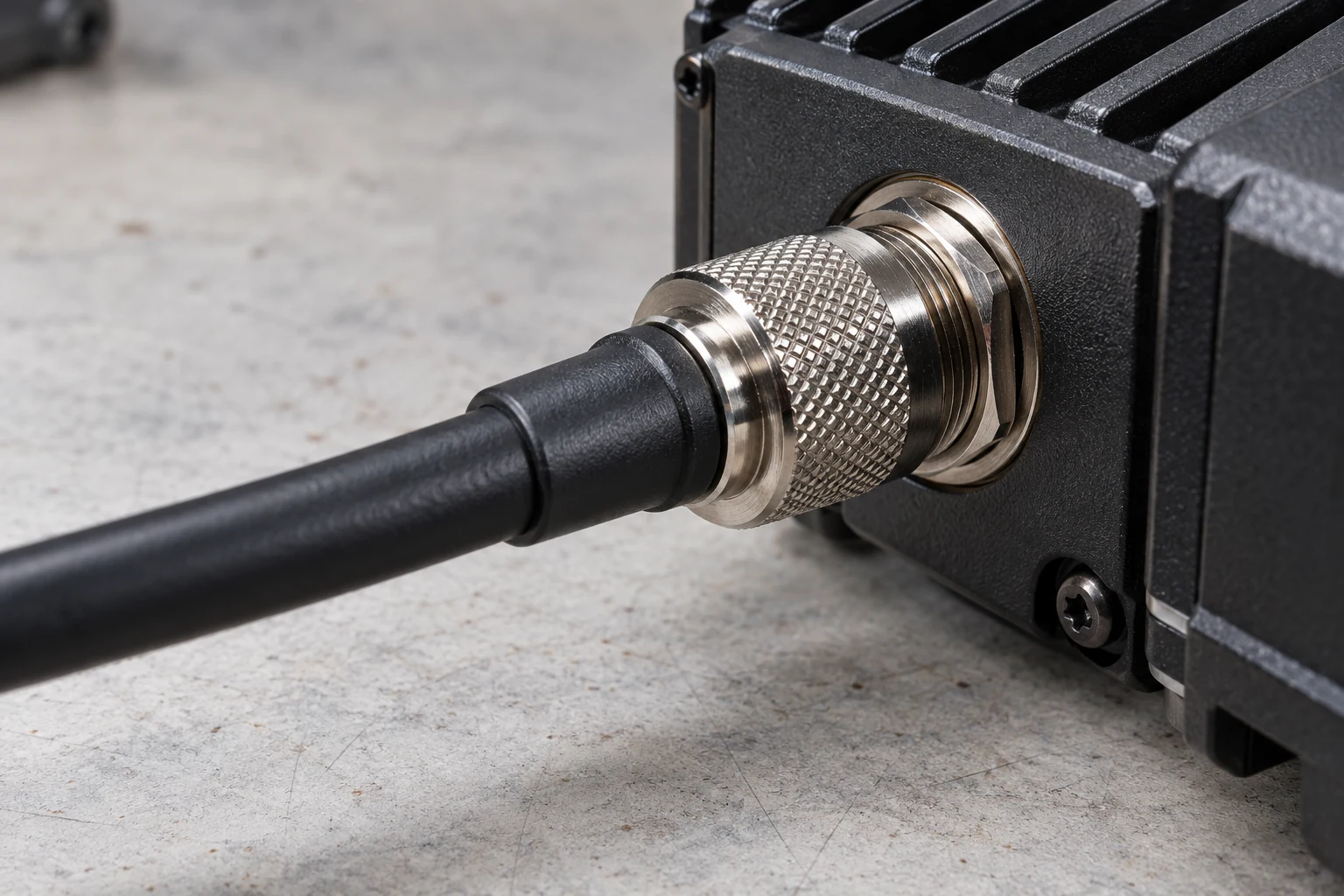
Keep this first station within simple portable handling. You do not need a tower, roof access or antenna construction project to learn from an outing. If a proposed setup calls for installation work, unfamiliar electrical connections or a position you cannot use safely, stop and get help from an experienced operator or qualified professional. That boundary still leaves you useful choices: FM or SSB/CW, an antenna suited to the mode, a suitable power source, and a location you can reach and occupy safely.
Choose a Safe Position and a Plausible Path
ARRL describes VHF bands as generally line of sight and emphasizes antenna height. That is a helpful starting picture, but it is not a rule that visible stations will always make contact or that hidden ones never will. NTIA’s more specific account says that the terrain between transmitting and receiving antennas, and the heights of both antennas above nearby terrain, significantly affect signal attenuation. Your station is only one end of the path.
For a portable attempt, turn that into a restrained location choice: look for a stable place where you are permitted to operate, the weather makes it safe to stay, and the direction toward likely correspondents is less obstructed than it would be indoors or behind nearby terrain. A public place is not automatically an operating site; follow its access conditions. Equally, a high place is not worth climbing onto a roof or entering an unsafe area. You are trying to improve a radio path while keeping the outing straightforward.
ARRL contrasts a handheld used on flat ground with one used from a mountain to illustrate how strongly a change in terrain can affect a contact. Use that example as a reason to compare sensible positions, not as a prediction for your station. A particular hill height, antenna type or transmitter output does not guarantee a number of miles. The other station’s antenna height and surrounding terrain also matter, so two contacts attempted from the same spot can have different results.
Apply the polarization choice to that path as well. If you are trying FM with an upright handheld, keep the antenna’s intended orientation in mind as you choose where to stand. If you are joining SSB/CW weak-signal activity, a safely used horizontal antenna better matches the arrangement ARRL favors for that activity than a vertical one does. This is a separate issue from feed-line loss: orientation concerns how the stations’ antennas match, while feed-line condition concerns the connection between your radio and antenna. Improving one does not silently fix the other.
Six meters also offers an occasional exception to ordinary expectations. ARRL describes summer sporadic-E conditions that can produce intense openings on 6 meters and, in some cases, extend to 2 meters. That gives a weak-signal operator a reason to listen for changing activity, but it is a conditional opening, not routine performance. Do not plan a first outing on the assumption that an opening will occur at the time you are available.
A reasonable aim, then, is not “reach a specified distance.” It is “give another appropriately equipped station a fair chance to hear me.” Choose a clear, lawful, weather-safe position; use the mode and antenna orientation that suit the activity; and remember that another operator must be in a workable position and on the air. If the attempt is quiet, those are useful variables to revisit rather than evidence that low power cannot work.
Make and Record a First Direct Contact
First separate rules from operating arrangements. The FCC’s US licensing requirements govern whether and how your station may transmit. ARRL describes its band plans as voluntary divisions intended to keep incompatible modes from interfering with one another. Check your license privileges and applicable rules, then consult the local band plan and activity before choosing a frequency. A listed calling frequency is a place to look for compatible activity, not legal authorization or a channel for every mode.
For US examples, ARRL lists 146.52 MHz as the 2-meter national simplex calling frequency, useful context for an FM simplex attempt. Its 2-meter plan places 144.200 MHz as a national calling frequency between weak-signal SSB and general SSB areas; it lists 50.125 MHz for 6-meter SSB calling. These are mode-specific examples, not interchangeable places to transmit with whichever radio is at hand. Check the applicable local arrangement rather than assuming a national example describes all local activity.
Once your station, privileges and frequency choice are in order, use this short sequence:
- Listen before calling. Give the frequency time to reveal activity, and check whether it is in use. A signal you hear establishes that someone is there; a moment without a signal does not conclusively prove the frequency is clear. ARRL advises checking before operating. If a conversation is underway, do not call over it—choose another appropriate place or wait.
- Make a brief call suited to the mode. On FM simplex, you might say, “This is [your authorized call sign], listening on simplex and standing by.” ARRL notes that a traditional long “CQ” is uncommon on FM simplex; an announcement that you are listening is more usual. On SSB, a short “CQ, CQ, this is [your authorized call sign]” followed by a pause to listen fits the short, repeated CQ style ARRL describes for SSB/CW. On CW, send a similarly brief CQ with your authorized call sign, then listen. Do not use someone else’s call sign as a sample to transmit.
- Answer and exchange information. If another operator responds, confirm whose call you heard and give your own identity. An ordinary voice exchange can include names, locations, signal reports and a brief description of each station, such as power and antenna. A useful report is an account of what you actually hear, not a claim about how far low power ought to travel. If you miss a call sign or location, ask the other operator to repeat it rather than guessing.
- Move when the calling frequency needs room. If you meet on a monitored or busy calling frequency, agree on another suitable frequency for the same mode and continue there. ARRL recommends that practice in its FM simplex example where 146.52 MHz is heavily monitored; it also describes places where that frequency is quiet. Likewise, its VHF advice says to move off a calling frequency when activity builds. There is no need to treat every otherwise quiet calling frequency as requiring an immediate move, but make room when other calls need it.
- Identify at the end, then note what happened. For US amateur stations covered by §97.119(a), transmit the station’s assigned call sign at the end of each communication and at least every ten minutes during one. An opening call sign does not replace that closing identification. Afterward, a voluntary log can record the date, frequency, mode, power, the other station’s call sign, start and end times, signal report, and any name or location learned. A log makes a later comparison easier; it is not a universal legal requirement for this contact.
If no one answers, you have not completed the exchange. Do not invent a report or log a contact that did not occur; make a note of the attempt if that will help you compare the next one.
Work Out Why the Attempt Was Quiet
Start by describing what actually happened. Hearing no activity differs from hearing stations but getting no answer. Neither observation alone proves the radio is defective or that the path can never work. ARRL notes that a calling frequency can be watched by many operators in one place and quiet in another. NTIA’s treatment of VHF paths also accounts for differences between locations and variation over time. One session is a measurement of that attempt, not a permanent verdict.
If you heard nobody, try a different reasonable time or an occasion when other operators are likely to be listening, still using a frequency appropriate to your mode and local plan. Listen first again. An occasional sporadic-E opening may change what is audible on 6 meters, but it is not an appointment you can schedule to rescue a quiet outing. If there is simply no available correspondent, increasing power or changing an antenna cannot make a station appear.
If you can hear stations but cannot work them, check whether your setup suits their mode and activity. On SSB/CW, revisit antenna orientation: does it match the horizontal arrangement customary for that activity? Check your safe position and the terrain in the direction of the stations: a different permitted position may test whether nearby obstruction is limiting the path. If you are using a separate antenna, revisit its practical feed-line connection; a poor connection or cable arrangement can undermine transmitted power reaching the antenna as well as received signals reaching the radio. These checks test different possible limits, so “use more power” need not be the first response.
Make a bounded comparison instead of changing everything at once. Keep the same mode and radio settings, change one supported variable—perhaps move to another safe, lawful position or correct the antenna orientation—then listen and make another brief call when the frequency is available. Note the place, time, mode, what you heard and whether anyone answered. If the result changes, you have a clue for the next attempt; if it does not, you have ruled out less than you might think, because activity and path conditions can also vary.
Stop if the next proposed “fix” would require unsafe access, antenna installation or electrical work you do not understand. Ask an experienced operator for help rather than turning a simple portable experiment into a hazardous one. A first VHF QRP contact depends on a lawful mode choice, a suitable station, a plausible path and someone available to answer. A quiet session gives you information to use next time—not a verdict on low-power operating.