The Short Answer: Choose for the Path, Not the Band Label
Neither VHF nor UHF has a universal range advantage. Choose for the link you need to make, not a promise attached to a band name. An open outdoor route and a route through a building pose different questions, but either way the comparison should cover the same factors for both bands: the path between users, obstacles along it, antenna position, equipment, and the feed-line run between radio and antenna.
That approach also keeps a promising feature from deciding the issue on its own. A convenient antenna size may matter little if its available position is poor. Likewise, a band that seems suited to a particular route may be less attractive with the equipment and installation you can use. Compare VHF and UHF as complete setups serving the same intended link. The sections below separate the differences in wavelength, outdoor and indoor paths, and installation so each can inform that choice without becoming a blanket range claim.
What VHF and UHF Mean
VHF (very high frequency) covers 30–300 MHz, while UHF (ultra high frequency) covers 300–3000 MHz, or 300 MHz–3 GHz. The ITU describes VHF wavelengths as metric—measured in meters—and UHF wavelengths as decimetric—measured in tenths of a meter. Icom uses the same frequency ranges for the two labels. These are broad categories, not single frequencies: saying that a radio uses VHF or UHF does not yet identify the particular frequency on which it operates.
Frequency and wavelength describe the same radio wave from different angles. Frequency tells you how often the wave cycles; wavelength tells you the distance covered by one cycle. As frequency rises, wavelength gets shorter. That inverse relationship is why the higher-frequency UHF category has the shorter wavelength scale, while the lower-frequency VHF category has the longer one. It also explains why a band may be named for a length in meters or centimeters even though a radio displays its frequency in MHz.
The 2 m and 70 cm amateur bands make the scale tangible. The names refer to approximate wavelengths: 2 m is an example on the VHF side, and 70 cm is an example on the UHF side. Neither example represents its entire VHF or UHF category. If you encounter two radios described simply as “VHF” and “UHF,” those labels establish which broad frequency range each belongs to; they do not tell you which specific amateur band or frequency either radio can use.
That distinction also applies when both radios carry the same broad label. Two radios described as VHF are not necessarily specified for the same frequencies; the same is true of two radios described as UHF. To understand what a band label means for a proposed use, look beyond the category to the particular frequencies the equipment supports. The wavelength nickname helps place an amateur band within VHF or UHF, but it is not a substitute for identifying the frequency involved.
Treat the 2 m and 70 cm examples as a way to read the labels, not as permission to transmit. Local service allocations must be checked separately. The broad VHF/UHF designation explains the frequency and wavelength scale; it does not establish that a particular frequency is available for your use.
Outdoor Paths: Sight Lines and High Ground Matter to Both
For an outdoor link, start by looking at the route between the two antennas. “Line of sight” means there is a reasonably clear path between them, rather than a mountain or large building blocking the route. Icom describes both VHF and UHF operation in line-of-sight terms, and notes that either kind of obstacle can disrupt a link. Those are operating examples, not results from an independent head-to-head range test.
Consider two users standing in an open area, then one walking behind a large building. The useful comparison is not simply how far apart they are: it is whether that building now lies across the path. The same question applies to a VHF link and a UHF link. Icom’s descriptions give a reason to examine the obstruction for both bands; they do not establish which signal would remain usable behind that particular building.
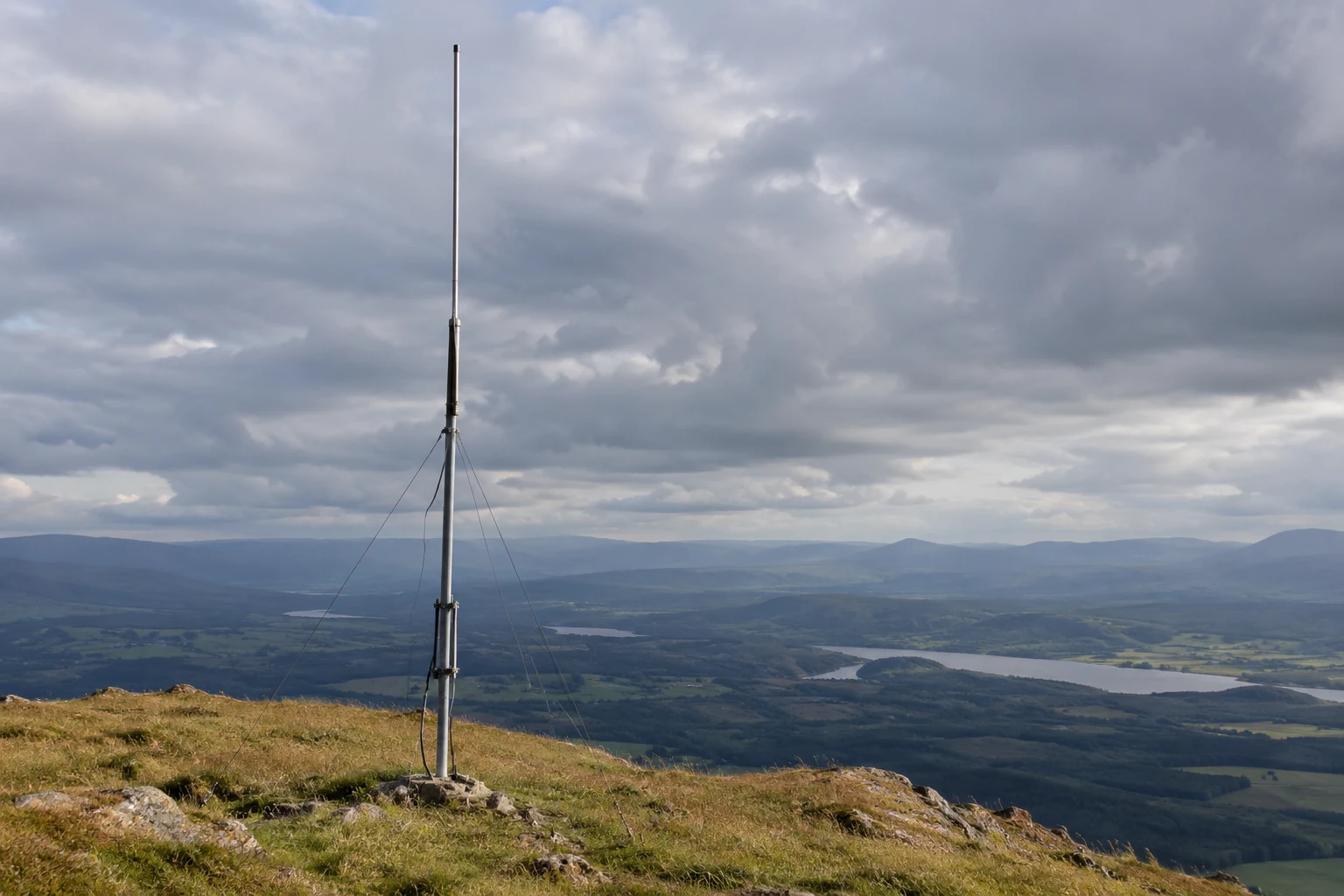
Height changes the geometry of an outdoor path. The radio horizon is the limit imposed by the antennas’ positions and the curve of the Earth; raising an antenna can extend the path available before that horizon becomes a constraint. ARRL specifically says that high repeater sites improve the radio horizon for VHF handhelds. A repeater is a station that receives a transmission and retransmits it, so its elevated location can provide a path that two handhelds at ground level do not have. That VHF example illustrates why site height deserves attention when assessing either band, but it is not a measured VHF-versus-UHF advantage.
In practical terms, compare the positions available to both setups before comparing their band labels. Two handhelds on opposite sides of a ridge face a different path from a handheld communicating through an elevated site. Likewise, moving an antenna to a position with a clearer view may matter more to the link than a small change in distance. A high site does not remove every obstruction: a mountain or large building can still interrupt the relevant path.
Icom’s guidance therefore supports the same outdoor question for VHF and UHF: where are the antennas, what lies between them, and is an elevated site part of the route? ARRL’s documented high-site benefit applies specifically to VHF handhelds; it should not be read as a comparative UHF test.
Inside Buildings: Useful Tendencies, Uncertain Paths
In a corridor or parking garage, UHF is worth considering: Icom names both as settings where it can be useful. That is an operating example, not a head-to-head finding that UHF will outperform VHF there. Icom also says VHF can be used in buildings and cities. For an indoor route, then, the useful comparison is not “Which band works indoors?” but “What does each signal have to get through or around on this route?”
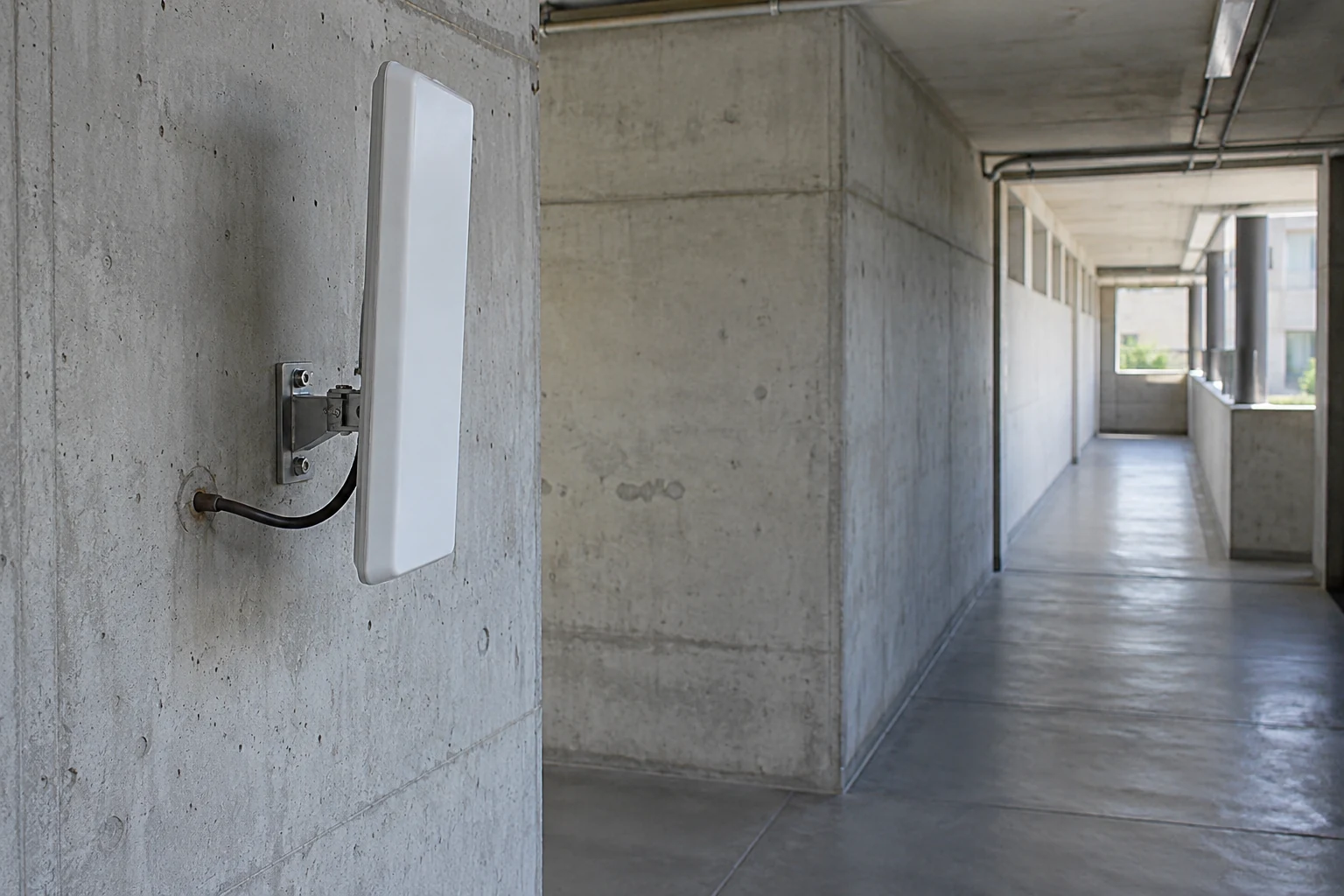
Picture two users separated by a straight corridor, then picture the same users on opposite sides of a sectioned floor. The first route offers a more direct path; the second puts structure between them and offers more opportunities for signals to arrive by different routes. Either band may provide a usable link in the first scenario, while neither should be assumed reliable in the second. Icom’s corridor and garage examples make UHF a plausible option to consider, but they do not rule out VHF where the building path permits it.
A usable link along the straight corridor does not establish that either band will work between rooms or between garage levels. Moving one user around a corner or behind a partition changes the path being compared. That distinction matters for both VHF and UHF: an indoor result applies to the positions and obstructions involved, not automatically to the whole building.
The reason for caution is visible in NIST measurements at 750 MHz, a UHF frequency, in large-building scenarios. NIST observed attenuation associated with materials and structure, as well as additional variability due to multipath—signals reaching a receiver by more than one route. Those findings help explain why a link can change as users move through an obstructed space: a wall or structural section may weaken a path, while the mix of arriving signals can also vary. The measurements document behavior in those studied environments; they do not measure VHF alongside UHF or establish a general indoor winner.
For a garage-to-corridor route, the distinction matters more than the building label. “UHF can be useful in garages” identifies a reasonable possibility, not a promise that communication will hold through every level, wall, or turn. Equally, “VHF can be used in buildings” prevents dismissing it merely because the users are indoors. The two bands face the same practical question—whether the particular route supports a usable signal—even though the cited building measurements characterize only a 750 MHz UHF setting.
Antennas and Feed Lines Can Change the Choice
A band comparison changes when the antenna has to fit in a real installation. VHF has metric wavelengths, while UHF has shorter, decimetric wavelengths; antenna designs often use dimensions related to a fraction of the operating wavelength. That generally makes a resonant VHF antenna physically larger than its UHF counterpart, though the dimensions depend on the design rather than the band label alone. A smaller UHF antenna may be easier to place where space is tight. Conversely, where a larger antenna is practical, its size need not count against VHF. The useful question is not simply which antenna is smaller, but what each installation permits.
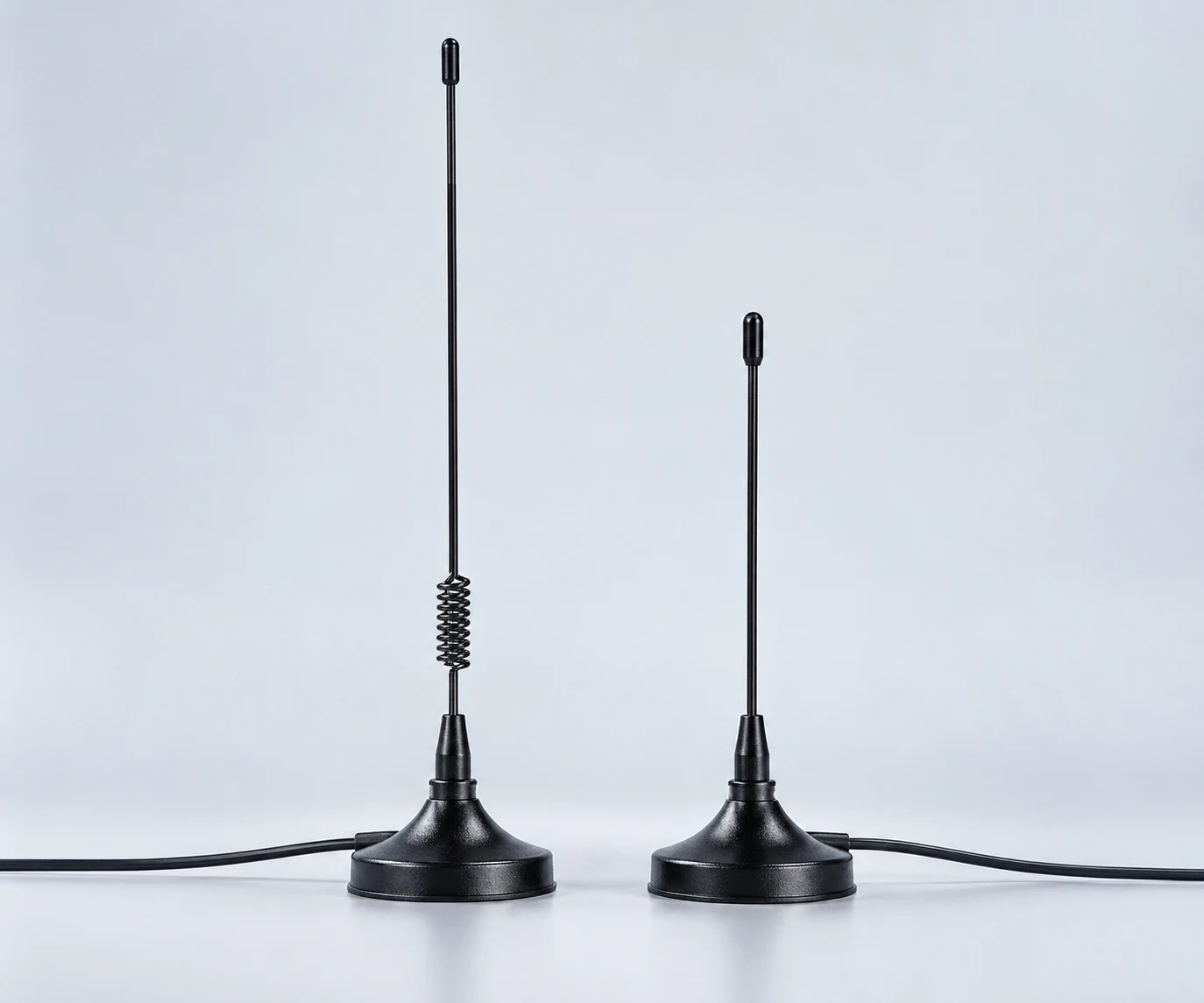
Placement can matter as much as size. ARRL identifies height as critical for both VHF and UHF, so compare the positions the two antennas can actually occupy—not an ideally placed antenna on one band with a poorly placed one on the other. For example, a compact antenna that fits at a favorable position may make a more useful installation than one whose larger dimensions force a less favorable position. That is an installation tradeoff, not a range guarantee attached to UHF.
Directionality is another choice independent of the band name. A directional antenna concentrates transmission and reception in selected directions, which ARRL describes as useful for distance and interference control. It may suit a link between known locations, while its narrower focus may be less convenient if the stations of interest lie in several directions. The same question applies to VHF and UHF: does the antenna need to serve a particular direction, or a wider area? Directionality should be compared alongside where the antenna can be mounted, rather than treated as an automatic advantage of either band.
The feed line is the cable connecting a radio to its antenna. A convenient antenna position can require a longer cable run, and coaxial-cable loss rises with frequency. That makes cable length particularly relevant to a UHF installation: a promising antenna location may offer less benefit if reaching it requires a long, lossy run. ARRL illustrates the difference by giving a shorter acceptable RG-8X run for the illustrative 70 cm band than for 2 m. The point is not that VHF cable loss can be ignored; it is that the same cable and length need not have the same effect on both bands.
These factors interact. Moving either antenna higher may improve its placement while adding feed-line length; choosing a more compact UHF antenna may ease placement while leaving a long cable run as the limiting part of the installation. Height matters on both bands, and the higher-frequency cable penalty remains part of the UHF tradeoff. Compare complete setups—antenna dimensions, feasible position, intended direction, and the cable needed to reach that position—rather than comparing frequencies while silently assuming identical installations.
| Factor | VHF | UHF |
|---|---|---|
| Frequency and wavelength | 30–300 MHz; metric wavelengths | 300–3000 MHz; decimetric wavelengths |
| Open outdoor path | Can suit an open site; sight lines and height matter | Can also work outdoors; sight lines matter |
| Corridors and obstructed interiors | Can work in some buildings; conditions vary | Can be useful in corridors and garages; materials and multipath can still disrupt a link |
| Antenna dimensions | Longer wavelength generally means larger resonant dimensions | Shorter wavelength generally permits smaller resonant dimensions |
| Feed-line run | Coax loss depends on frequency; assess the actual run | Higher-frequency coax loss can make a long run more limiting |
Which Band Fits Your Site?
For an open outdoor path, VHF is a sensible option: Icom describes it as suitable for open sites. That is an operating example, not a head-to-head result or a promise of greater range. UHF can work outdoors too, so an open setting alone does not rule it out. If a handheld struggles from ground level, antenna position may be more consequential than changing bands: ARRL identifies antenna height as important for VHF and UHF and says reaching a high spot can dramatically improve VHF handheld range. Before choosing a different band, ask whether either antenna can be placed higher at the positions where communication is needed.
For a route through corridors or a parking garage, UHF deserves consideration because Icom names those settings as potential uses. But that example does not establish an indoor winner. Icom also allows for VHF working in some buildings. A user trying to cover an outdoor entrance and an interior hallway therefore has two distinct paths to account for; a band that serves one need not be assumed to serve the other. If both links are essential, a good result on the entrance path alone is not enough to settle the choice.
Make the comparison about the intended link rather than the band labels. Identify where the radios must communicate, what stands between those positions, where each antenna can actually be placed, which equipment would be used, and whether either setup needs a feed-line run. Keep those conditions comparable when weighing VHF against UHF. Otherwise, a difference in antenna position or installation could be mistaken for a difference between the bands. The practical tradeoff is not simply “outdoors versus indoors”: an outdoor route with poor antenna placement may be less promising than its open setting suggests, while a building route should not be assigned to UHF solely because it contains corridors.
Where both setups are available, compare them at the actual positions that matter, including the most obstructed required path. Use the antenna locations and feed-line runs you could realistically keep, rather than giving one band a temporary advantage it will not have in use. If neither setup meets every required path, the decision may be about changing the antenna position or addressing the uncovered location—not declaring one band universally better. If only one setup is practical, judge it against the required links rather than against an idealized version of the other.
Choose VHF when the required link is an open outdoor path and the available setup supports it; consider UHF when the required link runs through corridors or a sectioned building and that setup is better suited to the route. Treat both as conditional choices, not exclusive territories. Icom’s examples leave room for UHF outdoors and VHF indoors, while ARRL’s height guidance shows why changing the site setup can change the decision. The better choice is the band that serves the places you need to reach with the antenna position, equipment, and feed-line run you can actually use—not the one credited with a universal range advantage.
Continue reading
Keep learning about radio