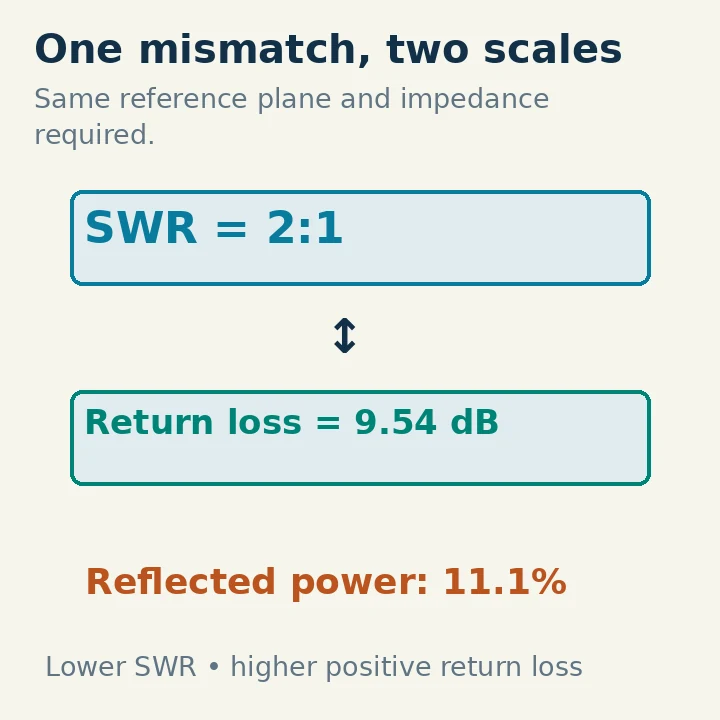
A 1:1 SWR reading tells you that the impedance looks matched where the reading is taken. That is useful information, especially when it describes what the radio sees. It does not tell you how much transmitter power reaches the antenna, how much of that power the antenna radiates, or where the radiated energy goes. ARRL makes the distinction plainly: a 1:1 SWR does not establish antenna efficiency. To judge performance, follow the signal from the radio through the feed line to the antenna, then ask a separate question about the direction of its radiation.
What a 1:1 Reading Actually Tells You
SWR is a match reading, not a report on everything happening beyond the meter. In ARRL’s explanation, an antenna tuner matches the impedance of the antenna system to the 50-ohm impedance the transceiver needs to see. If the antenna-system impedance differs too much from 50 ohms, SWR at the radio rises. A tuner can transform the impedance presented to the radio so that the radio sees a better match.
The location of the meter determines which part of the system that reading describes. Consider this labeled signal path:
Radio → meter → tuner → feed line → antenna
Here, the meter is between the radio and tuner. If it reads 1:1, the reading describes the match on that radio-side segment. It does not say that the feed line and antenna on the other side of the tuner are also matched. ARRL says the SWR reduction made by a tuner occurs between tuner and radio; the SWR between tuner and antenna remains unchanged.
That distinction is easy to lose because all five items are part of one station. The signal travels through them in sequence, but a reading at one point is not a measurement at every other point. In the example above, “the radio sees a match” and “the antenna end of the feed line is matched” are different statements. The first may be supported by the meter; the second requires evidence from the antenna side of the tuner.
A low radio-side SWR therefore has a real, limited benefit: it indicates that the impedance presented to the radio is close to the match the radio needs. That is the job ARRL describes for the tuner. There is no need to dismiss a good reading simply because it is incomplete. It answers one useful question. The mistake is treating it as the answer to two further questions: how much power arrives at the antenna, and what the antenna does with that power.
This also changes how to describe a station after adjusting a tuner. “The radio-side meter reads 1:1” identifies both the result and its location. “The whole antenna system is 1:1” claims more than that meter establishes. The difference matters most when troubleshooting: if a contact is difficult, improving a radio-side reading may have solved the match seen by the radio without resolving loss farther along the path. ARRL’s account of the tuner makes those two outcomes compatible, not contradictory.
How Power Can Disappear Behind a Good Match
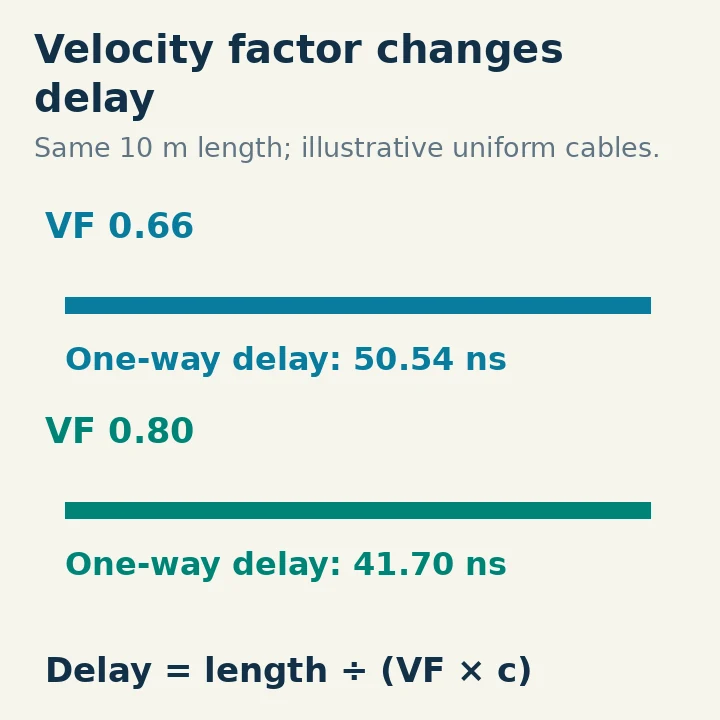
A match at the radio does not mean that every unit of power leaving the transmitter arrives at the antenna. The feed line—the connection carrying RF from the station toward the antenna—loses some energy even in ordinary use, according to ARRL. Thus, transmitter output and power at the antenna are different quantities. ARRL’s RF-exposure instructions express the distinction by defining power at the antenna as transmitter power after feed-line losses.
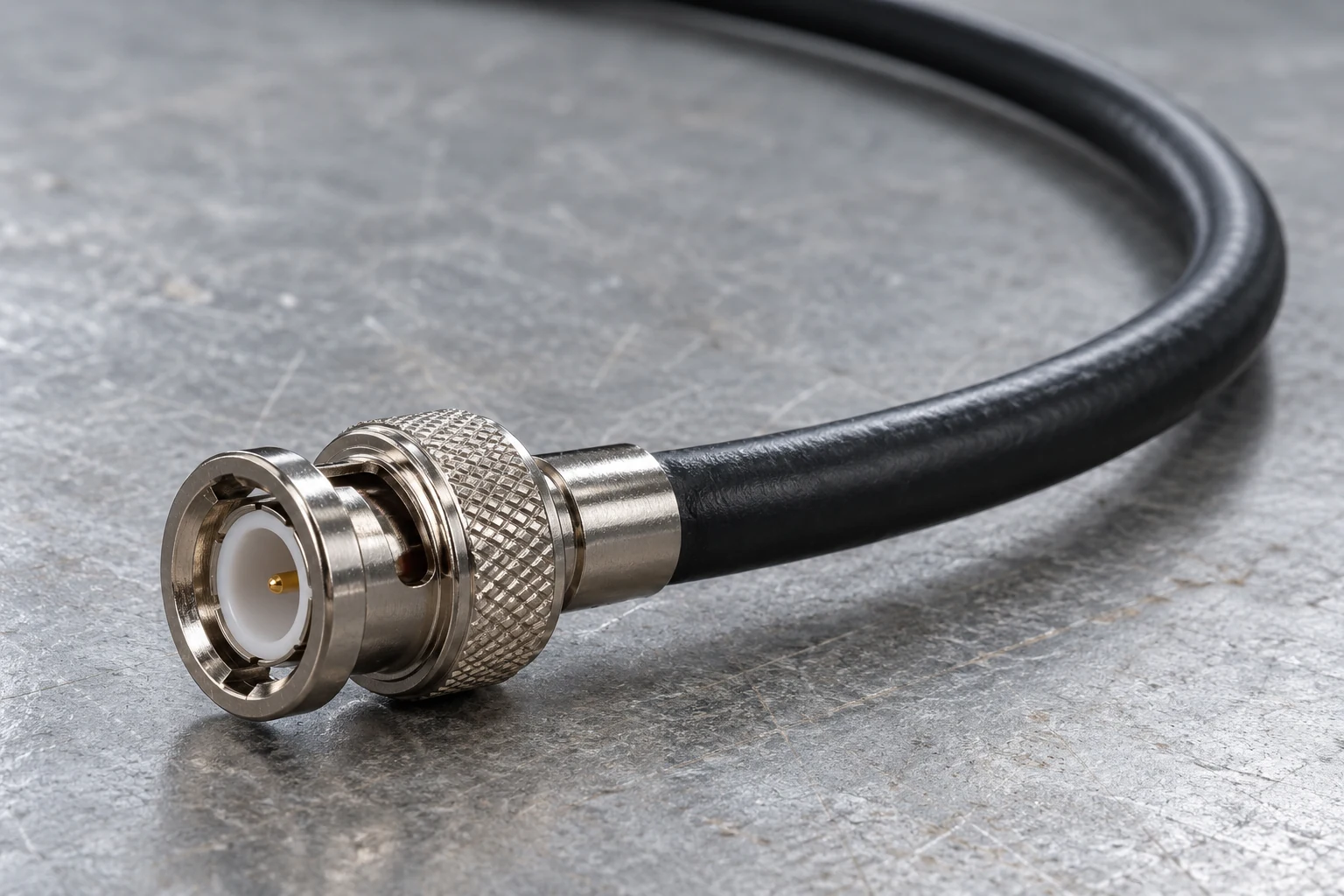
There is also a more specific loss concern when the tuner makes a good match for the radio while a mismatch remains along the coaxial cable between tuner and antenna. ARRL warns that a tuner can provide the radio with a 50-ohm match even though mismatch and high SWR persist between tuner and antenna, with increased loss in the coax. This is not a second description of the radio-side reading; it is a reason to examine what happens after the tuner. The radio may be presented with the impedance it needs while less power than expected survives the trip down the feed line.
Those are two related but distinct observations. Feed line has some loss regardless; ARRL says it always loses a certain amount of energy. Mismatch on coax between tuner and antenna can add to the loss concern. A 1:1 meter reading before the tuner does not quantify either amount. Nor does the existence of feed-line loss mean that every installation loses the same amount. The useful question is whether the line and the conditions under which it is used could materially change the power that arrives at this antenna.
Arrival is not the end of the chain. Once power reaches the antenna, another question is how much becomes radiation rather than being lost within the antenna. Antenna-Theory.com distinguishes radiation efficiency from impedance mismatch loss: it describes total antenna efficiency as radiation efficiency multiplied by impedance mismatch loss. In that account, a match and efficient radiation are not interchangeable properties. A good match addresses a mismatch question; it does not, by itself, supply a measurement of radiation efficiency. And a good reading back at the radio does not even establish the mismatch condition at the antenna when a tuner separates the two locations.
ARRL’s warning about tiny HF antennas gives this distinction a concrete setting. It notes that such an antenna can show 1:1 SWR while much of its RF energy is lost as heat rather than radiated. The example is about the tiny HF antennas ARRL discusses, not a measured efficiency figure for an antenna a reader happens to own. It is also not a rule that every compact antenna behaves alike. Its lesson is narrower and more valuable: an impedance match can coexist with substantial loss inside a particular antenna design.
It helps to keep three quantities separate in your mental picture. First is the power leaving the transmitter. Second is the power that arrives at the antenna after feed-line loss; ARRL explicitly treats this as distinct from transmitter power. Third is the part of that arriving power the antenna radiates, which depends on radiation efficiency rather than being established by SWR alone. No number for the third quantity follows automatically from knowing the first quantity and seeing 1:1 at a radio-side meter.
For example, imagine that a tuner has given the radio a 1:1 reading, but the feed line beyond it has appreciable loss. The match seen by the radio has not removed that loss. Now imagine instead that power arrives at a particular antenna but its design dissipates a substantial portion as heat. Improving the feed line would not, by itself, establish that the antenna radiates efficiently. These are illustrative possibilities, not diagnoses of a real station. They show why a disappointing result can call for different evidence depending on whether the uncertainty lies in delivery to the antenna or radiation by it. ARRL’s feed-line guidance and its tiny-HF-antenna example describe those separate loss locations.
Why Radiation in the Wrong Direction Still Matters
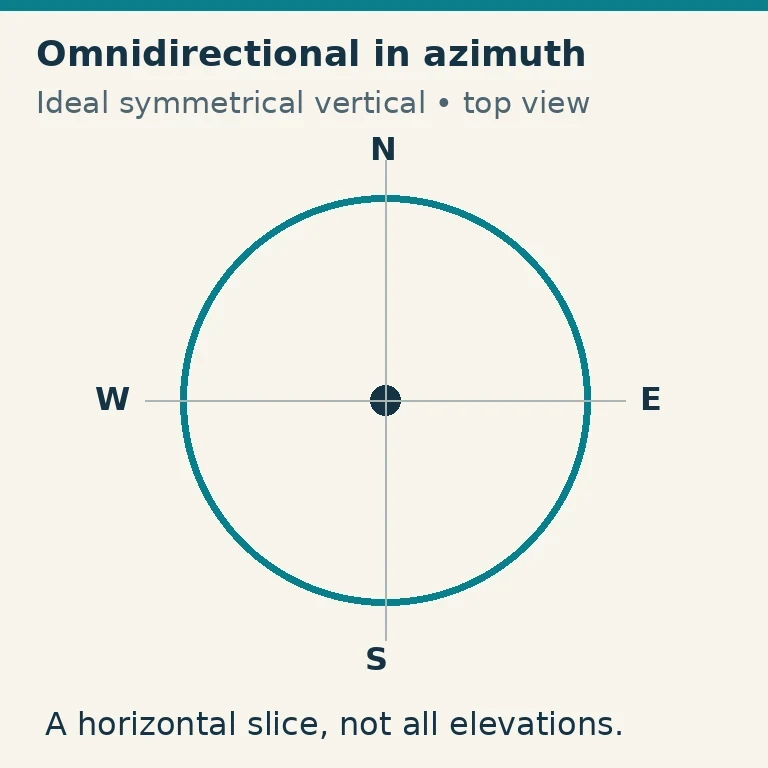
Even after power has reached an antenna and been radiated, there is another question: where does that radiation go? ARRL describes antenna gain as how powerfully an antenna directs RF energy, with gain expressed in decibels. Direction is therefore part of a performance question about an intended contact. It is not something a match reading can answer.
ARRL’s description of antenna modeling is useful here because it lists pattern, feed-point impedance, and SWR as things modeling can determine. Treating them as separate outputs prevents a common leap in reasoning. Feed-point impedance and SWR concern the match; a pattern concerns the directions in which the antenna radiates. Knowing one output does not supply the others. In particular, a radio-side 1:1 reading gives no basis for sketching a pattern or assigning gain toward a particular station.
Consider an explicitly illustrative comparison. Two antennas give equally low readings on meters at their respective radios. Suppose evidence about their patterns shows that one directs more of its radiation toward the desired contact, while the other directs less that way. Their matching meter readings would still be compatible with different amounts of energy directed toward that contact. This example does not assign either antenna a measured gain, establish how either is installed, or predict whether the contact will be made. It isolates a question the meters cannot settle: direction. ARRL’s definition of gain and its separate treatment of pattern and SWR support making that distinction.
The reverse assumption is just as risky. If an antenna is advertised with an impressive gain description, a low SWR reading does not verify that description. ARRL cautions that a gain assertion cannot be known to be true without analysis using antenna-modeling software or testing on a laboratory-grade antenna test range. A claim backed by relevant modeling or range testing is consequently different evidence from an unsupported assertion. It still deserves to be read for what it actually addresses: gain or pattern evidence, not a replacement for checking feed-line loss or the match at the point of interest.
For a beginner, the key is not to find one reading that stands in for every property. A match, efficient radiation, and useful direction answer successive questions about the same signal. The antenna can be matched yet lose power internally, and an antenna that radiates can direct different amounts of energy in different directions. The first possibility is illustrated by ARRL’s tiny-HF warning; the separate pattern question appears in its modeling guidance. Keeping those questions apart makes a performance claim easier to evaluate: ask whether its evidence concerns the match, radiation efficiency, or direction toward the contact you care about.
Checks to Make After You Read the Meter
Start by recording what the reading actually covers. Write down the order of the radio, meter, tuner, feed line, and antenna, including which side of the tuner holds the meter. If the meter sits between radio and tuner, interpret its 1:1 reading as radio-side match information. ARRL says a tuner’s SWR reduction is confined to that side, while the tuner-to-antenna SWR remains unchanged. This record is useful when comparing readings or describing a problem to another operator: it prevents the location of the measurement from disappearing behind the number.
Then let the unresolved question determine the next evidence you seek:
- If the question is power delivered to the antenna, examine the feed line. Identify the line actually in use and the frequency of interest, then consult its loss specification rather than assuming that a 1:1 reading means negligible loss. ARRL advises choosing feed line for low loss at the highest frequency one intends to operate and notes that feed line always loses some energy. Its definition of power at the antenna—transmitter power after feed-line loss—also makes clear why the transmitter’s output rating is not, by itself, the antenna’s input power. If the tuner precedes coax that remains mismatched, include ARRL’s additional coax-loss warning in the question you investigate.
- If the question is how well the antenna radiates the power it receives, seek evidence about that design. A good SWR reading is not an efficiency result, as ARRL explicitly warns. Antenna-Theory.com’s distinction between radiation efficiency and mismatch loss explains why match information alone cannot fill the gap. ARRL’s heat-loss example is a reason to question unsupported efficiency assumptions about a particular tiny HF design, not a reason to assign the same loss to every compact antenna.
- If the question is energy directed toward an intended contact, look for relevant pattern evidence. ARRL identifies pattern as a modeling output separate from feed-point impedance and SWR. A gain claim supported by modeling or laboratory-grade range testing has a different basis from one with neither, under ARRL’s warning about unverifiable gain assertions. A meter reading cannot substitute for either kind of directional evidence.
Here is a hypothetical station comparison that brings the checks together. Station A and Station B each show 1:1 on a meter between radio and tuner. At that point, both readings answer the same limited question: what match each radio sees on its side of the tuner. Neither reading establishes what is happening along the feed line beyond that tuner.
Suppose the stations use feed lines with different losses at their operating frequency. Even with identical radio-side readings, the power arriving at their antennas could differ; ARRL distinguishes power at the antenna from transmitter power precisely by accounting for feed-line loss. Suppose, separately, that one station has credible evidence about its antenna design’s radiation efficiency and the other has only a claim based on its 1:1 reading. The two readings do not close that evidence gap, because radiation efficiency is not the same property as impedance mismatch loss. Finally, suppose their pattern evidence differs in the direction of the intended contact. Equal SWR readings would not erase that directional difference, because pattern and SWR are separate properties.
None of those suppositions assigns either hypothetical station a measured loss, efficiency, or gain. They also do not guarantee that one station will make a contact and the other will not. Their point is to show what an equal reading leaves open. To compare delivered power, investigate the real feed lines at the frequency in use. To compare radiated power, look for evidence about the particular antenna designs. To compare energy directed toward a contact, consider supported pattern or gain evidence. Those are different investigations because they concern different parts of the signal’s path.
Keep the low SWR: it is useful evidence that the radio sees a match where you measured it. If performance remains in question, choose the next check by naming what is still unknown—power delivered to the antenna, the portion it radiates, or the direction of that radiation. A 1:1 reading answers none of those questions on its own.