A notch filter reduces interference by attenuating a very narrow range of frequencies. If a persistent tone falls in that range, the tone can become less distracting while much of the surrounding signal remains. The filter does not know which signal you want: wanted energy at the rejected frequency is reduced too. Placement also matters. A notch acting on receiver audio can improve what you hear, but it cannot prevent an earlier RF stage from being overloaded. The useful question is therefore not just whether the radio has a notch, but what sound you are trying to remove and where the rejection happens.
What a Notch Removes—and What It Leaves Behind
Picture the frequencies passing through a receiver as positions along a line. A band-stop filter reduces a chosen span on that line; a notch is a band-stop filter whose reduced span is very narrow. Analog Devices describes frequencies outside that narrow range as passing while frequencies inside it are attenuated. This frequency-response picture is more useful than imagining a filter that recognizes an interfering station: the notch responds to frequency, not ownership of the signal.

The center frequency locates the middle of the rejected range. Its bandwidth describes how far that range extends, and its attenuation depth describes how strongly energy there is reduced. Those are ways to describe a notch’s response, not a promise that your receiver provides three separate controls. Analog Devices defines the notch filter’s Q factor as center frequency divided by bandwidth. For a given center frequency, a smaller bandwidth therefore corresponds to a higher Q and a more tightly confined rejected range. A high-Q description alone does not tell you whether a particular receiver lets you adjust Q, width or depth.
Suppose you are listening to a wanted voice signal with a steady interfering whistle nearby in the received passband. As an explanatory example, centering a sufficiently narrow notch on the whistle could make it less prominent while leaving more of the voice-bearing range untouched than a wider rejection would. ARRL describes an adjustable notch that removes a very narrow slice of receiver audio to match an interference tone. The tradeoff is that any part of the wanted signal occupying that slice is removed along with the whistle. The same caution applies when the notch acts at another receiver stage: frequency overlap, not whether energy is “good” or “bad,” determines what is attenuated.
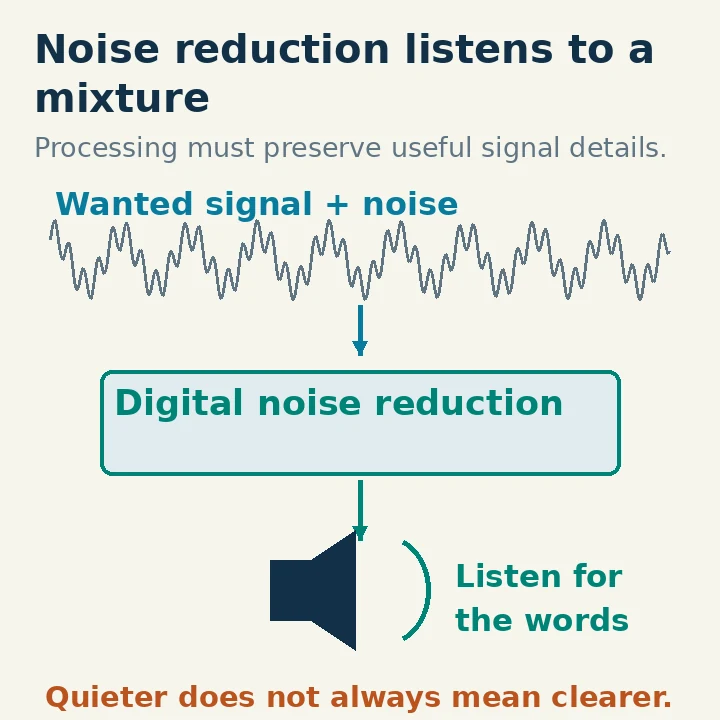
That tradeoff explains both the appeal and the limit of narrow rejection. Narrowing the affected range can preserve more adjacent wanted energy, provided the interferer fits inside the rejected range. But if the tone sits on top of useful wanted energy, a deeper or wider notch can make the interference quieter while also making reception worse. Kenwood explicitly cautions that the automatic notch in its TS-590S may slightly attenuate the desired signal. A notch can make remaining information easier to hear; it cannot restore wanted information removed by the filter or already obscured at that frequency. The last sentence is a consequence of the frequency-response model, not a claim that a particular receiver can measure what was lost.
Why the Notch’s Place in the Receiver Matters
“Notch filter” names the shape of the frequency rejection, not one universal point in a receiver. To compare remedies, follow the signal conceptually from the receiver’s RF input, through intermediate-frequency (IF) processing, to the audio you hear after conversion. An external filter at the RF input, an IF notch and an audio-frequency (AF) notch act at different points. Receiver designs and available controls vary; the stage label tells you where rejection occurs, not that every radio has that option. Kenwood documents an IF-stage notch, while ARRL describes a notch in the receiver’s audio range.
Before active RF stages: An appropriately selected external RF filter can reject unwanted energy before it reaches a component that might respond nonlinearly to a strong signal. Analog Devices gives a front-end example in which a suboctave filter removes interfering signals before they hit a nonlinear component. That example establishes the importance of early placement; it is not an example of a narrow notch, nor evidence that any external notch will solve any overload. Whether a particular external filter helps depends on what it rejects and whether it is placed before the stage causing trouble.
At IF: A receiver can reduce a beat during IF processing rather than waiting until it becomes output audio. Kenwood describes an IF-stage notch as effective for a single strong beat and says removing strong interfering signals can let a weak target signal stand out. Its TS-590S manual gives a more specific case: the digital IF Auto Notch finds and attenuates a single tone within the receive passband. Kenwood says this operation can affect the S-meter reading and may slightly attenuate the desired signal. For a strong beat covering an SSB signal, it also says that notching the beat can control AGC action and bring the desired signal forward. AGC, or automatic gain control, is the receiver behavior at issue in that documented example; the claimed meter and AGC effects should not be assigned to every IF notch.
At audio: ARRL describes a notch that removes a narrow slice of the audio range matching a tone. That can make a heard whistle less objectionable even though the receiver has already processed the incoming RF and IF signals. The stage distinction supplies an important causal limit: if an earlier RF component has already been driven into a nonlinear response, removing a sound afterward does not prevent the event that produced it. An audio notch may still improve listening, but improved listening is not proof that the RF input problem has been fixed. Analog Devices’ reason for placing a front-end filter ahead of a nonlinear component illustrates why timing matters.
These distinctions prevent a misleading comparison between similarly named controls. An IF notch may alter what reaches later receiver processing; an audio notch works on what has made it to audio; an external RF filter may act before the troublesome RF stage if appropriately placed. None of those descriptions guarantees a specific AGC response, meter indication or cure on an unspecified radio. Kenwood’s documented TS-590S behavior is a useful example precisely because it identifies both the stage and the particular effects, rather than treating “notch” as a complete specification.
Which Interference Sounds Like a Notch Problem?
A plausible notch target is interference concentrated in a small frequency range. ARRL says notches can reduce interference heard as continuous tones; Kenwood identifies a single strong beat as a good case for its IF notch. Think of one persistent whistle alongside a weak wanted signal. In this bounded listening example, reducing that whistle could make the portions of the wanted signal outside the rejected range easier to follow. Kenwood describes that weak-signal benefit for its IF notch. It does not mean the filter reconstructs wanted content at the frequency it removed.
The number and character of unwanted sounds matter. One distinct beat gives a single narrow rejection a clear target. Several separate weak beats do not necessarily fit into one narrow rejected range without also sacrificing a larger part of what you want to hear. Kenwood accordingly distinguishes its IF notch, effective for a single strong beat, from its AF beat-cancelling functions, which it says show results on multiple, comparatively weak beats. It further describes one beat-cancel setting for weak and continuous beats and another for intermittent beats such as CW signals. Those are descriptions of Kenwood features, not a menu of functions available on every receiver.
A crackling, pulse-like sound points to a different documented tool: Kenwood describes a noise blanker as reducing crackling, pulse-type noise. For noise in voice-audio modes, it separately describes a spectral-subtraction noise-reduction function. The distinction follows from the notch’s narrow-frequency action. As an inference from that action, removing one small frequency range is poorly matched to an unwanted sound that is not concentrated there. That does not establish that a blanker or noise-reduction function will always help; it identifies why they are different candidates from a single-tone notch.
Sound alone also has a limit as a diagnosis. Hearing a tone tells you there is something objectionable at the output, not necessarily which earlier receiver stage produced the difficulty. A stable, isolated tone makes a cautious notch comparison reasonable. If the wanted signal becomes clearer with the notch engaged and still sounds substantially intact, the rejection has served its listening purpose. If the sound is mostly pulses, general noise or several weaker beats, the documented distinctions above give you reasons to consider a different function rather than widening one notch indiscriminately. If the radio appears troubled by a strong incoming signal before audio processing, changing the audio sound does not settle that earlier-stage question.
How to Set a Notch Without Losing the Signal
Start with a comparison you can actually hear: listen with the notch off, identify the particular beat or tone you want to reduce, and compare the same wanted signal with the notch on. This establishes a useful baseline rather than assuming that a quieter receiver is a better receiver. The goal is improved intelligibility or a less intrusive beat without unacceptable loss of the wanted signal. Kenwood documents an on/off manual notch on the TS-590S, but the available controls and their names depend on the receiver.
If manual center adjustment is available, move the rejected range onto the offending tone. Kenwood’s manual-adjustment principle is to turn the notch control to the point where beat noise just disappears. That “just” matters as a listening criterion: it favors sufficient suppression over searching for an ever-more-extreme setting. It is not a universal knob direction, menu sequence or promise that every tone can be eliminated without affecting the wanted signal. If the beat weakens but the wanted audio weakens with it, their frequency content may overlap too closely for that adjustment to be beneficial.
Some receivers offer a choice of rejection widths. Kenwood, for example, documents Narrow, Middle and Wide damping ranges for a particular IF-notch implementation. Where such choices exist, a cautious inference from the narrow-stopband model is to favor the narrowest setting that adequately addresses the tone. A wider setting may help if a narrow one leaves too much offending sound, but it also exposes more nearby wanted energy to attenuation. Listen again after a width change; a tone-free but less intelligible signal is not necessarily an improvement. Do not assume the Kenwood choices, or an adjustable width at all, exist on another radio.
Tracking is a separate question from width. ARRL says a DSP notch frequency can be adjusted manually and that many DSP notch filters can instead detect an interfering tone and tune the notch automatically. If a tone changes frequency, automatic tuning may spare repeated manual readjustment; that is a practical inference from ARRL’s description, not a guarantee of how a particular receiver tracks. Recheck the wanted signal while the automatic function is engaged. Kenwood’s TS-590S warning that its IF Auto Notch can slightly attenuate the desired signal is a concrete reason not to equate automatic selection with harmless selection.
Judge the result using the evidence your own receiver exposes: intelligibility, the sound of the wanted passband, and—if that receiver shows a change—its meter or AGC behavior. Kenwood says its TS-590S IF Auto Notch can affect its S-meter and can relieve AGC action from a strong beat covering SSB; an audio-range notch must not be assumed to produce the same results. If moving or widening the notch makes wanted audio worse, back off or turn it off. That decision follows directly from the filter’s inability to distinguish wanted energy from interference at the selected frequency.
When Rejection at One Frequency Is Not Enough
A notch applied late in the chain cannot undo an earlier nonlinear response. The causal inference is straightforward: if a strong incoming signal has already driven an RF stage into overload or produced intermodulation there, removing one resulting sound from the audio does not remove the strong signal before that RF stage. Analog Devices illustrates the relevant earlier placement with a suboctave front-end filter that removes interfering signals before a nonlinear component. Its example supports choosing the point of rejection carefully; it does not turn that wider front-end filter into a narrow notch or prove that every heard beat indicates overload.
A suspected broadcast-signal overload case calls for a different question from “Where should I put the audio notch?” ARRL says additional filtering or attenuation may be needed at the amateur receiver to protect it in a broadcast-fundamental overload situation. It also discusses a broadcast high-pass filter as a way to determine whether the problem is coming from an overloaded receiver. Those are conditional receiver-side remedies and a diagnostic example for that case—not a prescription for a narrow notch, a high-pass filter or attenuation for every interfering signal. The relevant distinction is whether unwanted energy must be reduced before it can trouble the receiver, rather than merely made quieter afterward.
Different sounds likewise justify different processing choices. For a localized continuous tone or one strong beat, a suitable notch is a reasonable candidate. For multiple comparatively weak beats, Kenwood describes AF beat cancelling as distinct from its single-strong-beat IF notch. For crackling pulses it identifies a noise blanker, and for noise reduction in voice-audio modes it describes a separate spectral-subtraction function. These are conditional matches to documented interference patterns, not promises that every radio has the tools or that any one tool removes all unwanted sound.
External remedies bring a safety boundary that listening controls do not. ARRL explicitly warns against transmitting into receive-only filters or typical attenuators because doing so can damage them. Keep a receive-only accessory out of a transmit path; a receiver-side interference problem does not make that accessory suitable for transmitted power. This warning applies even if the accessory appears to improve reception.
A notch is most useful when the unwanted energy is narrow enough to reject while preserving the wanted signal. If the trouble arises earlier from a strong incoming signal, consider an appropriately chosen earlier-stage remedy instead. Let the interference pattern, the filter’s placement and the condition of the wanted signal decide whether the quieter result is truly better.