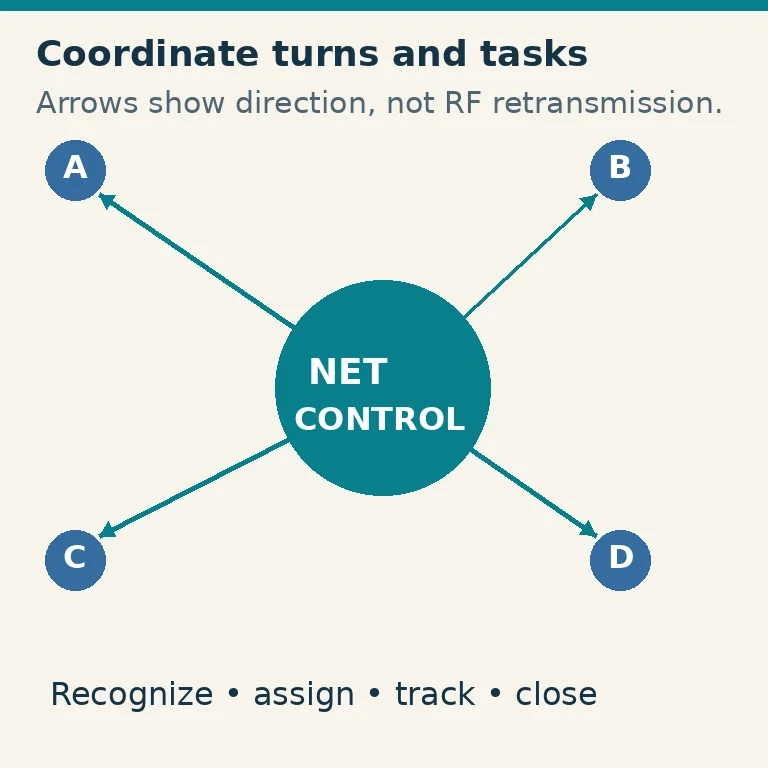
A directed amateur radio net is a group conversation supervised by a net control station, or NCS. If you are a licensed US beginner joining an ordinary social net, your first job is to listen: the opening tells you whom NCS is inviting, how check-ins work, and what information to give. Speak when an invitation applies to you and there is an appropriate gap; use your full assigned call sign, then wait to be recognized. Checking in joins the organized conversation—it does not give you the floor whenever the frequency goes quiet.
How a Directed Net Organizes the Conversation
The American Radio Relay League’s (ARRL) May 2002 Public Service Manual describes a directed net as one in which NCS supervises communications. Think of NCS as coordinating who speaks next. A check-in is a station’s initial request to join that organized exchange. After checking in, stations continue listening for NCS instructions. In the manual’s directed-net procedure, they also obtain NCS permission before checking out.
That structure is different from an open conversation in which someone might respond directly to the last speaker. On a directed net, a pause may simply mean NCS is about to call another station, invite a particular group, or continue an exchange already in progress. Silence alone does not tell you that it is your turn. The useful question is not just “Is anyone transmitting?” but “Has NCS invited a response that includes me?”
Imagine a social net where participants share a brief update. NCS might first invite new check-ins, then return to stations already on its list. Someone who checked in earlier may still be waiting to give an update. A newcomer who starts talking during a pause could cut across that sequence, even with a friendly comment. Listening to the opening and subsequent directions lets you fit your reply into the net’s flow rather than guessing at it.
The manual comes from a public-service operating context. It gives a useful model for understanding directed turns, but its procedure is not a mandatory FCC script for every casual social net. The actual net opening governs such details as check-in categories, whether stations are called individually, what information is wanted, and any announced convention for leaving. The stable idea is coordination through NCS; the particular words and order may differ.
Continued listening matters because a successful check-in is not the end of the interaction. NCS may acknowledge your call sign, ask you for the information the net requested, return to you later, or give a direction affecting everyone. If you hear only the invitation and then stop following the exchange, you may miss your turn. A beginner can participate with very little to say; paying attention between transmissions is part of participating.
From the Opening Announcement to Your First Reply
Before transmitting, listen for what NCS is asking stations to do. The opening may separate check-ins into categories, invite anyone eligible to call, or use a roll call, in which NCS calls stations individually. It may request a name, a location, a brief update, or something else. Those are possibilities to listen for, not a standard set of details you must supply. If you arrived after the opening or cannot tell whether the current invitation includes you, keep listening for a clearer invitation rather than treating the next pause as permission to transmit.
An open invitation gives the invited stations an opportunity to respond. Wait until NCS has finished speaking and there is a suitable gap, then make a concise check-in. With a roll call, wait for your station to be called or for a later invitation that applies to you; a pause between other names is not an open call. In either format, the opening—not your assumption about how nets usually work—determines which response fits.
Here is an original illustration of an ordinary social-net check-in. The bracketed call-sign text is a placeholder: a real operator would use the call sign assigned to their station, not transmit the bracketed words.
> NCS: “Check-ins for tonight’s social net are welcome. Please give your call sign and first name.”
> NCS finishes speaking; there is a gap.
> Beginner: “[My full assigned call sign], Jordan.”
> NCS: “[Your call sign], Jordan, you’re checked in. I’ll return to you for an update.”
> Beginner: Listens and waits to be called again.
In this imagined opening, the invitation applies to the beginner and requests only a call sign and first name. The reply supplies those details without launching into the update. NCS’s acknowledgment shows that the check-in was heard; its promise to return later tells the beginner when to expect another turn. If a real NCS instead asks for an update with the check-in, the appropriate reply would reflect that request. The dialogue illustrates how to interpret one opening, not words to recite on every net.
ARRL’s manual advises stations to use their full call sign when first checking in. That operating advice is distinct from the FCC station-identification rule. Under 47 CFR Part 97, a station must transmit its assigned call sign on its transmitting channel at the end of each communication and at least every 10 minutes during a communication. An NCS invitation does not replace that rule or expand what a station is authorized to transmit. For a licensed US beginner, the invitation answers when this net wants a reply; operating privileges and identification requirements still apply to the transmission.
Sometimes two stations answer an open invitation together. If you cannot tell whether NCS heard you, stop and listen. NCS may recognize one station, ask for the other, or make another invitation. Do not keep repeating your check-in over the controller’s reply. Likewise, if your call sign is not acknowledged, wait for an appropriate later opening and try again briefly. Recognition—not merely getting a transmission out—is what tells you that your check-in has entered the net’s organized exchange.
Taking Later Turns and Leaving the Net
Being checked in and having the floor are different things. Once NCS has recognized you, keep listening for its directions and for your next turn. ARRL’s manual says stations should not interrupt a net “transaction”—an exchange involving other stations or NCS—until that exchange is complete, except in an emergency. For an ordinary social-net comment, let the current speakers finish and wait for NCS to call you or invite further comments.
Suppose you missed whether NCS asked for a short update or just a check-in. If NCS calls you and the request is still unclear, a concise response such as “Could you repeat what you’d like with the check-in?” lets the controller clarify. If NCS is speaking with someone else, wait until that exchange ends and an appropriate break or invitation arises. Your question may be reasonable, but it does not need to interrupt another station’s turn.
The same distinction helps when you need to leave. In the manual’s directed-net procedure, stations check out with NCS permission. A brief request at an appropriate opportunity might be: “Net control, [my full assigned call sign] requests to check out.” Then listen for the reply rather than assuming the request itself ended your participation. If the casual social net has announced a different departure convention, follow that net’s stated procedure instead of imposing the manual’s public-service example on it.
The manual’s emergency exception is not a shortcut for an ordinary question, late check-in, or comment you do not want to forget. It distinguishes exceptional urgency from routine turn-taking; it does not, by itself, teach emergency operations or establish that a beginner is ready for an emergency assignment. For the ordinary social net considered here, the reliable pattern is simpler: listen for the net’s procedure, answer an invitation that applies to you, await recognition, continue listening for your turns, and leave according to that net’s convention.