An effective net control operator keeps a group of radio stations organized: who is present, who needs to speak, what information must move and when the net is finished. You do not need the loudest signal or the longest script. You need to listen, give clear instructions and maintain an accurate picture of what remains to be done.
Start with a routine club or training net and an experienced backup. Emergency, public-service and formal message nets may have their own plans and procedures. Learn those before taking responsibility; an informal check-in net does not confer emergency-management authority.
Understand the Job Before Taking the Microphone
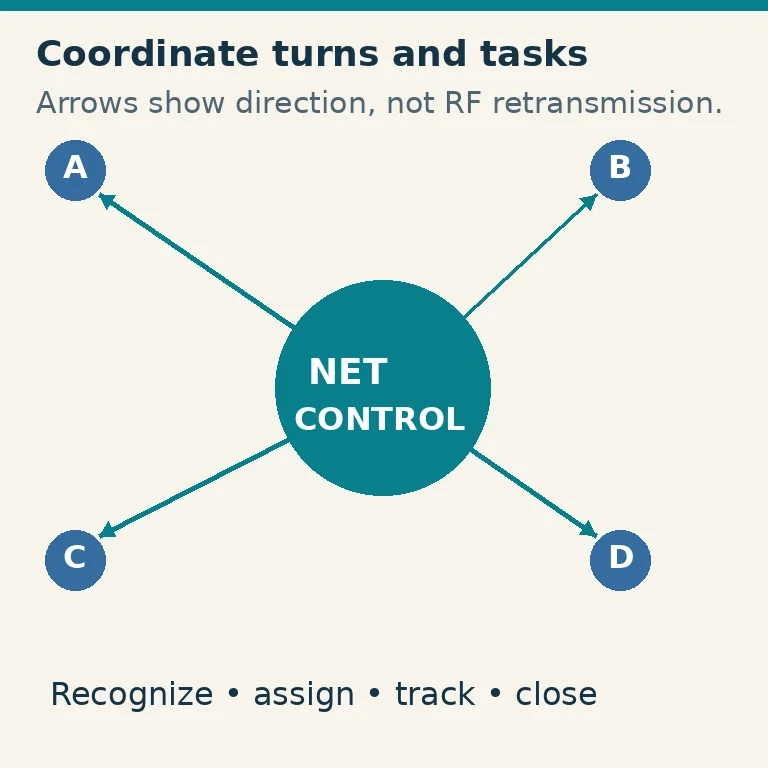
In a directed net, stations normally call net control and wait to be recognized rather than starting independent conversations. Net control allocates turns and coordinates traffic. It is an operating role, not ownership of a frequency or a repeater.
US amateur frequencies are shared. Listen before starting, respect ongoing communications and avoid deliberate interference. If the planned frequency is busy, follow the net's alternate-frequency plan or negotiate courteously. Announcing a scheduled net does not automatically displace another lawful user. The applicable US Part 97 provisions were checked on October 29, 2026.
ARRL's National Traffic System procedures provide useful models for orderly check-ins and traffic handling. Some terminology is specific to formal traffic nets. Use the procedures your own net has adopted; do not import unfamiliar abbreviations into a beginner roundtable merely to sound official.
Know the net's purpose. A social roundtable, equipment check, weather observation net and formal radiogram net need different pacing and records. Success means completing that purpose with clear communications, rather than maximizing the check-in count.
Prepare a Station and a Backup Plan
Check the correct frequency, mode, repeater offset and access tone where applicable. Listen to several sessions beforehand. Learn the usual coverage gaps, check-in pattern and how the group handles urgent traffic.
Use a microphone position and audio level that produce intelligible speech. Arrange a clock, writing surface or logging display where you can see them without fumbling. Keep a second way to record essentials if the computer fails.
Agree on a backup net control operator and a way to transfer control. The backup should monitor from a useful location, keep enough notes to take over and know the alternate frequency. A second station that cannot hear the weak end of the net is still helpful, but it may not solve every coverage problem.
For a repeater net, learn the timeout behavior and leave suitable pauses. Know how the net will continue if the repeater fails. For an HF net, expect propagation changes and arrange a relay station when appropriate.
Keep a short preamble with the net name, purpose, participation instructions and urgent-traffic procedure. Long introductions can bury the one instruction a new operator needs: when and how to call.
Open with Clear Instructions
First ask whether the frequency is in use and listen. When clear, identify your station and explain that you are acting as net control. Give the net's purpose and state whether it is directed.
For an illustrative informal training net, an opening might be: “This is [your callsign], net control for the club training net. Please call net control before passing traffic. Stations with emergency or urgent traffic may break in. We will take check-ins by the groups announced.” Replace placeholders with real information before transmitting.
Give one check-in instruction at a time. You might request callsign, first name and whether the station has traffic, followed by a pause for you to acknowledge. If you also need location or a field assignment, say so. Asking for seven details on the first transmission makes weak-signal copying harder.
Explain how late stations can join. Announce the net's alternate frequency or method when the operating plan requires it. Do not assume every newcomer heard last week's preamble.
Take Check-ins in Manageable Groups
Choose a method that fits the number of participants. A small net may accept any station. A crowded one may use callsign groups, geographical areas or a roster, followed by an opportunity for missed and late stations.
Copy the call first. If two stations double, acknowledge the part you heard and ask for a controlled repeat. “Station ending in Bravo, please give your full call” is more useful than “Everybody try again.” Use standard phonetics when a letter is uncertain.
Read back the stations you have recorded at useful intervals. Give a station a chance to correct its call rather than carrying an error through the whole net. Mark partial copies as uncertain until resolved.
Leave a pause between transmissions so weak stations and urgent traffic can enter. On a repeater, allow the system's timing to recover as its operator recommends. A net with no gaps can be orderly for its strongest members while excluding everyone else.
Do not publicly criticize a hesitant newcomer. Recognize the station, ask for the missing information and explain the next step briefly. The goal is a usable exchange and a participant who knows how to return next time.
Keep a Working Log, Not a Transcript
Record enough to know who is waiting and what still needs action. For a basic net, useful columns are callsign, name or location if needed, traffic or request, assignment and completion status.
Separate “checked in” from “traffic passed.” A station may be present but still waiting for a destination, relay or answer. Use visible marks such as pending, assigned and complete, with times where the plan requires them.
For an illustrative equipment-check net, one row might read: “[callsign] — weak receive audio — relay assigned — repeat confirmed.” It should describe the outcome, not merely contain a tick showing that somebody spoke.
Formal message traffic requires the net's approved message format and handling rules. Do not improvise a summary when the task is to move a message accurately. Request fills, preserve wording and record handling information as required. ARRL's traffic procedures are relevant here, while ordinary club comments do not all need formal radiogram treatment.
Keep personal information limited to the net's real purpose. Amateur transmissions are public. Avoid unnecessarily collecting or repeating sensitive details during routine check-ins.
Direct Traffic with a Complete Assignment
Before sending stations elsewhere, make sure the receiving station is available and the proposed frequency is appropriate. Give both callsigns, the task, the frequency or channel, and what to do afterward.
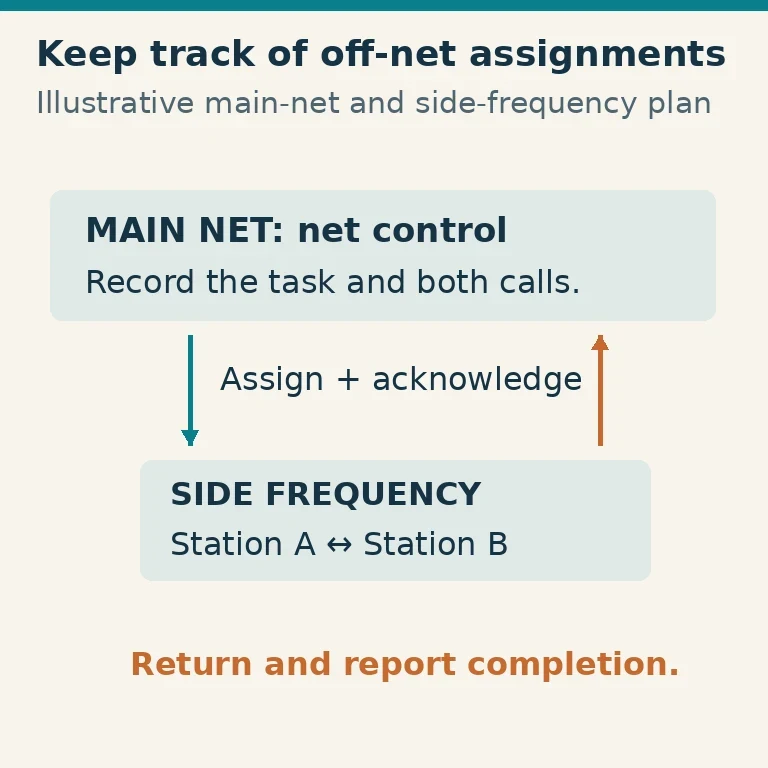
For example: “[Station A] and [Station B], check [agreed frequency] for your equipment test. Keep clear of existing activity, then return here and report completion.” This is an illustrative pattern, not a universal authorization to use any frequency. Both stations need privileges and compatible equipment for the assignment.
Ask for acknowledgment if the instruction was weak or consequential. Record the assignment and follow up if neither station returns. Otherwise a busy net can lose track of stations it sent away.
When using a relay, say which station should relay and what information is required. Do not have several strong stations repeat the same message simultaneously. A relay should improve the path while preserving accuracy, not substitute its own answer for the original station's words.
If the conversation belongs on the main net, recognize the speaker and keep the exchange focused. If it becomes an extended unrelated discussion, move it according to the net plan or offer time after the formal net closes.
Handle Interruptions, Weak Signals and Urgent Traffic
Stop routine check-ins when a station reports emergency traffic. Establish what is needed, keep the frequency available and follow the net's emergency plan. Do not delay a genuine request for help to complete your script.
For organized public-service work, operate within the event's communications plan and assigned role. Net control is not automatically a dispatcher, medical adviser or incident commander. Pass accurate information to the proper authority through the established route.
If a weak station is struggling, reduce the information requested per transmission. Ask for the call, then the essential message, with readbacks where needed. Use a better-positioned relay if available. Repeatedly telling the station to “speak up” may not improve an RF path.
If interference begins, remain calm. Determine whether another net or station was already there, whether the repeater has a technical problem, or whether an alternate frequency is needed. Avoid arguments that occupy more airtime than the original interference.
Tactical identifiers can make assignments easier, but they do not replace required amateur station identification. Follow legal identification rules and the operating plan together.
Hand Over and Close Deliberately
A useful handover includes the net purpose, current frequency, stations still pending, active assignments, outstanding traffic and any weak-signal or emergency issue. Ask the backup to acknowledge taking control. Tell the net who now has the role, using the stations' real callsigns.
Before closing, invite any remaining traffic and late check-ins according to the plan. Resolve or explicitly transfer unfinished tasks. A missed request should not disappear because the scheduled hour ended.
Thank participants, identify and state that the net is closed or that the frequency is returned to ordinary use. Submit the required report to the club or organization through its normal process, keeping check-in numbers distinct from messages actually handled.
Afterward, ask the backup what instructions were unclear or which stations were missed. Choose one improvement for the next session: shorter check-in groups, better pauses or more complete assignments. Effective net control grows from that repeatable listening-and-correction habit.