Plan one listening target and time, put your exact radio into a documented receive-only configuration, then listen and take brief notes. Afterward, review what you heard—and what you could not determine—before considering a later transmission. This gives you a way to learn call signs and operating procedure without checking in. It is not permission to transmit, and it does not test whether your station is ready to do so. The first task is to establish the transmit boundary; if you cannot verify it for the channel you intend to use, pause and get help rather than proceeding on an assumption.
Set up the Radio so the Session Stays Receive-only
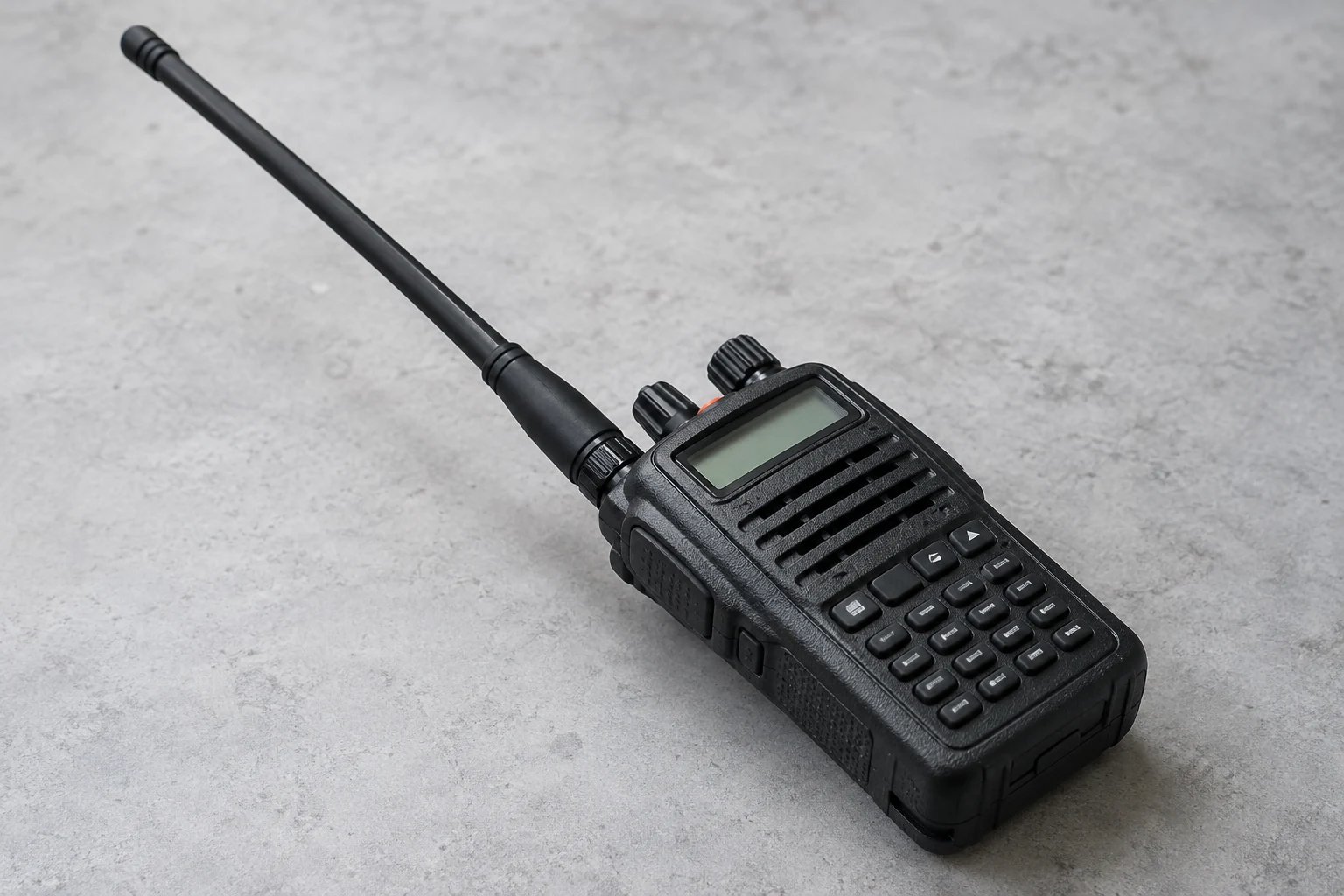
Choose a radio that can receive your intended amateur-radio target. Before powering it for the session, open the manual for that exact model and check how to select the target’s frequency and mode, use the appropriate antenna and power arrangement, and inhibit transmission on the selected channel. Stay with connections and settings you understand; unfamiliar antenna installation or electrical work is not part of this exercise.
Find and verify the documented transmit-inhibit setting before tuning or listening. For a bounded example, Icom’s V86 advanced manual says that setting TX permission to OFF inhibits transmitting on the channel. It also says VOX—voice-operated transmission—cannot transmit when that setting is OFF. Those statements describe that radio’s documented configuration; they are not menu instructions for another model. Check the selected channel rather than assuming a setting you saw elsewhere applies to it.
Look separately for anything that could start transmission without an ordinary button press. If your equipment has VOX or computer-controlled automatic transmission, use its actual documentation to disable or otherwise prevent those functions for this session. Do not press PTT, TRANSMIT, Tune, or Test PTT to see whether the inhibit works. A key lock is not a substitute unless the manual specifically documents it as a transmit inhibit for your setup.
If you cannot identify the correct setting, cannot verify that it applies to the selected channel, or are unsure what connected software might do, stop the powered-session plan and ask someone familiar with the equipment to help. You can still use the time to read the manual and choose a listening target. That is more useful than guessing at a menu item and hoping it prevents transmission.
This boundary is an equipment precaution for practice, not a legal determination. It does not establish your US amateur-radio privileges, check a transmitter, or certify the antenna and station configuration for a later contact. Keep those questions separate: today’s goal is to receive and observe.
Choose a Listening Target and Follow One Session
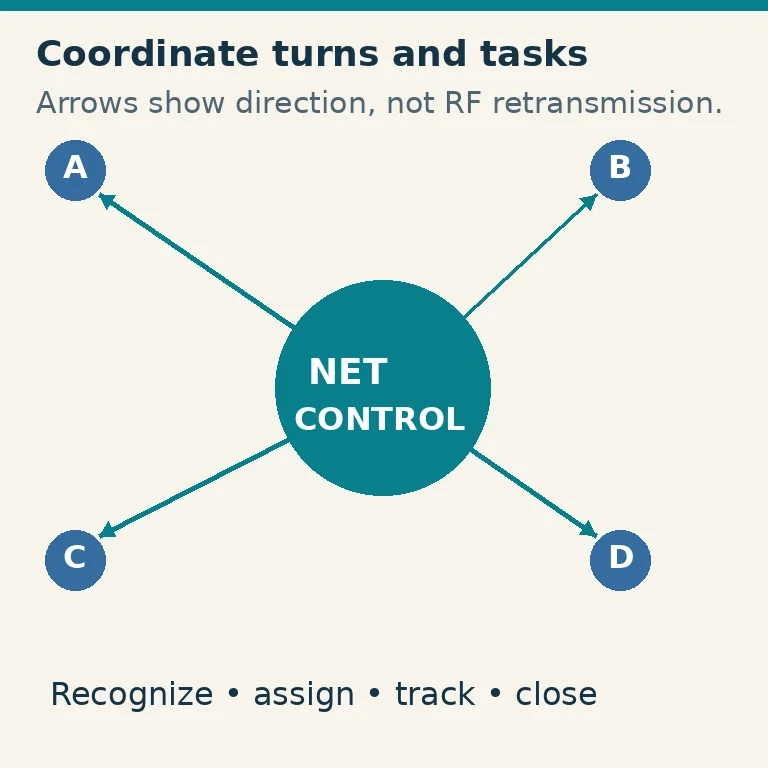
Pick one current target rather than scanning without a plan. A local club’s net listing is one option; ordinary amateur activity you can receive is another. A net is an organized on-air gathering. Its net control station, or NCS, directs the sequence of participants. A call sign is the station identifier you may hear as people take turns. You need not know everyone’s call sign in advance to listen for the pattern.
For a listed net, check its stated day and time, time zone, frequency, and mode against what your radio can receive. The Puget Sound Repeater Group’s published net schedule is an example of a group that explicitly welcomes people who are just listening. That invitation is not a promise that its activity will be audible where you are. Check a current listing rather than relying on an old schedule, and choose a different target if its timing or receive details do not suit your session.
A simple plan has a start time, a target, and an end point. Write down the planned local time with its time zone, plus the frequency and mode from the current listing or your other chosen target. With transmit inhibited as described above, select the documented receive settings. Set the volume to a comfortable level, then adjust squelch only as needed. Squelch keeps unwanted noise out of the speaker; an unsuitable receive setting can also make a listening attempt seem quieter than expected. Listen through a reasonable interval of the chosen activity rather than treating a few silent seconds as the result of the whole session.
If the target is unexpectedly silent, check the receive frequency, mode, and any receive filter against your manual before concluding that nobody is active. On the V86, Icom says tone squelch or DTCS squelch opens for a received signal with the matching programmed tone or code. Thus a receive filter is one possible reason that audio does not open; it is not proof of activity you cannot hear. The target may also be quiet, missed, or inaudible at your location. Do not try to resolve that uncertainty by transmitting.
While listening, notice whether you hear call signs and whether an NCS invites, acknowledges, or directs turns. What order do replies follow? Is there a pause before the next person speaks? Jot down a question if a setting or part of the procedure is unfamiliar. You are observing, not joining the net, so no on-air check-in is required.
Keep the log modest. For example, an illustrative note might read:
> 2026-10-20, 7:15 p.m. EDT — Target: [frequency from current listing] / [mode from listing]. Call signs heard: none copied. NCS turn-taking: not heard during this interval. Question: check receive-filter setting in manual.
The brackets are fields to fill from your actual target, not a frequency or mode recommendation. If you do hear activity, record only the call signs and procedural observations useful to your learning; there is no need to transcribe personal conversations. If you miss the planned net, or hear nothing after checking the documented receive settings, log that outcome and reschedule or choose another current target. An unheard session can still tell you which detail to verify next.
Review What Reception Taught You Before Any Transmission
After the session, separate what you observed from what you are tempted to conclude. Look over the date and time zone, target frequency and mode, call signs you could identify, and any NCS turn-taking you noticed. Mark gaps honestly: perhaps you heard voices but could not follow the sequence, or perhaps the entire interval was quiet. Keep these working notes offline rather than publishing personal conversations.
A clear received signal supports a narrow conclusion: your setup received that activity at that time. It does not show that your transmitter could reach the station or a repeater. A repeater is a station that receives a signal and retransmits it; hearing one side of that path does not test your own transmitting side. Conversely, failing to hear the planned target does not, by itself, establish a fault in your radio. Timing, the selected receive settings, and whether the activity is audible at your location remain questions to investigate. Treat both “heard” and “not heard” as observations, not verdicts about transmitter performance.
Turn each unresolved point into a next action you can complete without transmitting. If audio stayed closed, find the manual’s explanation of the selected receive-filter setting. If you heard an NCS but lost track of the order, ask a local club how that net normally handles turns, or listen to another session and compare notes. If your evidence is too thin to answer a question, plan another receive-only interval with a current target and record what changes. That gives the next session a purpose instead of making it a repeat of uncertain scanning.
Use the review to make a conditional decision. If the radio’s receive-only configuration or the observed procedure remains uncertain, keep listening and seek help. If you later want to transmit, a qualified control operator must first verify the relevant privileges and the actual station configuration. Do not treat this rehearsal as certification of a transmitter, antenna, or legal compliance.
The useful result is deliberately limited: a session bounded by a documented transmit inhibit, a record of what you actually heard, and a specific question or next step grounded in that record.