DMR, D-STAR and System Fusion all carry digital amateur voice, but they are different over-the-air systems. A radio that supports one does not automatically decode the others. For a beginner, the most useful choice usually starts with the repeaters and people you can actually reach, followed by the programming and network features you want to use.
Separate two questions throughout the comparison: what RF format reaches the local repeater, and what network carries the conversation beyond it? A worldwide network does not repair a weak local radio link, and an Internet bridge does not turn a single-mode handheld into a universal digital receiver.
What Each Name Describes
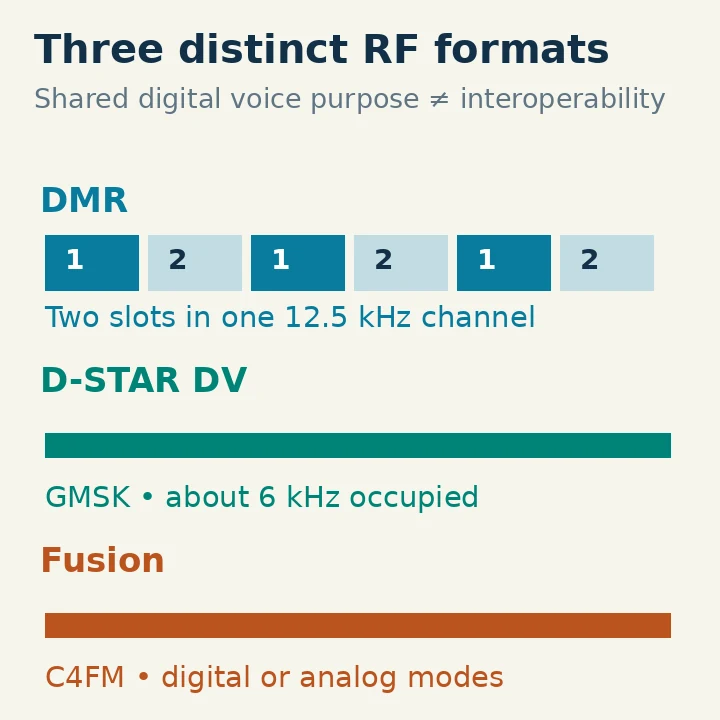
DMR, Digital Mobile Radio, is based on an ETSI standard used widely outside amateur radio as well as by hams. Conventional amateur repeater operation normally uses DMR Tier II. Its two-slot time-division arrangement provides two communication paths within one 12.5 kHz RF channel. The DMR Association explicitly distinguishes that actual channel from its 6.25 kHz-equivalent efficiency per path.
D-STAR, Digital Smart Technology for Amateur Radio, is an amateur digital communication protocol developed by the Japan Amateur Radio League. For ordinary digital voice, Icom describes GMSK modulation with an occupied bandwidth of about 6 kHz, identified as 6K00F7W. D-STAR also has other modes and data capabilities, so that voice figure should not be applied to every D-STAR transmission.
System Fusion is Yaesu's implementation of digital amateur communication using C4FM. Its product family combines digital operation with conventional analog FM. Yaesu describes voice/data, full-rate voice and data modes, along with Automatic Mode Select, or AMS, which can recognize an incoming supported mode and select operation accordingly.
Those descriptions are technical scopes, not a quality ranking. The fact that two formats use digital voice or related speech-coding technology does not make their RF framing, modulation and control information interchangeable.
Compare the Local RF Arrangement First
DMR's distinguishing feature for repeater use is its time slot. A channel configuration must use the slot assigned to the intended talkgroup. Two simultaneous paths do not mean two people can speak at once in the same talkgroup on the same slot; that conversation still needs orderly turn-taking.
D-STAR's ordinary DV operation uses its own RF format and routing fields rather than DMR color codes and time slots. A matching-frequency analog FM radio will not decode its digital voice. A D-STAR radio that also supports analog FM must actually be in an appropriate supported analog mode to communicate with an analog station.
Fusion likewise needs a C4FM-capable radio for its digital voice. Its analog compatibility is valuable, but AMS is not a general DMR or D-STAR decoder. The repeater's configuration matters too: it may accept one mode and retransmit another, or be configured differently from the neighboring Fusion repeater.
Before buying, obtain the actual local repeater's current band, frequency pair, mode, access requirements and coverage reports. Confirm that the advertised “digital” function on the radio means the system the repeater uses. Do not assume that a programmable radio supporting analog FM can gain an unrelated digital voice mode through a codeplug.
Identity and Programming Feel Different
For DMR, expect a numeric radio ID, digital contacts and one or more programmed channels organized into zones. A digital contact may identify a group destination or an individual. Each repeater channel brings together receive/transmit frequencies, color code, time slot and a default transmit contact. An RX group list may determine which group calls the radio unmutes.
A codeplug is the stored radio configuration assembled by programming software. It is not a firmware update or a new license. A downloaded codeplug can be a useful example, but the radio model, firmware, your own ID and current repeater details must all be checked before writing it to the radio. Building one known channel first is easier to diagnose than importing hundreds of unfamiliar entries.
D-STAR organizes operation around call signs and repeater/gateway routing information. Its call-sign routing can reach a user or a specified repeater under the system's conditions. Radios with a repeater-assistance function can simplify entry, but you still need to understand whether you are making a local call or routing through a gateway.
Fusion users should understand the selected C4FM or analog mode, the repeater's access policy and any linking interface in use. A radio's ability to participate in local C4FM voice is a separate question from its ability to initiate every WIRES-X or other network function. Verify the model's supported functions rather than assuming that a common brand name guarantees every feature.
A Talkgroup, a Reflector and a Room Are Not Universal Equivalents
A DMR talkgroup identifies a group-call destination. The repeater and its network determine which destinations are available on which slots and whether they are permanently carried or activated under particular conditions. Do not assume that the same number has identical behavior on every DMR network. The qdmr manual explicitly distinguishes network arrangements even when the local RF format is DMR.
A D-STAR reflector can link participating repeaters and users for a shared conversation. Icom's introduction also describes call-sign routing and gateway calls, which are related capabilities but not interchangeable labels for every link. Registration or access requirements should be checked with the gateway system you intend to use.
A WIRES-X room belongs to Yaesu's Internet-linking system. Fusion describes the local radio technology; WIRES-X describes a linking service and associated equipment/functions. A repeater can provide local communication without being linked to the room you want.
Other servers and bridges can connect parts of these ecosystems. Their existence is useful, but it adds an operator-managed translation path. It does not prove that all signaling, identification, data, control functions or audio characteristics survive unchanged. Ask which specific route is available rather than accepting “all digital systems are linked” as a purchase criterion.
Local Communication and Worldwide Linking Have Different Dependencies
A direct digital contact between compatible radios depends on the RF path and appropriate settings. A local repeater contact additionally depends on the repeater being operational and reachable. A linked conversation adds a gateway, server or network route, often with an Internet connection.
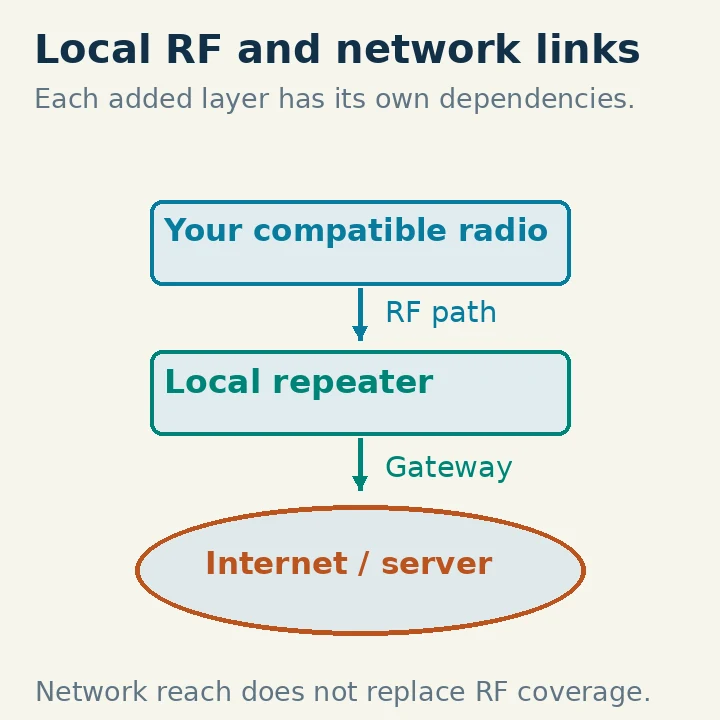
The dependency drawing shows those layers separately. If a network route fails, the local RF side may still be usable. If your radio cannot reach the local repeater reliably, a distant server's availability does not solve the problem.
That distinction is especially important when planning backup communications. Confirm which local functions work without the Internet and what the repeater operator has actually arranged for power and connectivity. A diagram of worldwide links is not evidence of resilience at a particular site.
A hotspot provides a nearby RF-to-network access point for supported modes. It can be useful where there is no suitable repeater, but requires its own configuration and network connection. Choosing a hotspot before choosing the people and services you want to reach can simply move the compatibility problem to another box.
Compare the Listening Experience Fairly
Digital voice can sound consistent while a usable signal is decoded, then become broken or disappear as errors exceed what the system can handle. The exact behavior depends on the RF conditions, codec, receiver and implementation. Manufacturer claims about clarity should not be treated as a universal measured advantage over the other two systems.
Listen to the same kind of operation you plan to do: ordinary local conversations, a mobile route, or linked nets. Ask for reports from your actual operating position. A demonstration near a repeater does not establish coverage from inside your house.
Do not compare nominal channel widths as a complete range calculation. Antennas, frequency band, terrain, transmitter power and receiver performance all affect the result. Two DMR time slots are a capacity feature; they are not a promise of double the RF range. Similarly, a preferred voice sound is a personal operating preference rather than proof of greater sensitivity.
All three systems require understandable microphone technique and pauses. Network linking can add delay and shared-channel constraints. Listen before calling, allow the previous transmission to finish and avoid repeatedly pressing PTT just to make an ID or status indicator appear.
Match the System to a Realistic First Goal
| Your first goal | What to verify before choosing |
|---|---|
| Join an existing local group | Which system its members and accessible repeater actually use |
| Reach a particular linked net | Exact network and destination, schedule and access policy |
| Use one radio with analog friends too | Supported analog bands and modes, not only the digital label |
| Learn programming gradually | Availability of a matching manual, current software and someone who can help with one channel |
| Operate where no repeater is reachable | Compatible direct operation or a deliberately planned hotspot/network arrangement |
For example, a well-supported local DMR group can make DMR a practical first system despite its unfamiliar programming fields. A beginner who already has access to an active D-STAR gateway may gain more from learning that route than from buying the format with the most appealing marketing comparison. A Fusion club using mixed analog and digital operation may value the available mode-selection arrangement. These are conditional examples, not claims about which system dominates in your town.
Check the ongoing practical costs as well: programming cable, supported computer, any interface or hotspot and the time required to keep the configuration understandable. Avoid choosing solely from the price of the handheld body.
Before committing to a radio, ask a local operator to show the actual channel selection and a complete contact. Notice how a missed destination differs from poor RF coverage. Check whether the manual and programming software support your computer, and retain a small example configuration that you can explain. That short demonstration answers practical questions a specification comparison cannot.
Keep Amateur Privileges Separate from Network Access
For US operation, Technician, General and Amateur Extra operators may use appropriate VHF/UHF amateur voice segments, subject to their actual privileges and applicable restrictions. A numeric DMR ID, D-STAR gateway registration or network account is not an FCC license and does not extend the authorized bands. FCC §§97.105, 97.301 and 97.305 were checked October 29, 2026.
Commercial DMR specifications include encryption features. Their availability in a menu does not authorize messages encoded to obscure their meaning in ordinary US amateur communication. Keep encryption/privacy settings disabled for amateur voice operation and observe identification and interference obligations.
The strongest first choice is the system that serves a verified communication goal and that you can configure, test and maintain. Establish one local conversation first; then add the network features whose dependencies and operating rules you understand.