Calling CQ invites any station that hears you to make a contact. For a new US operator, the sequence is straightforward: choose a frequency and mode your license permits, listen and ask whether the frequency is in use, send a brief call using your own assigned call sign, then stop transmitting to hear a reply. If someone answers, copy their call sign, respond, and identify correctly through the end of the contact. If no one answers, you can try again—but silence alone does not tell you that the frequency is free or that your equipment has failed.
Choose Where to Call
CQ is a general invitation to make a contact, rather than a call to one particular station. A call sign is the identifier assigned to an amateur station; when you call, use the call sign authorized for your station, not one you saw in an example. Simplex means direct station-to-station operation without a repeater. A repeater, by contrast, is a station that retransmits signals. Those distinctions matter because a suitable opening on one kind of channel may be out of place on another.
For your first HF contact, use SSB voice or CW as the main path in this guide. Before looking for a spot, establish where you are allowed to transmit. In the US, 47 CFR § 97.105 says a station may be operated only in the manner and to the extent authorized by the control operator’s license class. Check current privileges for the particular frequency and mode you intend to use. An ARRL article from 2020 tells readers to consult a band chart from that issue; its chart is historical guidance, not current permission to transmit.
Keep receiving and transmitting separate in your mind. Hearing other stations on a frequency may make it interesting to explore, but reception does not establish that your license permits you to call there. Nor does this guide designate one frequency that is suitable for every operator. Your next task is to find a place within your current privileges and check whether anyone is using it.
If you are operating VHF SSB or CW, ARRL says calling CQ as you would on HF is standard practice. The same basic sequence—choose an authorized place, listen, check, then make a short identified call—applies to that branch. If instead you are on VHF FM simplex, ARRL says a traditional CQ is possible but uncommon; announcing that you are listening and standing by for a call is the more usual approach. That alternative applies to a direct simplex channel, not automatically to every VHF channel.
If you are using a repeater, do not carry over the HF-style CQ opening. ARRL specifically advises that calling CQ is not good repeater etiquette. These branches are choices based on the mode and channel you actually use: HF or VHF SSB/CW for the CQ procedure below, FM simplex for a listening announcement if appropriate, and no assumption that a repeater is a place to practice CQ. Once you have an authorized, suitable calling place, the next question is whether transmitting there would interrupt someone.
Listen and Check Whether the Frequency Is in Use
Start on a frequency and mode you have confirmed you may use. Then listen before transmitting. ARRL advises finding a frequency unoccupied by another station before calling CQ. Hearing a conversation is an obvious reason not to start there; hearing nothing is only an initial observation. It is not proof that every station using the frequency is within your hearing.
Give listening its own place in the sequence rather than treating it as a momentary gap before you speak. While listening, consider whether what first sounded quiet is actually part of an ongoing exchange. You might hear a station after a pause that concealed its previous transmission from you. The practical point is modest: use what you can hear to avoid an interruption, while recognizing that listening cannot reveal a station you cannot receive.
If the frequency still seems clear, ask whether it is in use and state your assigned call sign. That follows ARRL’s guidance for a pre-CQ inquiry. On voice, a simple model is: “Is this frequency in use? This is [your assigned call sign].” The bracketed text is a place to insert your actual authorized call sign; do not speak the brackets or an example station’s identity. Ask, then stop transmitting and listen for a reply.
For CW, make the same underlying check: listen first, send a brief inquiry about use of the frequency with your own call sign, and listen again. There is no need to treat a particular CW inquiry string as a required script. What matters here is the action the inquiry serves: giving a station already using the frequency a chance to tell you before you start calling CQ.
If someone says the frequency is occupied, do not begin CQ there. The same applies if you hear activity that you initially missed, even if no one answers your inquiry directly. Look for another frequency that is both permitted for you and suitable for the intended mode, and repeat the listening check there. An ARRL-hosted operating guide explicitly directs operators to find another frequency when the first is occupied. Moving is not a shortcut around checking.
If nobody answers the frequency-use inquiry, pause and listen again before proceeding. An unanswered inquiry gives you no reported objection from a station you could hear; it does not verify that the channel is free of all use. That limit is worth carrying into the next step. Make a short call rather than occupying the frequency for a long uninterrupted transmission, and remain ready to stop if use becomes apparent. The check reduces the chance of interfering with another contact, but it cannot certify what you cannot hear.
Transmit a Short CQ on Voice or CW
Once you have checked an authorized, apparently unused place, make your call brief and identifiable. A CQ needs to tell listeners that you are inviting a contact and which station is inviting it. ARRL’s illustrative SSB call is: “CQ CQ Calling CQ. This is AD5UAP, Alfa-Delta-Five-Uniform-Alfa-Papa.” AD5UAP is ARRL’s example call sign, not yours to transmit as your station’s identity.
For your own HF SSB call, use this as a template instead:
> “CQ CQ, calling CQ. This is [your assigned call sign], calling CQ.”
Replace the placeholder with your station’s authorized call sign. The opening “CQ” signals a general call; “calling CQ” makes the invitation plain; and your call sign tells a listener whose call they are answering. You can keep the wording natural rather than trying to reproduce the illustrative sentence exactly. What must not change is whose identity you give.
If letters in your call sign may be difficult to copy, spell your own call phonetically after saying it. ARRL’s example demonstrates that approach by following its illustrative call sign with spoken phonetic words. Use phonetic words for the letters actually in your authorized call sign, not the words attached to AD5UAP unless those letters are yours. The aim is clarity for the station listening, especially when it may have caught only part of a short call.
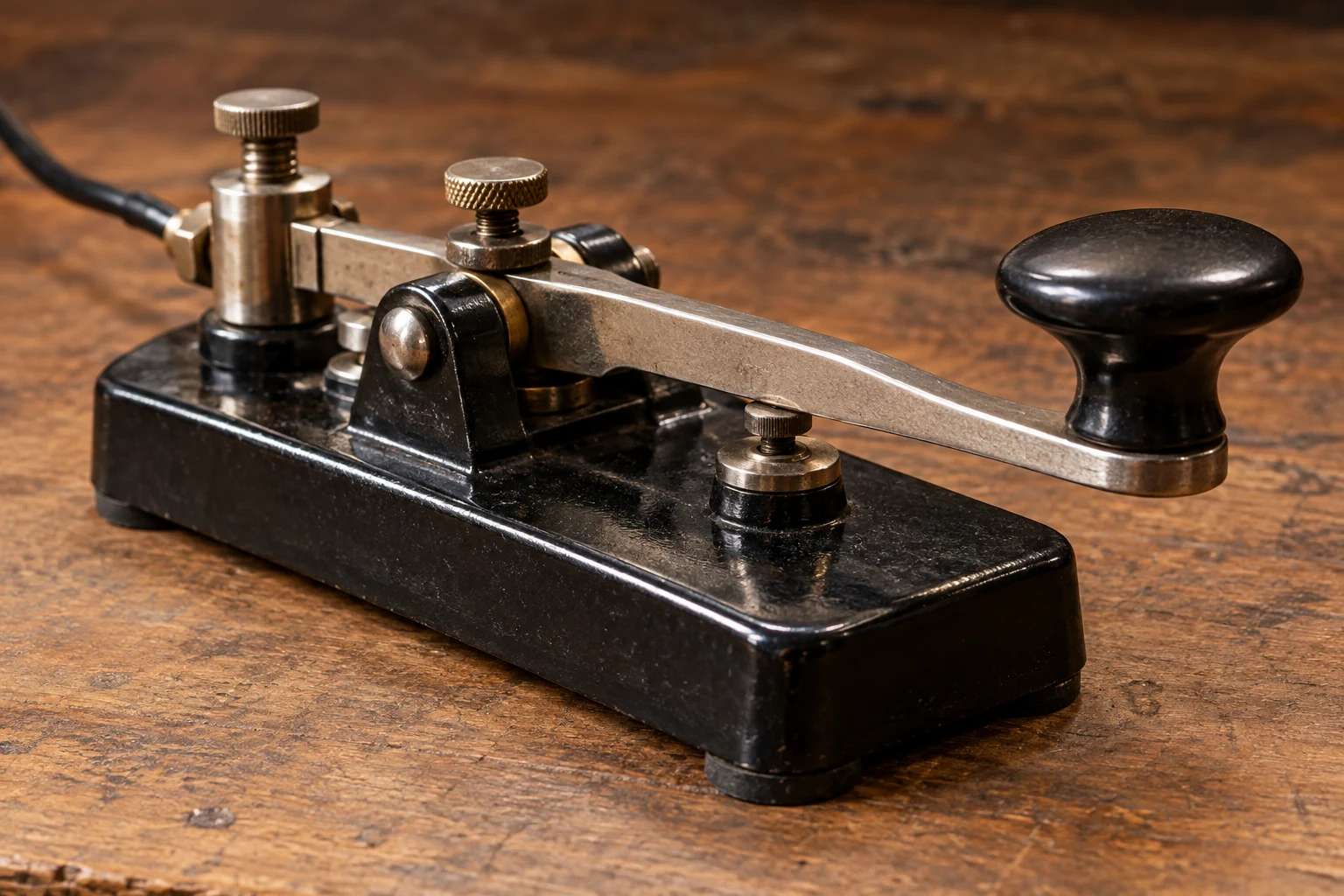
On CW, ARRL illustrates a similarly compact general call:
> CQ CQ CQ DE W1BXY W1BXY K
W1BXY is an example call sign, not an instruction to use it as yours. ARRL explains that DE means “from” and K means “over,” or “your turn.” The repeated example call sign supplies the caller’s identity, and the ending yields the opportunity to answer.
Adapt the sequence with your own authorized identity:
> CQ CQ CQ DE [YOUR ASSIGNED CALL SIGN] [YOUR ASSIGNED CALL SIGN] K
The bracketed text is a placeholder, not CW text to send literally. Send your actual call sign in both places. Whether you are speaking or sending CW, a listener needs a usable chance to copy that identity and then respond; an impressive-looking sequence is no help if it identifies the wrong station.
Keep calls short enough to leave openings for answers. ARRL recommends several short SSB calls over one long call and notes that a long-winded call can discourage contacts. On voice, finish a concise CQ and release transmit so another operator can reply. The CW example makes the same practical opportunity visible through its ending: after you send the call, listen rather than immediately starting another one. Neither example establishes a universal number of seconds to transmit, a required number of CQ repetitions within one transmission, or a promise that someone will hear you.
For a first attempt, clarity beats elaboration. You do not need to announce your whole station description before anyone has answered; that can wait for the contact. Give the invitation and your identity, leave room for a response, and pay attention to what happens next. The US rule for identification during and at the end of a communication is covered below, but it never makes an example call sign acceptable as your own.
Listen for an Answer, Then Decide Whether to Try Again
After each short CQ, stop transmitting and listen. Another station can answer only if you give it an opening, and you need to hear enough of that answer to respond accurately. ARRL’s illustrated calling sequence suggests listening for about five seconds before sending again if nothing is heard. Treat that as an example pause, not a mandatory timer for every voice or CW contact. The usable principle is to leave a real listening interval after each call rather than filling every gap with another transmission.
If you hear no answer, make another short call and listen again. ARRL’s first-contact guidance suggests trying CQ three or four times and then trying another frequency if there is no response; another ARRL calling example likewise suggests changing frequency after several tries. Those are practical examples of when to reconsider your approach, not a threshold that guarantees a contact. A shorter or longer attempt may make sense in the situation you hear, provided you continue leaving room for replies and stop if you become aware of other use.
Silence has limited meaning. It does not establish that the frequency is clear: the listening and frequency-use check cannot reveal every station you cannot hear. It also does not establish that your transmitter or receiver has failed. ARRL notes that, at some times, HF conditions leave few stations available to answer calls on a band. That is one possible reason a call goes unanswered, not a diagnosis of your particular contact attempt or your equipment. Avoid drawing a firm conclusion from one unanswered CQ—or even several.
After several attempts, you have two low-risk choices. You can stop and try again later, or you can seek another place that is authorized for your license class and chosen mode. If you move, start the check again: listen, ask whether the frequency is in use with your own call sign, and listen for a response before calling CQ. The fact that the previous place produced no answer tells you nothing about the new one. If activity becomes audible where you are calling, stop calling there and find another suitable place rather than trying to speak over it.
This keeps the decision practical without making silence do more work than it can. A reply means you can begin a contact. No reply means you can offer another brief opportunity, change places after a fresh check, or leave it for another time. None of those choices requires assuming the channel was conclusively free or treating an unanswered call as an equipment test.
Answer the Station and Finish the Contact
First, keep the two sides of a CQ straight. ARRL advises an operator answering someone else’s CQ to say the called station’s call sign followed by their own. In this guide, you are the operator who called CQ. When someone answers you, your immediate job is different: listen for and copy their call sign, then respond using their call sign and your own authorized call sign. This is a practical continuation of the contact, not a quoted ARRL dialogue.
For example, using placeholders rather than either ARRL example identity, the continuation might sound like this:
> Answering station: “[YOUR CALL SIGN], this is [ANSWERING STATION’S CALL SIGN].”
> You, the original CQ caller: “[ANSWERING STATION’S CALL SIGN], this is [YOUR CALL SIGN]. Thanks for the call.”
Replace each placeholder with the call sign it describes. The example shows whose identity goes where; it is not a required script. In particular, do not repeat a call sign you think you heard as though you are certain if you missed part of it. Ask the answering station to give its call sign again, listen, and then use the identity you copied. That small pause is more useful than building a conversation on a guess.
Once you have each other’s identities, the exchange can be simple. ARRL suggests starting with your name, location, a signal report, and a brief account of your station. You might give your name and location, tell the other operator how their signal is coming through, and mention your station briefly; then leave room for their answer. If the conversation is short, those basics are enough to make it a contact. They are topics to draw from, not a required checklist or a rigid order.
Keep identifying as the communication continues. For ordinary US amateur stations, 47 CFR § 97.119(a) requires the station’s assigned call sign on its transmitting channel at the end of each communication and at least every ten minutes during a communication. It also prohibits unidentified transmissions and using, as the station’s call sign, a call sign not authorized to that station. The quoted provision states exceptions for space stations and telecommand stations; those do not change the ordinary-contact procedure described here.
In practice, say or send your assigned call sign as you close, even if both operators already know who is speaking. If the contact lasts long enough, identify at least every ten minutes during it as well. The answering station’s call sign helps you address and acknowledge that operator; your assigned call sign identifies your station. Keeping those jobs separate also prevents a source’s illustrative identity—or a call sign you heard on the channel—from becoming your own by accident.
A first CQ does not have to produce a contact to be done well. Choose a place your privileges permit, listen and inquire, make a brief call with your own identity, leave space for an answer, and identify correctly if a contact develops. That sequence remains useful on the next attempt, whether this one ends in conversation or silence.