Choose the Setup That Passes Every Check
The best portable antenna mast for your POTA activation is the one that supports your antenna at a usable height, travels to your operating spot, fits its complete support arrangement within the available space, is allowed there, and can be raised safely. Published height alone cannot answer those questions.
Picture two trips: for a walk-in activation, a mast that is easy to carry may still be a poor choice if the antenna cannot attach where you need it. Beside a vehicle, a larger support may be easier to transport but unusable if its mount or guy lines cannot fit the site. Compare the complete setups, not just the poles: antenna and attachment hardware, packed kit, base or mount, and any required guys.
A failed check is a reason to change the antenna arrangement, support plan, or site—not to force the tallest mast into the activation.
Start with the Antenna and Its Usable Attachment Height
An extended-height figure does not tell you where your antenna can attach. Start with the antenna’s intended position: a horizontal wire needs a supported attachment point, while a vertical system may use the mast differently. On the SOTABEAMS Travel Mast, horizontal antenna attachment is practical only to 7 m, although a vertical can use the full mast height. SOTABEAMS recommends attaching its Band Hopper antenna no higher than 6 m on that mast. A plan that depends on putting that horizontal antenna at the mast’s full height therefore needs a different plan—not just a longer-looking specification.
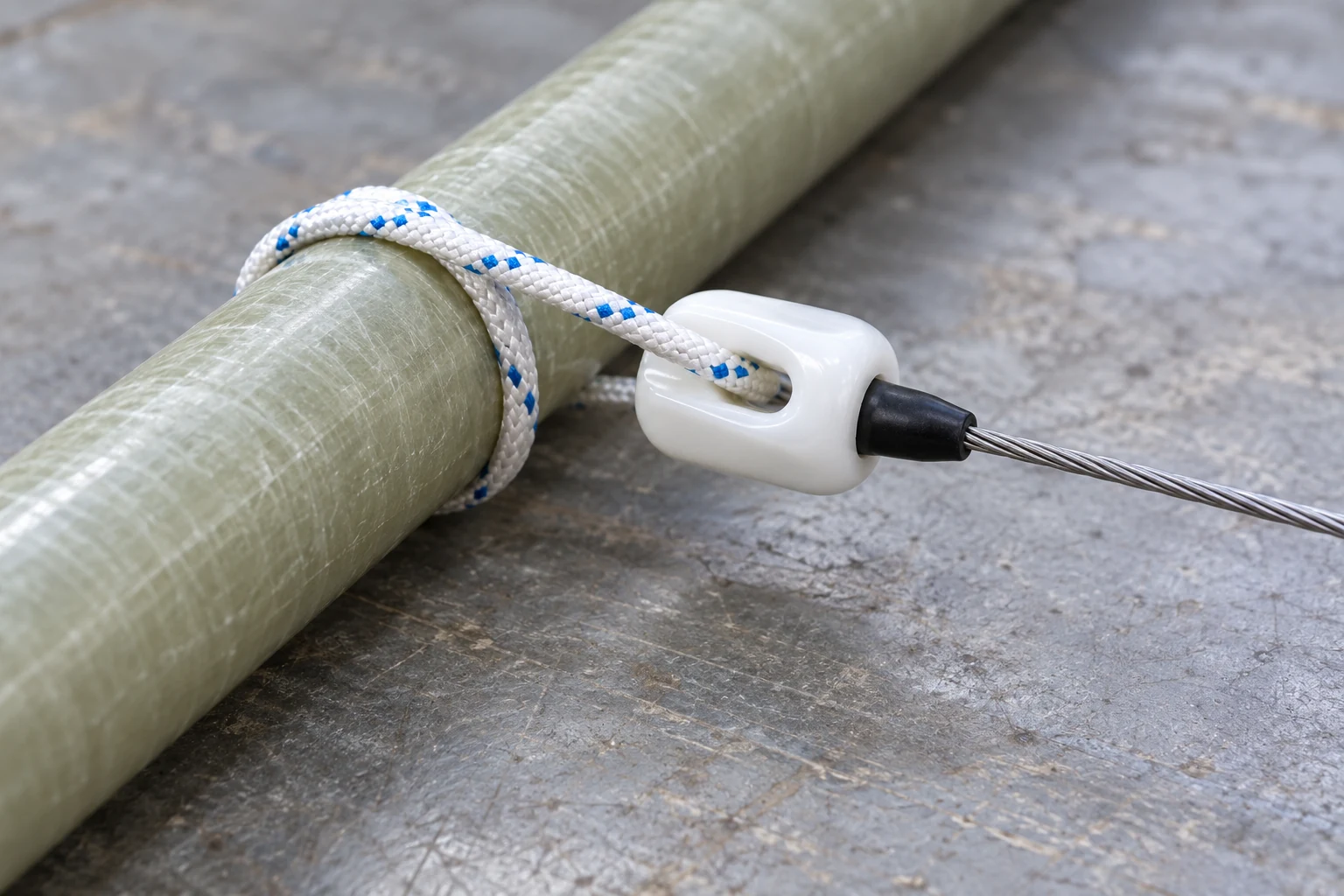
Include everything the mast must support in that plan: the antenna, its attachment hardware and any feed line that will hang from or pull on it. Feed line is the cable between the radio and antenna; its route matters because a cable left to tug at the attachment point changes the load the mast must carry. Decide where the cable will run and how the antenna will attach before interpreting a published load figure. This is particularly important if you intend to raise a vertical antenna high on an extended mast rather than support a lighter wire lower down.
For example, Chameleon says some CFM-34 HD vertical configurations limit which sections may be extended and require guying. Its published maximum antenna load is 6 lb, but that figure must be reduced according to height, antenna surface area and wind. Thus, an antenna weighing less than 6 lb is not automatically suitable at every extension: the relevant question is whether the particular antenna configuration is supported at the height you intend to use. With a carbon-fiber mast, do not assume that guidance about antenna separation or electrical behavior transfers from another model. Follow the selected manufacturer’s separation instructions.
Hardware can make an otherwise attractive pairing unusable, too. The Chameleon PORTA-MAST calls for the appropriate sleeve and a documented mount path for the selected model. For antenna attachment, Chameleon specifies the swivel ring or optional mast adapter rather than clamping a bracket directly to the mast. If your antenna relies on a bracket, determine whether that bracket works with the specified attachment path; do not treat the mast tube itself as an interchangeable mounting surface.
These differences change what “enough height” means. For a horizontal wire, compare the height you need with the manufacturer’s practical attachment limit, not the mast’s extended length. For a vertical, identify the permitted extension and attachment arrangement for that vertical system. In either case, account for the feed-line route and the hardware the antenna actually requires. That gives you a usable antenna position to compare with your operating plan, rather than a height number that may not apply to your setup.
Match Mast Class and Packed Size to the Trip
Published height is only one transport measure. For a walk-in activation, packed length determines whether a mast can travel with the rest of the kit, while mass matters over the distance from the vehicle to the operating spot. For a vehicle-based activation, a longer, heavier mast may be practical if it can be carried to where it will be raised. The three named masts here are manufacturer-specified examples of those tradeoffs, not an independently tested ranking of the market.
The SOTABEAMS fiberglass Travel Mast is the compact example: it is specified at 67.6 cm packed, 1.3 kg, and 10 m extended. Its short packed length gives a walk-in operator more ways to carry it than a mast that remains over a metre long; its lower mass leaves more of the carrying burden for the antenna and other equipment. That does not make 10 m the height to plan around for every antenna. “Extended” describes the mast’s published dimension, not the height at which every attachment will be used. Treat the compact pack size as the reason to consider this path, then apply the chosen antenna’s attachment instructions to the height decision.
The Chameleon carbon-fiber CFM-34 HD presents a different packing compromise. It is specified at 10.24 m extended, 1.71 m collapsed, and 2.18 kg. The published extended heights of the two telescoping examples are close, but the CFM-34 HD remains substantially longer and heavier when carried. That difference matters if the route involves a long walk, a small vehicle, or an awkward carry through a crowded area. Conversely, an operator who can transport the longer collapsed mast may find that its size is not the limiting factor. Neither inference says which mast performs better on the air; the specifications describe what has to be transported.
The CFM-34 HD also illustrates why a mast class cannot stand in for a model’s operating instructions. Chameleon publishes a 6 lb antenna-load figure but says allowable loading varies with wind, height, and antenna surface area; certain vertical deployments also restrict extension and require guying. An operator comparing the two roughly 10 m published heights should therefore avoid treating them as interchangeable usable heights. If a planned vertical installation requires a restricted configuration, the CFM-34 HD’s headline extension does not describe that installation. The relevant comparison is the height available with that antenna and its required support arrangement, not the longest dimension printed beside the mast name.
For an activation planned around vehicle transport, the Chameleon aluminum PORTA-MAST, 15 ft model shifts the compromise again. Chameleon specifies a 15 ft effective height, a 6.58 ft collapsed length, and a 14 lb mass for this telescoping antenna-support mast. “Effective height” and the other examples’ “extended” heights are the manufacturers’ stated measures; they should not be flattened into a promise of identical antenna placement. Its collapsed length makes transport in or on a vehicle a more plausible starting assumption than carrying it on a walk-in route. The PORTA-MAST also requires the appropriate sleeve and a documented vehicle-mount path, so the aluminum mast by itself is not the complete transport-and-support package.
A useful comparison starts with the part of the journey that is hardest to change. If the mast must fit inside a small carry arrangement for a substantial walk, the Travel Mast’s 67.6 cm packed length is a materially different proposition from the CFM-34 HD’s 1.71 m or the PORTA-MAST’s 6.58 ft. If the activation is vehicle-based, carrying length and mass may recede, but the mount becomes part of what must travel. In either case, compare the whole planned kit rather than selecting the tallest published figure and trying to make its packed form fit afterward.
| Mast | Published height | Packed length | Mass | Model-specific limit to check |
|---|---|---|---|---|
| SOTABEAMS fiberglass Travel Mast | 10 m extended | 67.6 cm | 1.3 kg | Horizontal attachment is practical to 7 m; Band Hopper attachment is recommended no higher than 6 m. |
| Chameleon carbon-fiber CFM-34 HD | 10.24 m extended | 1.71 m | 2.18 kg | Certain vertical setups restrict extension and require guying; the 6 lb load figure varies with height, surface area and wind. |
| Chameleon aluminum PORTA-MAST, 15 ft model | 15 ft effective | 6.58 ft | 14 lb | Requires the appropriate sleeve and documented mount and antenna-attachment paths. |
Account for the Entire Base, Mount and Guying Footprint
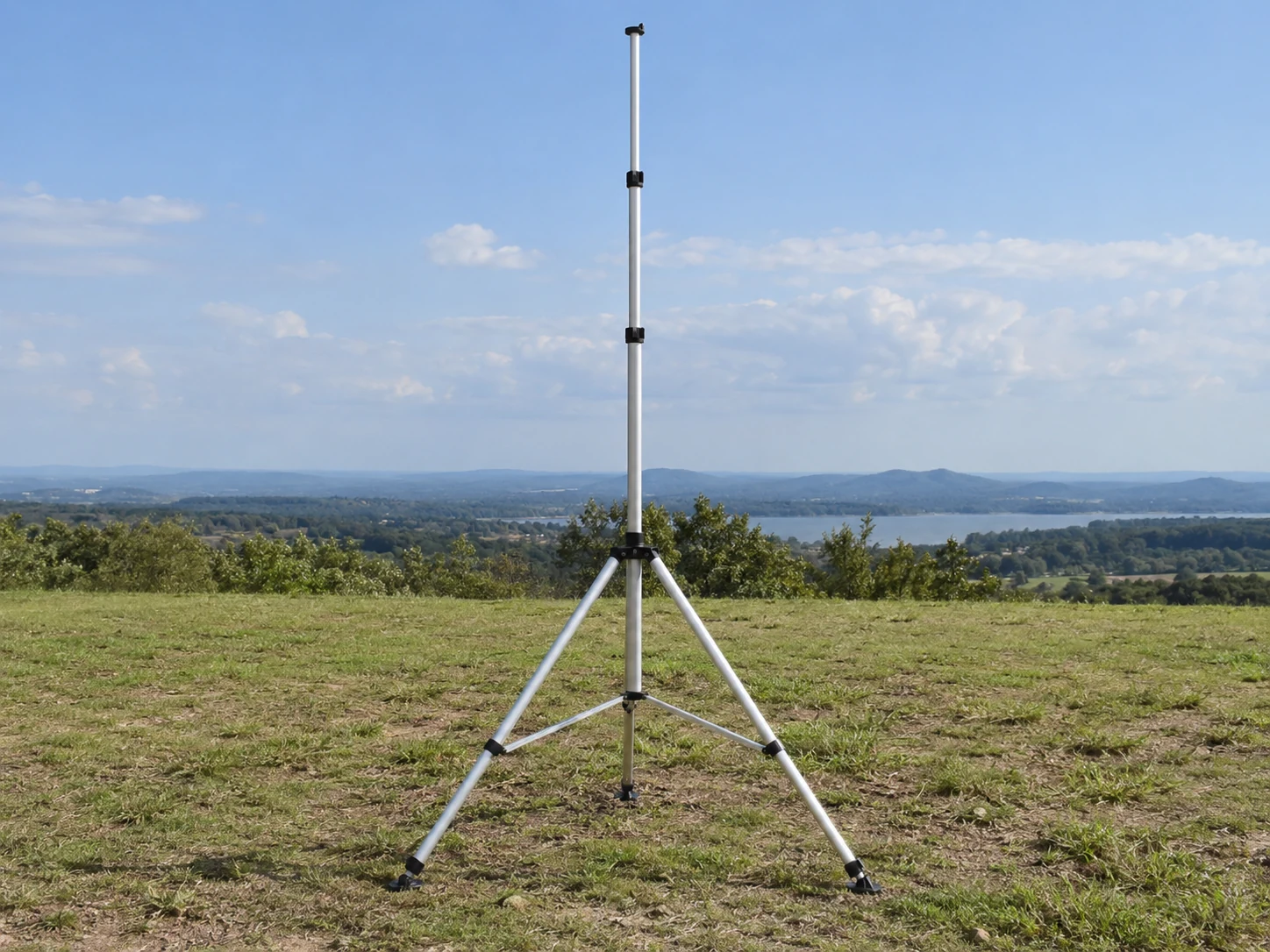
A mast’s packed size tells you what you must carry, but not how much room you need to put it up. Picture the complete support arrangement at the operating spot: the base, any tripod legs or guy lines, and the space needed to reach each attachment point. A narrow patch that accommodates the mast itself may not accommodate the setup that holds it.
For a flexible mast such as the SOTABEAMS Travel Mast, reserve room for carefully placed guys rather than planning to pull the mast straight with extra tension. SOTABEAMS warns against excessive bending and says too much downward force from guys or the antenna can collapse its sections. That creates a practical tradeoff at a cramped spot: shortening the guy spread by pulling harder is not a substitute for adequate room. If the intended antenna also pulls downward, account for that force when deciding whether the arrangement is workable.
The Chameleon CFM-34 HD illustrates a different base decision. Its documented options include a 21-inch ground spike or a heavy-duty surveyor tripod with an adapter. Those are distinct setups, not interchangeable ways to describe “a base.” A spike calls for a place where that installation can be used; a tripod needs room for its legs and the adapter in the kit. If the only open space is immediately beside a path or between closely spaced obstacles, consider the footprint of the chosen option before counting the spot as usable.
Vehicle support does not make the mounting question disappear. For CFM-34 HD PORTA-MOUNT use, Chameleon limits the arrangement to listed vehicle mounts with its approved sleeve kit. Having a vehicle nearby is therefore not enough: identify the particular mount and sleeve combination you would use, and consider where the vehicle must stand for the mast to clear its surroundings.
The purchase implication is to price and pack the support system, not just the telescoping sections. A mast that fits your bag but needs a guy spread you cannot provide, a tripod you have not allowed room for, or a vehicle sleeve you do not have is not yet a complete setup for that spot.
Check the Actual Park’s Rules Before Committing
A mast can fit the available space yet still be unusable at a particular park. Before committing to a site, check the current park authority’s instructions and applicable local law for the complete setup: whether you may place an anchor, run guys, attach a mast to a structure, or use a vehicle at the intended operating spot. Ask about permits before arrival if the published guidance does not settle the question. POTA’s rules do not override local or federal law or radio-license conditions.
Check the operating location against POTA’s separate boundary requirement, too: the activator and all equipment must be within the park boundary on public property. A nearby parking space or convenient support point is not enough merely because it is close to the park. If a vehicle is part of the proposed setup, confirm both that it can reach the intended spot under the park’s rules and that the resulting operating position meets POTA’s requirement.
The Cape Cod National Seashore radio platform shows why permission has to be checked by attachment method, not by the broad question “Are masts allowed?” Its guidance permits temporary attachment to the platform rails without damaging fixtures, but prohibits guy wires and antenna radials extending to the ground there. The same guide asks visitors to inquire before arrival about whether a permit is needed. Thus, an attachment that the platform allows does not make every antenna arrangement at that platform permissible.
Use that example to frame a specific question for the authority at your chosen site: describe where the base and any supporting or antenna lines would go, what they would touch, and whether a vehicle is involved. A rule allowing a temporary rail attachment would not, by itself, authorize ground anchors; a rule against ground-running lines would not, by itself, answer whether another attachment is allowed. Cape Cod’s provisions apply to its specified platform, not to parks generally.
Confirm that any published permission covers the exact operating area, not just another part of the park. If the guidance addresses radio operation but leaves your proposed mount or lines unclear, ask the managing authority about those components before buying for that site. POTA eligibility does not itself grant permission to install the setup.
Do this before treating the mast purchase as settled. If the proposed antenna needs ground-running lines but the intended location prohibits them, the problem is not solved by choosing a lighter or shorter pole. You need a different permitted arrangement or a different operating location. Likewise, a site that allows the physical setup still has to satisfy POTA’s public-property and boundary rule.
Treat Hazards and Changing Conditions as Stop Conditions
A mast that fits the antenna and the site can still be the wrong setup on the day. Do not raise it near overhead power lines. Both SOTABEAMS and Chameleon warn against deploying their masts or antennas near lines. Consider the antenna and the full raising movement, not just where the mast would stand once upright. A shorter mast or a different raising angle is not a reason to treat a location near lines as safe. Move to a location without the hazard or leave the mast down.
Wind makes a published load figure especially easy to misread. Chameleon says the CFM-34 HD’s 6 lb figure is not blanket approval: height, antenna surface area and wind all affect the load the mast can carry. An antenna weighing less than 6 lb is therefore not automatically suitable at every extension height or in every breeze. Before raising it, assess the assembled antenna and mast under the conditions actually present; if the setup cannot be kept under control, leave it down or lower it rather than relying on the rating. A manufacturer’s figure is a limit to interpret with its instructions, not a promise of safe use in changing conditions.
Raising the mast deserves its own decision, separate from whether it might remain standing afterward. Chameleon’s PORTA-MAST guidance says not to raise or install it in windy conditions without appropriate help and control. For a vehicle-based activation, having the vehicle available does not by itself supply that control. If the mast or attached antenna is difficult to manage during the raise, stop rather than assuming it will become manageable once secured. If the conditions and available help do not permit a controlled raise, postpone it.
The hazard area also includes people walking through the setup. The POTA activator guide advises visible marking of guy lines, stakes and feedlines to reduce trip hazards. Think about the entire route a visitor might take past the operating position, not just the mast base: a line that is obvious to the operator can still cross someone else’s path. Inspect the layout before operating and reconsider it if a line cannot be kept visible and safely managed. Marking helps people notice these components; it does not make an otherwise hazardous route acceptable.
Conditions can change after a successful raise. POTA advises shutting down an activation when changing weather threatens safety. Reassess the setup while operating rather than treating the initial raise as the final safety check. If wind builds, the mast becomes difficult to control, or weather threatens a safe takedown, end operations while you can still manage the equipment. Do not wait for a load rating to be exceeded or try for one more contact. A safe setup at the start is not a promise that it will remain safe for the whole activation.
Make the Purchase Decision—or Choose Another Site
For a walk-in activation, choose the compact fiberglass path if you can carry the complete kit, attach your antenna at a usable height, and fit its support arrangement in the available space. A carbon-fiber path may suit the same trip, but only if your particular antenna arrangement follows that mast’s attachment and separation instructions. Neither choice is improved by extra advertised height you cannot use.
For a vehicle-based activation, consider the aluminum path when the packed kit can reach the operating spot and you can use its specified mount. Vehicle access does not, by itself, provide a workable base or permission to set one up.
Before buying, identify the antenna attachment, feed-line route, base, guys or mount you would actually use. Then confirm that the complete arrangement fits the site’s rules and can be raised and operated safely under the conditions you expect. If one piece remains unresolved, change the kit or site. If no complete setup passes those checks, do not deploy a mast there.
Continue reading
Keep learning about radio