A QSL card is a written acknowledgment that a radio contact took place. After your first QSO—a contact with another station—the job is to copy the details from your log accurately, then find a way to send the card that the other station can actually use. The card might be a keepsake, evidence for an award, or both, but those goals do not always call for the same confirmation method.
Start with the contact you made, not a generic card template: identify both stations, verify when and how they communicated, and state where you were operating. Before mailing anything, check whether the recipient wants a direct card, uses a QSL manager, or can receive cards through a bureau. If your goal is award credit rather than a card to hold, check the award’s rules first; an electronic LoTW confirmation may be the better route for that particular goal.
Decide What You Want the Confirmation to Do
The International Amateur Radio Union (IARU) describes exchanging QSL cards as both a social gesture and a way to document achievements. A card can give the other operator a tangible reminder of the contact. That is a reason to enjoy exchanging one, not a rule that every QSO needs a paper reply.
ARRL also notes that cards can serve as proof of a two-way contact for certain awards. Certain matters: if you are collecting confirmations toward a particular award, find out what that award accepts before assuming the card you plan to send—or receive—will count. A card you treasure as a keepsake and a confirmation an award administrator will accept are related, but separate, outcomes.
Make the first decision in plain terms:
- You want the card itself. Prepare an accurate physical card and look for a route the recipient accepts.
- You want award credit. Check the award’s confirmation requirements before choosing paper or an electronic method.
- You want both. Plan for both outcomes rather than assuming one confirmation will automatically provide the other.
This choice can save an unnecessary mailing. For example, if the other station does not accept bureau cards, placing one in the bureau system is not a reliable way to get the keepsake you hoped to exchange. If an applicable award accepts a LoTW match, you may be able to pursue credit without waiting for a physical card. Neither possibility changes the central rule for the card you do prepare: it must describe the contact that actually happened.
Fill Out a Card from Your Contact Log
Use your QSO log as the source for the card’s contact details. ARRL identifies call signs, location, date and time, frequency, two-way mode, and signal report as basic QSL information. Its guidance says to use UTC for both date and time, convert properly if your log is in local time, and spell out the month to prevent confusion. A dated March 1995 AMSAT script also advises including your own call sign and a signature alongside the worked station’s details; that field advice is useful without relying on the script for current mailing instructions.
As you transfer the entry, make it clear which station each field describes. Put your call sign and the other station’s call sign in separately labeled places. State the geographic location from which you operated for that QSO; a mailing address printed on the card is not, by itself, a statement of where the contact occurred. Include the frequency or band shown by your log, the mode used for the two-way contact, and the signal report associated with the station worked. Do not substitute a customary-looking frequency, mode, or report for what you recorded.
Take particular care with the date. If your log already records the contact in UTC, use its UTC date and time. If it records local time, determine the UTC offset that applied when the QSO occurred, then convert both the time and the date. A late local-evening contact can fall on the next UTC date: as an arithmetic illustration, a log entry at 23:30 on 14 March at UTC−5 becomes 04:30 UTC on 15 March. Check the resulting day rather than changing only the hour. Writing “15 March” instead of a numeric date also prevents readers from having to guess which number is the month. ARRL explicitly recommends UTC and a spelled-out month.
Here is an author-created, entirely fictional illustration, not a real QSO or a prescribed report or frequency. Imagine that the operator of W1XYZ checked their log after contacting K9ABC. Their card might show:
| Card field | Fictional entry |
|---|---|
| From / my call sign | W1XYZ |
| Confirming contact with | K9ABC |
| Date of QSO | 15 March 2025 (UTC) |
| Time of QSO | 04:30 UTC |
| Band | 20 m |
| Two-way mode | SSB |
| Report for K9ABC | 59, as entered in this fictional log |
| My operating location for this QSO | Boston, Massachusetts, USA |
| Signed | Alex, operator of W1XYZ |
The location line says where this illustrated contact occurred. It is not inferred from a return address. Likewise, the displayed date and time are the fictional log’s UTC contact details, not the date Alex filled out or mailed the card. The report is an example of a recorded entry, not a value to copy onto another contact’s card.
Before sending, compare the completed card against the log field by field. Check the worked call sign especially carefully: one wrong character points the confirmation at a different station. Then check your own call sign, the UTC date and time together, the band or frequency, the mode, the report, and the operating location. Finally, read the card as the recipient would. Can they tell who contacted whom and when? If you write a note elsewhere on the card, keep it from obscuring those contact details.
If you discover an error while preparing your own card, make a clean replacement rather than sending a card with a confusing correction. That is practical advice about what you send; it is different from changing a confirmation you have received from someone else, particularly when you intend to use that received card for DXCC. ARRL’s DXCC guidance says not to fix erroneous data on a received card yourself; contact the sender for a replacement.
Find a Route the Other Station Can Use
Do not choose a route solely because it is available to you. Check the recipient’s current QSL instructions—or the instructions of a designated QSL manager—before addressing or dispatching the card. ARRL identifies three physical routes to consider: direct mail, a QSL manager, and a QSL bureau. The useful question is which of those routes will reach this station under its current arrangements.
Direct mail means addressing the card for direct delivery when the recipient’s instructions call for it. Confirm the destination and any return-card instructions from that recipient’s current information; do not assume a previously seen address still applies. If a physical reply matters to you, check what the station asks for before sending. The point of a direct route is to follow a verified delivery preference, not merely to put a card in an envelope.
A QSL manager is the station’s designated representative for confirmations. If the station says to use a manager, follow the manager’s stated routing details rather than addressing the card as though the worked station handled all its own mail. Keep the identities straight: the QSO record still identifies the station you actually worked, while the delivery route may identify its manager. ARRL’s DXCC guidance explicitly recognizes written confirmation from a DX station’s designated representative, such as a QSL manager, within its stated non-electronic confirmation method. That DXCC provision is not a general promise about every award.
A QSL bureau is a clearinghouse route rather than direct correspondence. The IARU describes national-level bureaus exchanging cards in bulk between countries. That can be useful when the recipient accepts bureau delivery and the services needed along the route are available to the senders and recipients. It is not a universal address for every card: ARRL notes that not all DX stations use the bureau and describes bureau delivery as not time-sensitive. The IARU also notes that some member societies cannot provide bureau service to nonmembers. Check access on the relevant parts of your route instead of assuming that the presence of a bureau in one country guarantees delivery in another.

For a US operator considering ARRL’s outgoing QSL service, check that service’s current submission instructions separately. ARRL asks outgoing-service users to enclose proof of current ARRL membership. It also has a specific sorting rule when cards go through that outgoing service to foreign QSL managers: sort those cards by the manager’s call sign, not the call sign of the station worked. That sorting instruction does not change what you enter as the worked station on the card. Nor does the outgoing membership requirement establish eligibility rules for receiving cards through an incoming call-area bureau.
The practical choice is conditional. If the recipient specifies direct mail, use the verified direct instructions; if it specifies a manager, follow that representative’s route. Use a bureau only when the recipient accepts bureau cards and the necessary services can handle them. If prompt delivery matters, do not treat a bureau card as time-sensitive. When the intended physical route cannot be verified, pause rather than guessing an address or feeding a card into a system that may not deliver it.
Arrange to Receive Cards and Handle Replies
Sending a card does not automatically arrange for someone else’s card to reach you. For a US operator expecting incoming DX bureau cards, ARRL says to use the incoming bureau serving your call-sign area and follow its receiving arrangements. Its general description mentions claiming cards with a self-addressed stamped envelope (SASE) or money credit. But the first-call-area bureau entry says it accepts money credit only, not SASEs. Find your actual bureau and read its current instructions before sending either.
Keep incoming and outgoing ARRL services separate. ARRL states that membership is not required for its incoming call-area service; that differs from the proof of current membership requested for its outgoing service. An incoming call-area bureau is also not a general mailbox for every kind of card. ARRL says not to send domestic US-to-US cards to those bureaus and not to send your outgoing DX cards to your incoming call-area bureau.
Expect a wait when the route is an incoming DX bureau. ARRL warns that DX cards may take several months after the QSO to arrive. A practical way to avoid uncertainty is to keep a simple sent-and-received status beside the QSO in your own records: note whether you sent a card, which route you used, and whether a reply arrived. That is a suggested personal tracking habit, not an ARRL requirement. Before sending a follow-up, look at your record and recheck the recipient’s chosen route. A missing reply after a short wait does not, by itself, show that the card was lost.
Be selective when replying or sending an unsolicited card through a bureau. The IARU warns that some cards entering the bureau system are unwanted or cannot be delivered, and encourages choices that reduce those cards. If a station states that it does not accept bureau cards, respect that preference even if the QSO was enjoyable. If you want an exchange, use a route it actually accepts; if no workable physical route is available, you need not assume that every completed QSO demands a paper mailing.
There is a separate problem if a received card has wrong QSO data and you need that confirmation for DXCC. Do not correct the sender’s card yourself. ARRL’s DXCC FAQ warns that alterations can trigger an audit and says to contact the sender for a replacement when the card does not reflect the QSO actually worked. Preserve the received confirmation as received while you seek an accurate replacement. This is DXCC-specific guidance, not a claim that every award worldwide handles errors identically.
Choose Paper or Lotw for the Result You Need
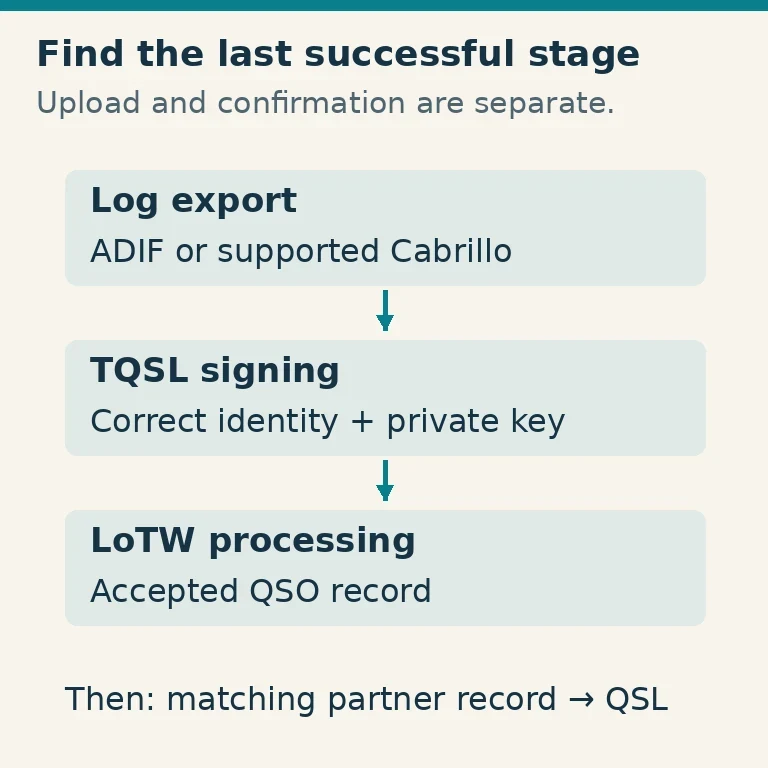
ARRL’s Logbook of The World (LoTW) offers an electronic confirmation path with a defined matching condition: both QSO participants submit matching records, producing a QSL usable for ARRL award credit. Submitting your record alone does not meet that condition. LoTW can therefore serve an award-credit goal when the other station also submits a matching record, but it does not by itself promise a match for every contact in your log.
An electronic match is not a displayable paper card. ARRL specifically notes that LoTW produces no card to display. The IARU recognizes electronic confirmations as additional or alternative ways to confirm contacts, but that observation does not give every electronic QSL service the same standing under every award. Decide whether you want evidence in an accepted format, a physical reminder from the station, or both.
For ARRL two-way-contact awards, the boundary is more specific: ARRL’s DXCC FAQ identifies LoTW as the only electronic confirmation method valid for those awards. For DXCC, the FAQ also describes a non-electronic written confirmation directly from the DX station worked or its designated representative, such as a QSL manager. Those are ARRL award rules, not a worldwide rule for all award programs. If another award is your goal, consult that award’s requirements rather than assuming that a paper card, a LoTW match, and another service’s electronic QSL are interchangeable.
Choose a physical exchange when the card itself matters and you have a viable route the recipient accepts. Choose LoTW when an ARRL award-eligible electronic match meets your goal and both participants’ matching submissions are available. Pursue both if you want the tangible card and the relevant electronic credit: prepare the card from your log, verify its delivery route, and check the applicable award’s rules before relying on either confirmation.