RF exposure depends on RF conditions at a person’s location, over the relevant time, not on a transmitter’s power setting alone. Frequency, power reaching the antenna, antenna direction, separation, operating pattern, and other sources that may transmit at the same time all matter. So does who can occupy the location: an operator at the controls and a visitor near an antenna may present different exposure scenarios. A useful mental model is to follow the signal from the station to the antenna, then ask where its field reaches people and for how long. The transmitter setting starts that inquiry; it does not finish it.
What Exposure Measures—and What Transmitter Power Does Not
A transmitter power setting describes output from equipment. An exposure limit concerns the RF energy present where and when someone is exposed. The distinction matters even before making a calculation: two stations set to the same transmitter output need not produce the same conditions at a person’s location if their antennas, feedlines, operating patterns, or accessible locations differ. That comparison is an explanatory inference from the factors ARRL asks operators to consider, not a claim about either station’s measured field.
In the United States, the FCC’s maximum permissible exposure (MPE) table expresses external-field limits using electric-field strength, magnetic-field strength, and power density. These are different quantities, with units of volts per meter, amperes per meter, and milliwatts per square centimeter respectively. The table organizes limits by frequency range; a limit appropriate to one operating frequency cannot simply be carried over to another. ARRL likewise notes that MPE limits vary with frequency. Thus frequency affects both the station scenario and the limit against which exposure is considered.
The FCC also describes specific absorption rate, or SAR, as a measure of the rate at which RF electromagnetic energy is absorbed. That is a different concept from reading an external electric field, magnetic field, or power-density value from the MPE table. In particular, an estimated separation distance from an antenna should not be mistaken for a measurement of energy absorption in a person. These quantities answer related but different questions; a transmitter watt rating, a field estimate, and SAR are not interchangeable descriptions of exposure.
The current US table has separate sections headed occupational/controlled and general-population/uncontrolled exposure. Those categories affect which limits and averaging times apply. At this stage, the important point is not to assign a category from the station’s name or ownership. First identify the people and locations in question; the final section explains why their awareness, ability to control exposure, and access matter. ARRL describes the uncontrolled limits as applying in circumstances such as exposure of the general public.
This framing keeps a power number in its proper role. Transmitter output is necessary information about the source, but it is not a field reading at a person, an exposure averaged over time, or a stand-alone verdict. The question is what conditions the complete station can create at places people may occupy, compared with the applicable frequency-dependent limit.
How the Station Delivers Power Toward a Location
The first change between the transmitter and the antenna can occur in the feedline—the connection carrying RF power to the antenna. ARRL’s calculator instructions distinguish transmitter power from power at the antenna, describing the latter as transmitter power minus feedline losses. ARRL notes that at VHF and UHF frequencies those losses can leave significantly less power applied to the antenna. No particular loss follows from the band name alone: the relevant input is the power that reaches the antenna in the station being considered.
That distinction prevents an easy mistake in either direction. Treating the transmitter setting as though all of it reaches the antenna overlooks loss in the path. But assuming that a feedline has made exposure negligible is no better without knowing its effect. An explanatory comparison is two otherwise similar stations with the same transmitter setting but different feedline losses: their antenna-input powers would differ, even before antenna placement or operation is considered. The comparison illustrates why the path matters; it supplies no measured exposure value for either station.
Operating frequency must remain a separate input. ARRL’s calculator asks for it alongside power and antenna gain, while the FCC’s MPE table assigns values by frequency range. Recording only “the transmitter runs at this many watts” therefore loses information needed both to characterize the station and to select the relevant exposure limit. A change of frequency cannot be represented merely as a change in power, even if the transmitter setting stays the same.
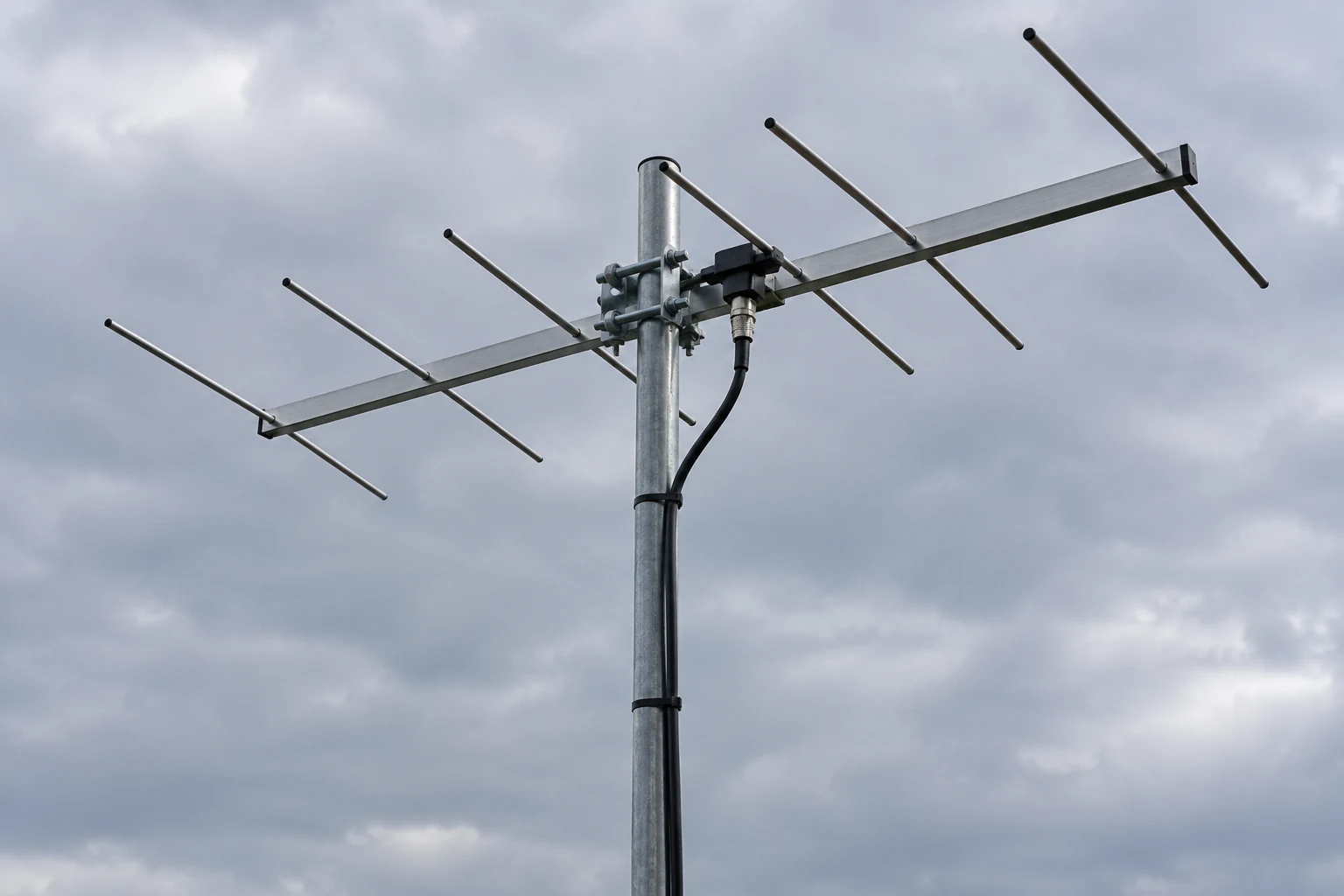
At the antenna, direction matters as well as input power. Antenna gain and pattern describe why the RF field need not be equally strong in every direction. A directional pattern can have lobes—directions that warrant separate attention when looking for exposed locations. ARRL cautions that accounting for an antenna’s lobes and directionality may require more than one run of its calculator. One gain entry or one chosen direction does not, by itself, describe every place a person could stand.
Consider two accessible locations around the same directional antenna: one lies in a direction associated with a prominent lobe, while the other lies off to the side. With the transmitter setting, feedline, and antenna unchanged, it would be a mistake to assume that the two locations have identical field conditions merely because they are part of the same station. This is an explanatory example about direction, not a prediction that either location exceeds a limit. Their actual conditions would also depend on their positions and the wider exposure scenario.
The causal path is therefore more informative than a single watt figure: transmitter output passes through the feedline to become antenna-input power; the antenna’s gain and pattern affect how that input bears on particular directions; and the operating frequency remains relevant when those conditions are compared with an exposure limit. The next question is where people are relative to that antenna—not simply how far the station is from them on a map.
Where a Person Stands Changes the Field—and the Estimate
Exposure has a location. Separation from the antenna matters, but so do the antenna’s height, direction, and the places people can actually occupy. For example, imagine an antenna mounted above an accessible area, with another accessible position off to one side. The transmitter’s setting alone does not characterize either person’s conditions: each position has a different relationship to the antenna and its directional pattern. Nor should “below the antenna” automatically be read as “outside the exposure scenario.” The relevant question is what field conditions occur at the occupied location.
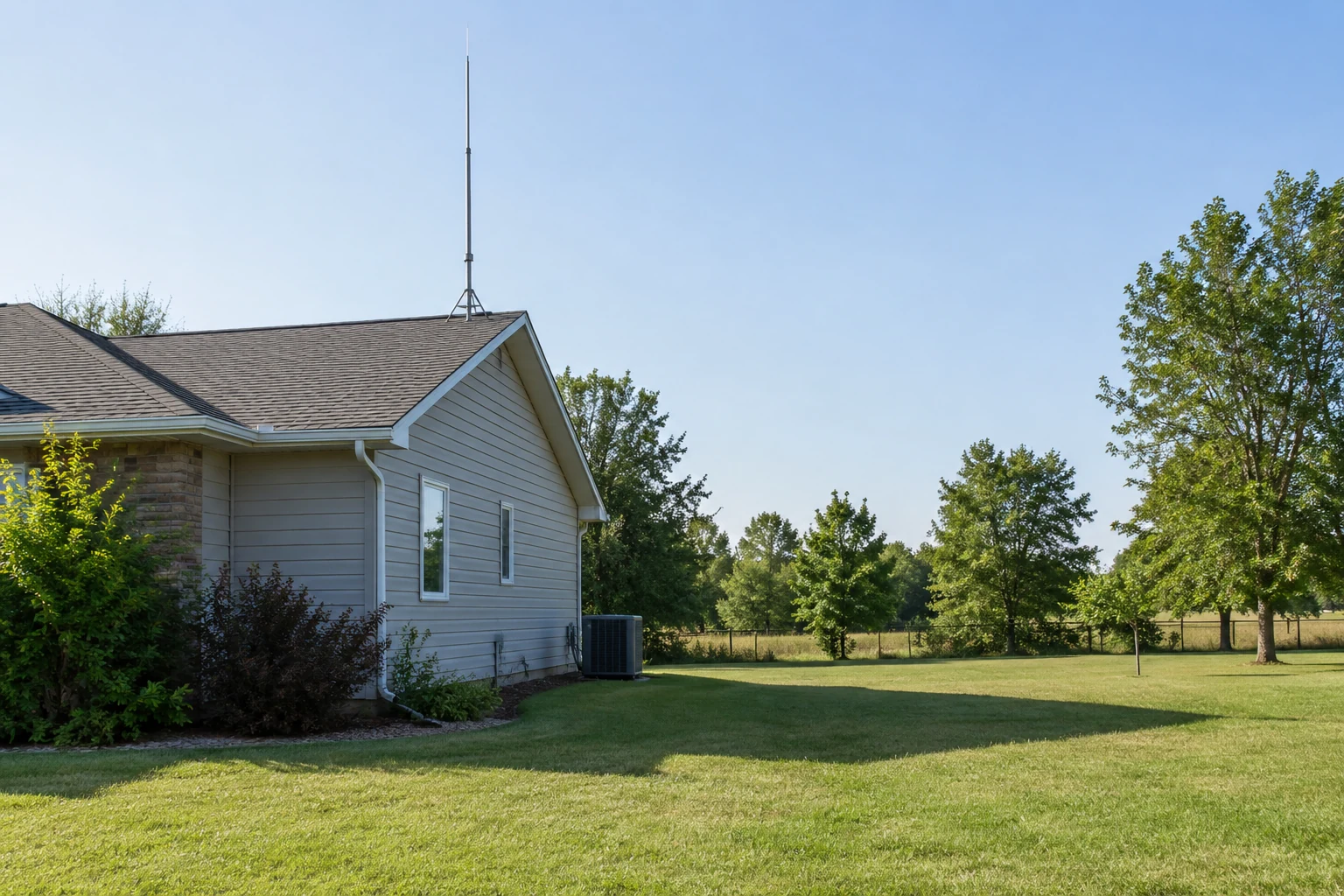
The surroundings can complicate that picture. ARRL’s calculator includes an option to account for ground reflections, and ARRL says the height of the RF source above ground can make such reflections worth considering. This does not mean that every station has the same reflection effect, or that choosing the option establishes a measured field. It means the route from antenna to person may not be described adequately by pointing to a single direct line and ignoring where the source sits.
ARRL’s calculator reports a minimum compliance distance for the scenario entered. That output is useful only in the context of those inputs and the calculator’s scope. It is not a universal safe radius around every antenna, nor a substitute for noticing another accessible location in a different lobe or a situation where reflections matter. If the station or the person’s position changes, the scenario represented by the output changes too. ARRL’s suggestion to consider directionality with multiple runs reinforces why a single result cannot describe all possible positions.
There is a more fundamental limit close to an antenna. ICNIRP, explaining the science of electromagnetic fields, notes complexities in measuring fields in near-field zones. It also says that specifying far-field and near-field zones must be considered together with features of the exposure scenario, including antenna shape and size. In other words, proximity cannot always be reduced to a generic distance rule, and a simplified far-field picture should not be assumed to describe conditions immediately around an antenna. ICNIRP supplies scientific context here, not a replacement for applicable local rules or a measurement of a particular station.
ARRL states a concrete boundary for its calculator: it should not be used for an antenna less than 20 cm (8 inches) from a person. That is a limitation of the tool, not a declaration that every position just beyond 20 cm is compliant or that a closer position can be resolved with an improvised inverse-square estimate. A person close enough to fall outside the calculator’s stated scope calls for a suitable station-specific approach rather than a confident answer from that calculator.
A dated ARRL example can help clarify why “distance” must name its endpoints, provided it stays in context. In ARRL’s Station Evaluation explanation, an excerpt from January 1998 QST, distances in the particular tables it discussed meant separation between any part of the antenna and an area where people would be exposed. That describes those tables; it is not a current universal formula for all antennas. The lasting conceptual lesson is to specify the antenna parts and exposed areas being compared, rather than measuring from an unspecified point called “the station.”
Taken together, location factors turn a simple question—“How many watts?”—into a spatial one. Where are the antenna and its lobes? Which positions can people occupy? What are the height, separation, and possible reflection conditions? Are any positions so close that the chosen estimating method no longer applies? Answers to those questions shape the scenario an estimate must represent; none supplies a universal safe distance on its own.
How Transmitting Time Changes Average Exposure
A transmitter’s output during a transmission is not necessarily its average output across a period of operation. ARRL’s calculator instructions distinguish two time-related inputs. Mode duty cycle concerns the output pattern during transmission; the instructions say it affects average output power. The transmit/receive split asks how many minutes the station transmits rather than receives, and ARRL says that split also affects average output power. They are separate questions: what happens while transmitting, and how much of the relevant time is spent transmitting at all.
ARRL’s calculator provides bounded examples of mode duty cycle. It uses 100% for voice FM and 20% for conversational SSB without speech processing. These describe the modes as specified in those calculator examples; they do not establish that every operator’s signal or operating session has the same pattern. ARRL also uses 100% for other or unknown modes as a worst-case catch-all. That is a conservative calculation assumption, not an observation that an unknown signal actually transmits continuously at full output.
For an explanatory comparison, suppose two operators select the same peak transmitter setting and use otherwise comparable antenna arrangements. One spends more of a relevant period transmitting; the other spends more of it receiving. Their peak settings match, but the greater transmit share tends toward a greater time-averaged contribution from that station. If their mode duty cycles also differ, that changes the average-output picture during the transmissions themselves. This comparison gives the direction of the time effect, not a compliance result: the occupied location, applicable limit, and actual operating pattern are still needed.
The averaging interval cannot be chosen merely because it makes an operating pattern look favorable. The current FCC rule says its MPE and SAR limits address continuous exposure and permits higher exposure levels for shorter times when the average over a period no longer than the table’s specified averaging time stays within the applicable limit. The table has separate averaging-time entries for occupational/controlled and general-population/uncontrolled exposure. Thus a momentary peak is not automatically the entire time-averaged comparison—but neither is an arbitrarily long average or a calculator’s mode default.
Time averaging also does not erase the question of where exposure occurs. If someone is present at a particular accessible position during transmissions, the operating pattern relevant to that position matters. A statement such as “I do not transmit all the time” identifies a potentially important factor, but without the transmit share, mode behavior, applicable averaging period, and field conditions at that position, it is not an exposure assessment. That conclusion follows from the distinct inputs in ARRL’s instructions and the FCC’s specified averaging framework.
Who Can Be Exposed, and Which Sources Operate Together
The applicable exposure category depends on people and circumstances, not simply on whether a site is called a home, a station, or private property. Under the current US rule, general-population/uncontrolled limits apply where the general public may be exposed. They also apply where people exposed through employment may not be fully aware of the potential exposure or cannot control it. ARRL’s discussion of controlled environments emphasizes awareness and the ability and knowledge to control exposure; its calculator instructions describe uncontrolled areas in terms of people being unaware of exposure and its effects.
Consider an accessible area near a station antenna and, separately, a location occupied by someone who knows about the RF exposure and can control their presence there. Those situations raise different category questions even if both are on the same property. The example does not assign either location a legal category: actual access, the people involved, their awareness and ability to control exposure, and the applicable rule decide that. In particular, calling someone an operator or a family member is not enough to establish controlled treatment.
A person may also be exposed to more than one operating transmitter at the same point. ARRL’s January 1998 Station Evaluation explanation describes expressing each transmitter’s contribution at an evaluated point as a percentage of the permitted MPE, then adding the percentages for transmitters that could operate simultaneously. Its warning is conceptual: separate looks at individual sources can miss their combined contribution. That historical explanation is not a present-day legal walkthrough, and it does not establish the contributions of transmitters at a particular station without an evaluation.
This matters most when the question is framed too narrowly. “What does my main antenna do at this spot?” may not capture the whole scenario if another transmitter can operate while a person occupies that same spot. Conversely, a source that cannot operate simultaneously presents a different timing question from one that can. The point is to describe the plausible operating combination at the exposed location, rather than assuming one transmitter always stands alone.
A station-specific picture therefore needs five connected descriptions: the frequency and applicable exposure category; the power reaching each relevant antenna and its directional pattern; the locations people can occupy and their geometry relative to the antennas; the modes and transmit/receive pattern over the applicable averaging time; and any sources that can operate together. Those inputs explain why a transmitter setting, one gain figure, or one calculator distance cannot settle every exposure question.
If the people and locations are identifiable and fall within a suitable estimating method’s scope, those facts can support a station-specific evaluation. If someone may be very close to an antenna, the field conditions are too complex for the chosen shortcut, or concurrent sources have not been accounted for, the defensible conclusion is narrower: do not infer a universal safe distance from incomplete inputs. Use an evaluation suited to the actual scenario or seek qualified help where the method’s limits prevent a reliable estimate. ARRL’s less-than-20-cm calculator exclusion is one explicit example of such a limit.