A 59 report means that the receiving operator finds a signal perfectly readable (5) and extremely strong (9). A 599 report adds a third rating for a CW signal: perfect tone (9). These are descriptions of reception at the operator giving the report, at that time—not permanent grades of the transmitting station. The distinction matters because the numbers answer different questions. A signal can be easy to understand without being especially strong, and a strong meter reading does not tell you what another receiver hears. The familiar numbers also depend on context: voice reports leave out the tone digit, while a 59 or 599 sent as part of a contest exchange may be customary rather than a careful observation.
What the Numbers in a Report Describe
The American Radio Relay League (ARRL) calls the three-part system RST: R is readability, S is strength and T is tone. On voice, the tone component is left out, producing a two-part RS report. CW uses the three-part form, which includes the heard tone.
The order gives you a way to read an unfamiliar report. The first digit answers, “How well could this receiving operator make out the message?” The second answers, “How strong did the signal seem there?” For CW, the third describes the quality of the tone heard there. Keeping those questions separate prevents an easy mistake: interpreting every high number as another way of saying “loud.”
A report also has a direction. If you give another operator a report, you describe their signal as received by you. When they give you a report, they describe your signal as received by them. Those observations need not match. Neither report, by itself, measures both directions of the contact or assigns an intrinsic quality rating to a transmitter. This is an inference from what the report components describe: reception at the reporting end, rather than a property measured everywhere.
For a useful report, first identify whose reception the number represents. Then interpret its digits separately. A high readability digit tells you the content got through at that receiver; a high strength digit tells you the signal seemed strong there. Whether either observation helps with a particular question depends on the mode and the path between the stations.
Readability: How Much of the Message Gets Through
Readability is about recovering the message, not merely detecting that a signal exists. ARRL’s traditional R scale runs from 1 to 5:
| R | Meaning |
|---|---|
| 1 | Unreadable |
| 2 | Barely readable; occasional words distinguishable |
| 3 | Readable with considerable difficulty |
| 4 | Readable with practically no difficulty |
| 5 | Perfectly readable |
The middle ratings are particularly useful because “I heard you” can conceal very different experiences. At R3, the receiving operator can make out the message, but doing so takes considerable effort. At R4, it comes through with practically no difficulty. R5 is the top rating: perfectly readable. If you missed substantial content or had to work hard to understand it, reporting R5 would hide the very difficulty the R digit is meant to convey.
Consider an illustrative reception, not a measured contact: a voice signal sounds weak, yet the listener understands every word. Its strength need not be high for the listener to give it a high readability rating. Conversely, hearing a conspicuous signal is not enough to justify R5 if its words remain difficult to make out. Those are separate judgments: how much signal seems present and how much of the message gets through.
At the bottom of the scale, R1 means the message is unreadable. R2 is a little more informative: occasional words can be distinguished, but the message is barely readable. The progression from R2 to R3, then R4 and R5, describes increasing success at understanding content—not prescribed strength readings.
A practical way to choose among the upper values is to think about the content you actually received. Did you follow it only with considerable difficulty? That fits R3. Was there practically no difficulty, even though reception was not quite perfect? That fits R4. Was it perfectly readable? That fits R5. This uses ARRL’s distinctions rather than automatically giving a 5 whenever you can tell someone is transmitting.
Strength: the Report and the S-meter
The S digit describes apparent signal strength on a nine-point scale. ARRL’s qualitative descriptions are:
| S | Meaning |
|---|---|
| 1 | Faint, barely perceptible signals |
| 2 | Very weak signals |
| 3 | Weak signals |
| 4 | Fair signals |
| 5 | Fairly good signals |
| 6 | Good signals |
| 7 | Moderately strong signals |
| 8 | Strong signals |
| 9 | Extremely strong signals |
These words are useful even without a meter. They let a receiving operator distinguish a faint signal from a fair one, or a strong signal from an extremely strong one. They do not turn each step into a statement of calibrated transmitter power. The number belongs to a report of reception, not to a specification of the other station’s transmitter.
A receiver’s S-meter can help an operator describe what is happening at that receiver, but it should not be mistaken for an absolute verdict about the transmitting station. ARRL notes that the relationship between receiver S-meter units and received signal level is approximate, and that actual levels vary from receiver to receiver. An indication on one receiver therefore cannot establish that another receiver will indicate—or hear—the same thing.
For example, imagine an illustrative listener who understands every word but judges the signal only “fairly good” in strength. 55 would communicate two independent observations: R5 for perfect readability and S5 for fairly good strength. Another listener, or the same listener at another time, could reasonably have a different observation. The example is not a claim that S5 produces R5; it shows why the ratings must be chosen separately.
Likewise, an S9 indication or an S9 report means “extremely strong” within the strength scale used for that reception. It does not tell you the transmitter’s power, and it does not promise S9 at a different receiver. If you need to convey difficulty that the number alone obscures, a brief description of what you could or could not understand is more informative than treating the meter as a complete account of the contact.
This distinction is especially helpful when numbers appear to conflict. “Weak but perfectly readable” is not a contradiction: weak addresses strength, while perfectly readable addresses the message. Nor does a strong indication require a top readability rating. The report is most useful when each digit records its own observation rather than being pulled toward the other one.
CW Tone and the Difference Between 59 and 599
The third digit, T, describes the heard CW tone. ARRL’s operating aids say to omit tone from voice reports. Thus, a voice operator should not treat a third digit as a voice-audio-quality rating within this system.
ARRL’s traditional tone scale runs from a very rough, broad tone to one with no trace of ripple or modulation. Its intermediate ratings distinguish degrees of roughness, filtering and audible modulation:
| T | Traditional description |
|---|---|
| 1 | Very rough and broad, described as sixty-cycle AC or less |
| 2 | Very rough, harsh and broad AC tone |
| 3 | Rough AC tone, rectified but not filtered |
| 4 | Rough note with some trace of filtering |
| 5 | Filtered rectified AC, but strongly ripple-modulated |
| 6 | Filtered tone with a definite trace of ripple modulation |
| 7 | Near-pure tone with a trace of ripple modulation |
| 8 | Near-perfect tone with a slight trace of modulation |
| 9 | Perfect tone, with no trace of ripple or modulation |
The scale describes what is heard. It does not require a new operator to determine why a note sounds rough. The useful distinction is that T1 and T2 sit at the very rough, broad end; the middle grades describe an improving but still imperfect note; and T9 is the top, perfect-tone description. For instance, T7 is near pure but still has a trace of ripple modulation, whereas T8 is near perfect with only a slight trace of modulation. Those are not interchangeable with T9’s absence of any trace.
Now the familiar examples can be decoded without collapsing the components:
- Illustrative voice report: 59. The receiving operator finds the voice transmission perfectly readable (R5) and the signal extremely strong (S9). There is no T digit in this voice RS report.
- Illustrative CW report: 599. The receiving operator finds the CW perfectly readable (R5), the signal extremely strong (S9) and the heard tone perfect, with no trace of ripple or modulation (T9).
The extra digit changes what is being described; it is not a more emphatic version of 59. Seeing 599 should prompt you to ask about its CW tone component, while seeing 59 in a voice contact gives you only readability and strength. That mode distinction also keeps RST from becoming a supposed universal format for every kind of radio communication.
Giving a Report During a Contact
The most useful report starts with a simple question: What am I receiving? The operator who speaks a report is rating the signal arriving at their receiver. The other operator’s reply rates reception in the opposite direction. Neither can determine their own transmitted signal’s readability just by listening to it at their own end.
Here is an illustrative exchange. [CALL A] and [CALL B] are fictional callsign placeholders, not accounts of an actual contact:
> Operator A, [CALL A]: “Your signal is 45 here. I can follow you with practically no difficulty, but you’re only fairly good in strength.”
> Operator B, [CALL B]: “You’re 35 at my end. Your signal is fairly good, but I’m having considerable difficulty reading the message.”
In A’s report, 45 describes B as A receives B: R4 means readable with practically no difficulty; S5 means fairly good strength. In B’s report, 35 describes A as B receives A: R3 means readable with considerable difficulty, and S5 means fairly good strength. The two reports describe reception in opposite directions, and each number agrees with the operator’s stated observation.
That correction illustrates why descriptive feedback matters. A number and its explanation should agree. “I caught only occasional words,” “I could read you with considerable difficulty,” and “I understood everything” describe different readability experiences; they should not all be reduced to the same R digit. ARRL’s R scale gives those experiences distinct places.
For an illustrative FM or repeater conversation, an operator might give direct feedback instead of trying to force every observation into a numerical report: “I heard the start of your message, but missed the last few words,” or “I could understand the whole transmission, though it sounded weak here.” Those statements tell the other operator what arrived at the reporting end. They do not claim a universal FM scale or diagnose the cause of the missed words.
The same directional language keeps a report candid: “I receive you…” is an observation; “my signal must be strong at your end…” is a conclusion that only reception at the other end could support. A short description can make a report useful without asking its digits to explain more than readability and strength actually cover.
Why a Strong Repeater Downlink Does Not Rate Your Uplink
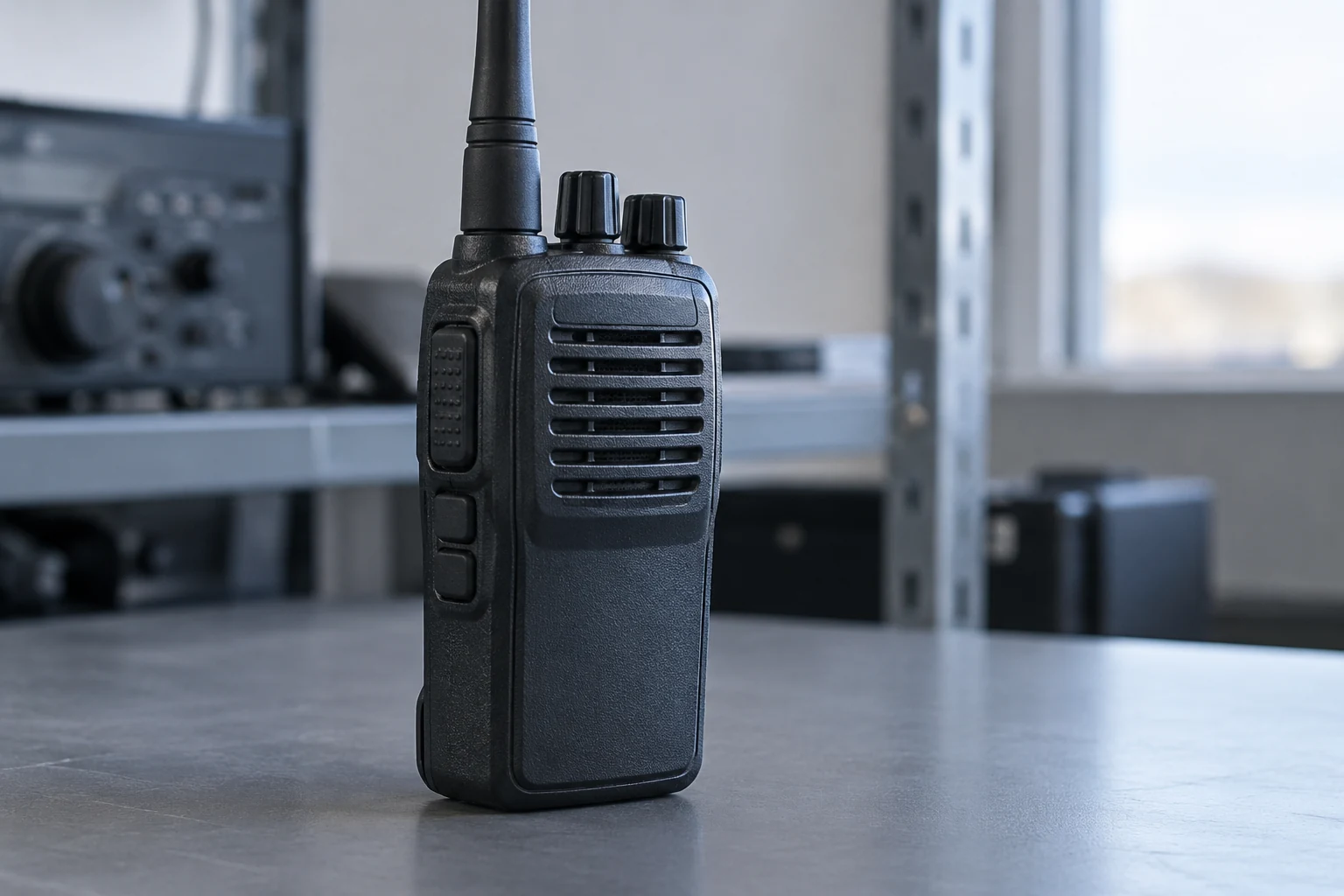
A repeater contact has two relevant directions. A handheld transmits an uplink, which the repeater receives. The repeater transmits a downlink, which the handheld receives. A reading on the handheld while it hears the repeater describes reception of that downlink; it does not measure how the repeater receives the handheld’s uplink.
ARRL gives exactly this caution: an operator may receive a repeater’s powerful transmitted signal well even though the repeater’s receiver is not receiving that operator’s transmission as well. The apparent mismatch is possible because the handheld is listening to one transmitted signal while asking a question about a different signal arriving at a different receiver.
Imagine an illustrative handheld showing a strong indication whenever the repeater transmits. The defensible statement is “the repeater’s downlink is strong at my handheld.” It is not “my uplink must be strong at the repeater.” Even excellent reception of the downlink supplies no rating for the opposite leg of the path.
If the question is whether your transmission is getting through, feedback must concern how it is received—for example, whether another operator can understand your words or reports missing parts. That stays within what the listener can observe. Quoting your handheld’s downlink meter reading as proof would attach a real observation to the wrong direction of travel. The distinction identifies what information is missing; it does not, by itself, diagnose an equipment or audio problem.
When the Familiar Numbers Mean Something Different
Not every 59 or 599 is intended as careful reception feedback. ARRL observes that in major contests whose exchanges require a signal report, operators often send 59 or 599 even though the number is probably not an accurate report. That makes context important: the same digits that can describe perfectly readable, extremely strong reception may instead function as a customary part of an exchange. This does not mean every contest report is inaccurate; it means you should not assume the familiar maximum numbers were measured or thoughtfully chosen each time.
The distinction changes what you can learn from the number. In an ordinary conversation where someone has described what they understood, the report and explanation can be read together as feedback about reception. In the contest situation ARRL describes, a routine 59 or 599 alone offers much less evidence about how well the signal was actually received. If you need diagnostic detail, the familiar digits—particularly when sent by convention—cannot substitute for a description of what the listener heard.
Digital modes set another boundary. IARU Region 1 says RSQ reporting may be used for digital modes where applicable. Its example rates text readability separately from visible signal quality: the readability examples range from undecipherable text to nearly all text readable, while the quality examples distinguish a clean visible signal from one showing progressively more visible sidebars or splatter. That is an example of a different applicable scheme, not evidence that RST is universal or that one report syntax fits every digital protocol.
The dependable reading habit is therefore to identify the receiving end, the mode and the purpose of the exchange. Choose readability and strength independently from what you receive; include tone when giving a CW RST report, not a voice RS report. Finally, distinguish an observation meant as feedback from a number sent because the operating context calls for a familiar exchange.