To diagnose a sudden rise in radio noise, first record a symptom you can reproduce. Then check whether it depends on the antenna, make a safe comparison between household-powered and independently powered equipment, and narrow any remaining outside lead before reporting it. Each test answers a limited question. A higher S-meter reading, a particular sound, or a loud signal near a utility wire does not, by itself, identify an emitter.
Record the Noise Before Changing the Station
Make a short log entry while the noise is present. Note when you first noticed the change, which bands and frequencies are affected, and the date, time and weather during each observation. Record the S-meter reading if it is useful on your receiver; otherwise, describe what you hear—for example, whether the noise is steady or intermittent. Include comparable periods when the noise is absent. ARRL recommends logging both presence and absence, along with frequency, level, weather and time of day, when investigating suspected power-line noise.
A usable entry might read: “Noise present at 8:15 p.m. on the frequency noted below; S-meter reads S7 between signals; intermittent bursts heard. At 8:15 p.m. yesterday, with the same setup, the frequency was quiet between signals.” That is an example of how to record a comparison, not a threshold that diagnoses interference. If you do not have a reliable earlier reading, write that down too. “Seems louder than usual” is a reason to investigate, but a newly recorded baseline will make the next observation more useful.
Alongside every reading, note the receiver, mode, bandwidth, and whether its preamplifier or attenuator is on. ARRL specifically calls for those receive settings when presenting S-meter data. Also note any relevant change you made before the rise, such as switching receivers or changing a receive setting. For a later comparison, return to the same frequency and receiver configuration. If you change bandwidth or attenuation to investigate, record the change as a separate test rather than treating its new reading as a direct comparison with the old one.
Time, weather and household activity can help you decide when to repeat a test. ARRL notes that power-line noise can vary with weather, while noise from some consumer devices may follow periods of human activity. Neither pattern identifies an owner. If the symptom appears only at certain hours, arrange the antenna or power comparison for one of those hours; do not declare that a neighbor’s appliance, or the utility, is responsible because the timing seems suggestive.
There is a second reason to begin with observations rather than an accusation. Ofcom describes interference causes as including both unwanted electromagnetic disturbance, which may arise naturally or artificially, and a fault or deficiency in the affected station. That is a useful distinction for diagnosing your own setup, not a US reporting route. Your first question is what changed at your receiver; source ownership comes much later, if the tests support it.
Test the Receiving Chain Before Looking for an Emitter
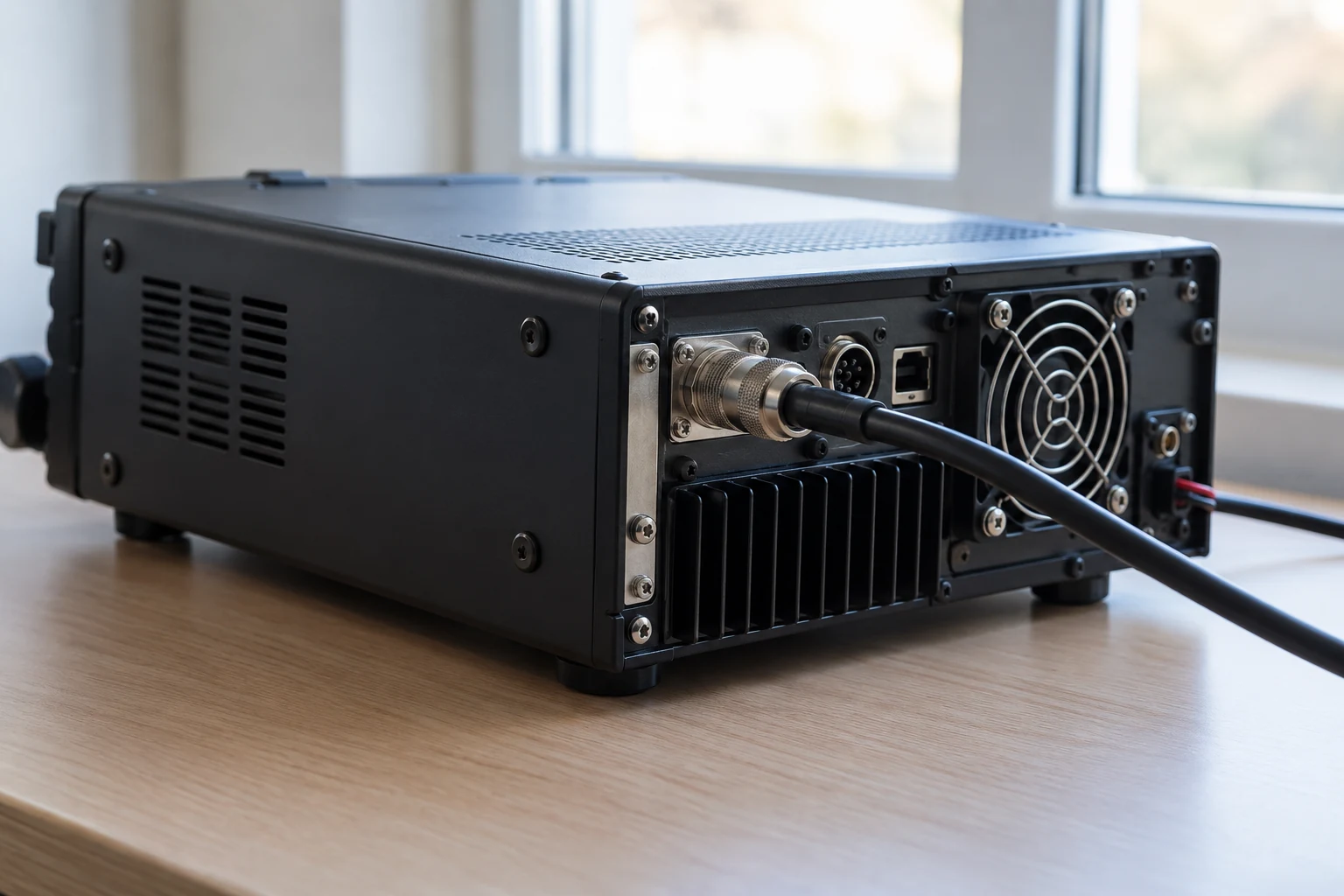
With the noise active, listen at the recorded frequency using the recorded settings. Note what you hear and, if applicable, the S-meter reading with the antenna connected. Then disconnect the antenna connection to the receiver and listen again without changing the other controls. Record the second observation, and restore the original connection before making later antenna-connected comparisons. ARRL recommends antenna removal as an initial way to see whether the noise changes.
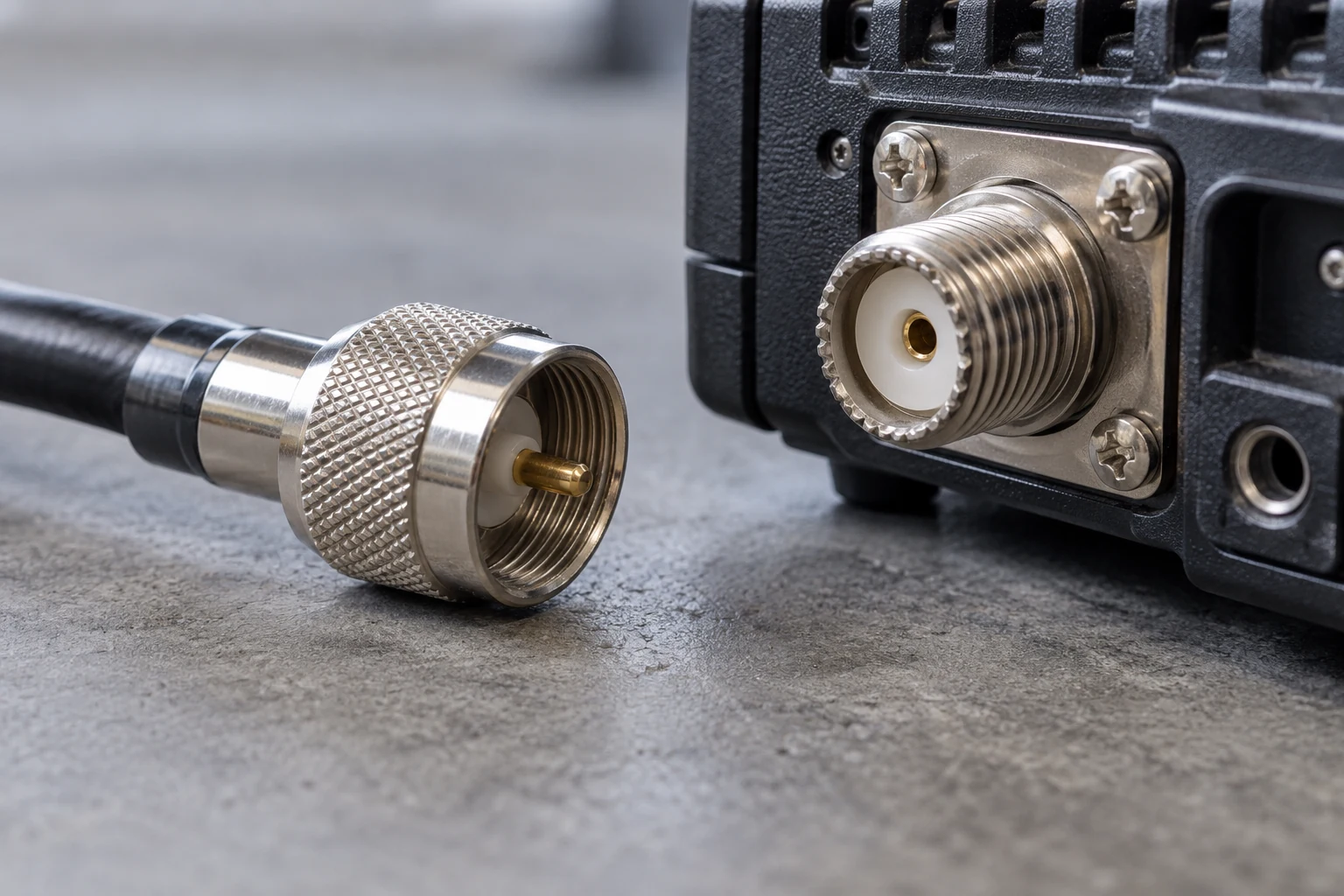
If the noise changes little or not at all, do not begin a neighborhood search yet. ARRL says that result can point toward the receiver, its power supply, or an interference source near the receiver or connected to the same AC circuit. The test does not separate those possibilities. Look back at your log: did a receiver setting, supply arrangement or nearby powered setup change around the time the noise rose? If you can safely switch off an accessible nearby device, compare one change at a time and note whether the same symptom remains. Ofcom describes switching off devices one at a time as a possible isolation method, but only where doing so is safe.
If disconnecting the antenna produces a substantial, repeatable reduction, the antenna-connected path deserves further investigation. That is evidence about how the noise reaches this receiver, not evidence that its source is outdoors or belongs to a utility. Reconnect the antenna and confirm the original symptom returns under the same conditions before carrying that result forward. If the noise stopped on its own during the comparison, mark the test uncertain and repeat it while the symptom is active.
A receiving problem and an external disturbance are not always mutually exclusive explanations. Ofcom notes that inadequate filtering or immunity can allow an external disturbance into affected apparatus; it also lists a fault or deficiency in the affected station as a possible cause. The antenna test alone diagnoses neither. Its practical branch is narrower: a reproducible antenna-dependent symptom can move to a household-power comparison, while noise that survives antenna removal calls for attention to the receiver, supply and nearby powered equipment before you assign an outside source.
Find Out Whether Household Power Feeds the Source
An antenna-dependent result does not establish whether the source is in your home. For this comparison, first confirm that you can hear the same active noise on a battery-powered AM receiver near the location of the breaker controls. ARRL calls for verifying the noise with the battery-powered radio before its breaker test. Keep that listening receiver independently powered throughout: a household-powered station receiver cannot show what happened to the noise after you turn off its own supply. Make a note of the frequency or tuning position and what the noise sounds like on the portable receiver. If the portable cannot reproduce the symptom, do not treat a later quiet portable reading as a valid verdict on the noise heard at the station.
Safety boundary: Operate only breakers that are safe, accessible operator controls. Do not enter a panel, remove a cover or work on wiring. If you are uncertain how to operate the controls safely, ask a qualified person; if a safe comparison cannot be made, leave this branch unresolved. ARRL cautions against removing a breaker-panel sub-cover without qualifications and advises professional help when safe operation is uncertain.
While the portable still hears the noise, compare its reception immediately before and during a safe main-breaker-off interval, then after household power is restored. Write down whether the noise stopped, persisted, changed partly or varied independently of the switching. Compare the same portable receiver at the same tuning and settings, from the same listening position. If the noise was already fading before the switch, the result cannot reliably be credited to the switch.
A repeatable disappearance when household power is removed supports a source among the equipment actually deprived of power. ARRL describes noise stopping in this comparison as an indication of an in-house source. It is not yet the name of a circuit or device. Conversely, persistence can lead you toward an outside source, as ARRL’s procedure suggests, but only after considering what stayed powered and whether the noise remained stable throughout the test. ARRL also advises disabling battery-powered devices during an outside-source test. Where possible and safe, account for those devices and any other independently supplied equipment before interpreting persistence.
A partial reduction is not a clean inside-versus-outside verdict. More than one source could contribute to what you hear, or the noise could be changing during the test. An unchanged reading also tells you less if a suspected device retained an independent power source. Record what was and was not deprived of power; do not upgrade an uncertain comparison into proof of an external emitter.
If removing household power reproducibly stops the noise, the next question is which household circuit is associated with that change. Only if you can operate the accessible controls safely, test circuits individually while the portable receiver again hears the active symptom. Observe the effect of each change and return breakers to their normal positions after the comparison. ARRL describes testing individual breakers, restoring them, and then unplugging devices on an implicated circuit to isolate the source. A circuit that repeatably changes the noise narrows the search; it does not identify an offending device.
On that circuit, unplug accessible devices one at a time where safe, observing the portable receiver after each change. Keep a brief record of which device was disconnected, whether the noise disappeared, and whether it returned when the original conditions were restored. Ofcom likewise describes one-at-a-time device switching as an isolation approach where safe. Do not open an appliance or undertake electrical repair as part of this listening test.
If no single circuit or unplugged device makes a repeatable difference, revisit the conditions before deciding the source must be outside. Was the noise audible for the whole test? Was another device independently powered? Did you change listening position or compare readings from different receivers? You may have narrowed a possibility without isolating a cause. Preserve that uncertain result in the log and repeat the comparison when the symptom is steady, rather than forcing it into an inside or outside category.
Narrow an Outside Candidate Without Mistaking a Clue for Proof
Investigate beyond your premises only if the earlier comparisons support an outside lead—and only from places you may lawfully access and where you can listen safely. Do not approach or touch utility infrastructure. ARRL specifically warns against climbing or striking poles and against touching or pulling down guys, the support cables attached to poles. A portable listening search is an observation task, not a reason to handle electrical hardware.
Use the log to choose a period when the symptom is likely to be active. A raspy buzz or frying sound is a clue ARRL associates with power-line noise, and ARRL notes that such noise can vary with weather. Time-of-day patterns can instead point toward an electrical device or appliance associated with human activity. These clues suggest tests to repeat; they do not establish that a pole, house or specific appliance emits what you hear. In particular, a broad or loud noise on your station receiver does not by itself prove power-line arcing.
With a portable receiver, listen from safe, lawful locations for an area where the same noise is strongest. Note your tuning, receiver settings, locations and time so that each comparison has a common reference. If your portable has RF gain control or an antenna attenuator, reduce gain or increase attenuation when a signal is strong enough that every location sounds equally loud. ARRL describes this method as a way to narrow the area of possible sources. Use a change of gain as a new, documented comparison: a reading taken at high gain in one place should not be ranked against a reading taken at low gain somewhere else.
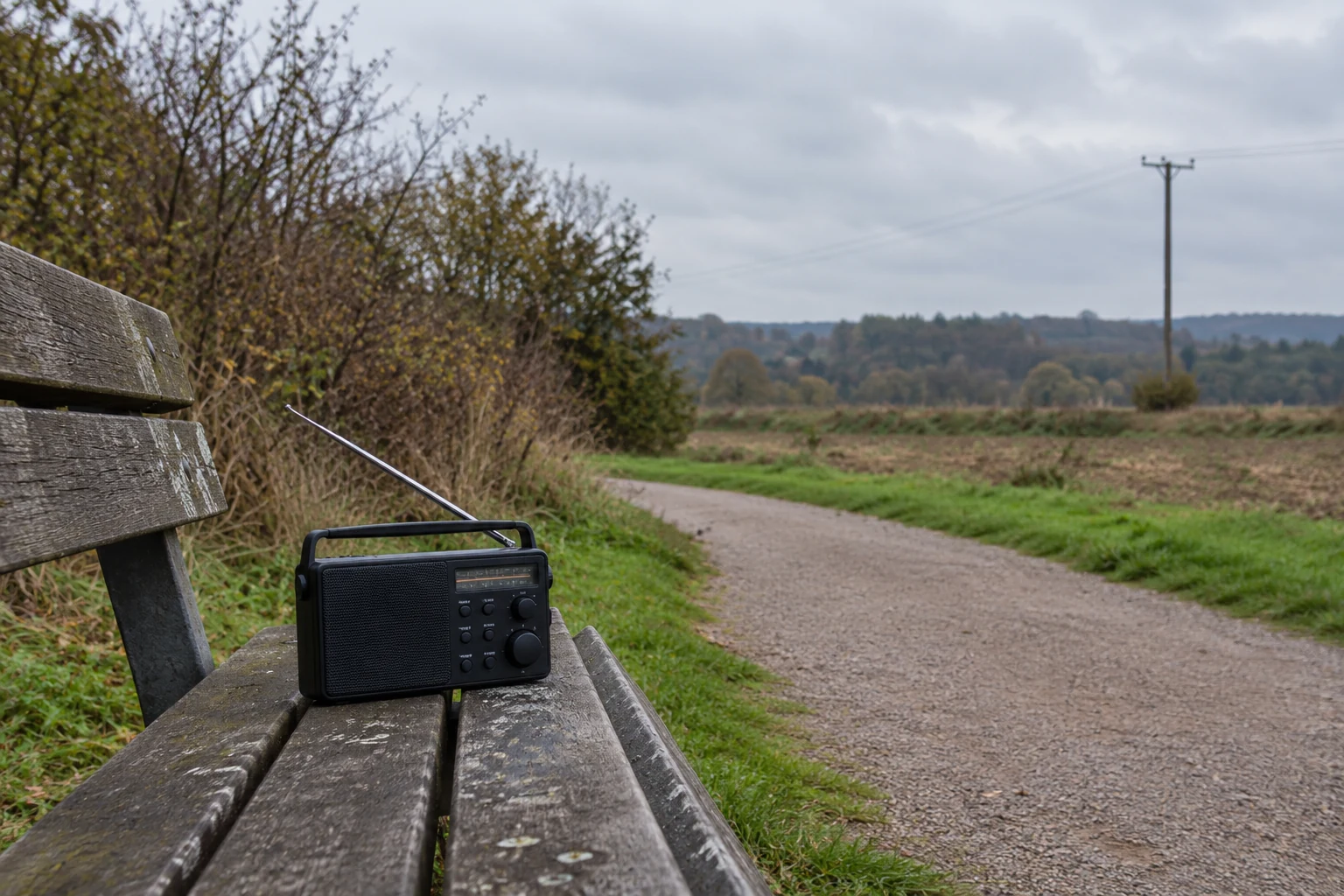
Radio direction finding—comparing reception from different positions or directions—may help narrow a candidate area. ARRL recommends it for locating many power-line noise sources. But a direction or strength peak establishes neither the emitter nor the owner. For a concrete trap, ARRL warns that both indoor noise and utility-origin noise can peak at utility ground wires and down guys because those structures can radiate signals from either kind of source. A loud reading beside one is therefore a location clue, not proof that the wire or the utility produced the noise. Observe from a safe position; never test that idea by touching the hardware.
If the strongest reception moves between visits, the noise vanishes during the walk, or several places produce similar readings, describe exactly that. Repeat during another active period using comparable tuning and settings. You can report a bounded finding such as “strongest in this area during two comparable visits” without naming a property or a utility component as the culprit. The useful outcome of this stage is a better-supported location hypothesis—or an honest record that the location is still unresolved.
Act on the Strongest Supported Finding
Match the next action to what actually changed in a repeatable test. If the noise remains when the antenna is disconnected, return to the receiver, its power supply and nearby station-side equipment rather than accusing an outside emitter. If a household device’s removal repeatedly makes the observed noise disappear, you have an immediate source to address locally; ARRL’s isolation procedure uses unplugging devices on an implicated circuit for that purpose. Keep the device disconnected if that is a safe and practical interim step. Leave electrical assessment or repair you cannot safely perform to a qualified person. A successful unplugging test identifies a change you can reproduce; it does not authorize opening equipment or wiring.
If household isolation has made a utility-origin power-line problem likely, contact the utility’s customer service department. That is the route ARRL recommends after the problem is judged most likely to be power-line noise rather than a source inside the home. Give a factual account: affected frequencies, the dated presence-and-absence log, the antenna and safely performed power comparisons, and any bounded location finding. Say which comparisons were inconclusive. Record any ticket number, names, dates and a brief summary of each conversation, as ARRL advises. A strong reading near a down guy belongs in the account only as an observation—not as proof that the utility owns the source.
For a different outside candidate, report observations to an appropriate owner if you can identify one without guessing, or seek further help with localization. Sound, timing, proximity and one portable reading are not ownership tests. In the United States, the FCC Consumer Complaint Center lists interference under its Radio Issues category, so that is an optional filing route for a radio-interference complaint. Filing is not a promise of investigation, a particular finding or a remedy; give the same bounded facts you would give any other recipient. Ofcom’s guidance above supplies general diagnostic and safe-isolation concepts, not a US escalation authority.
If your results conflict, preserve the conflict. A repeatable receiver-side or unplugged-device change supports local action. A credible outside lead, narrowed without unsafe access, supports a factual report to the likely responsible party. Noise that fluctuates across tests, persists despite an incomplete power comparison, or peaks in several places calls for more observations under comparable conditions—not a definitive accusation.