Call and
Signal
Menu

Beginner guides

Guides

Beginner amateur-radio guidance for the United States, with current-rule checks, realistic equipment choices, and clear safety stop points.

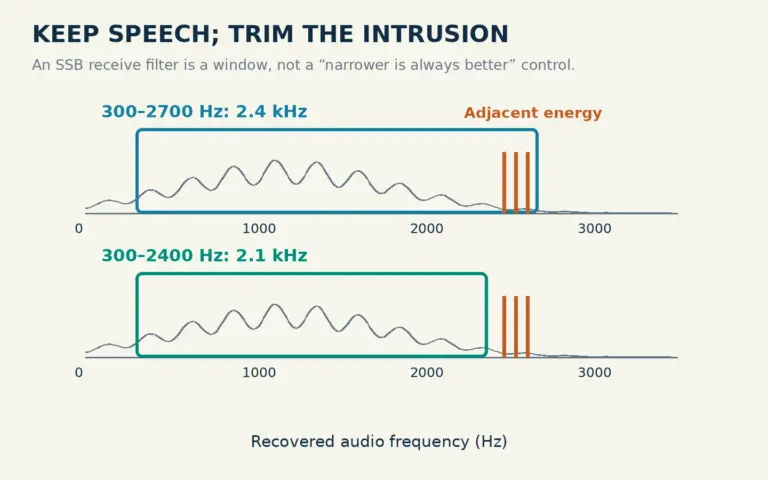
Two receive passbands over the same illustrative speech envelope; lowering the high cut reduces included adjacent energy while also removing some speech frequencies.
Operating Skills · 6 min

How to Set SSB Receive Filter Bandwidth

Set an SSB receive filter wide enough to preserve understandable speech, then narrow or shift it only as much as needed to reduce unwanted sound. Start by tuning the voice correctly in USB or LSB. A narrow filter cannot fix the wrong sideband or a badly mistuned signal.

Read guide →
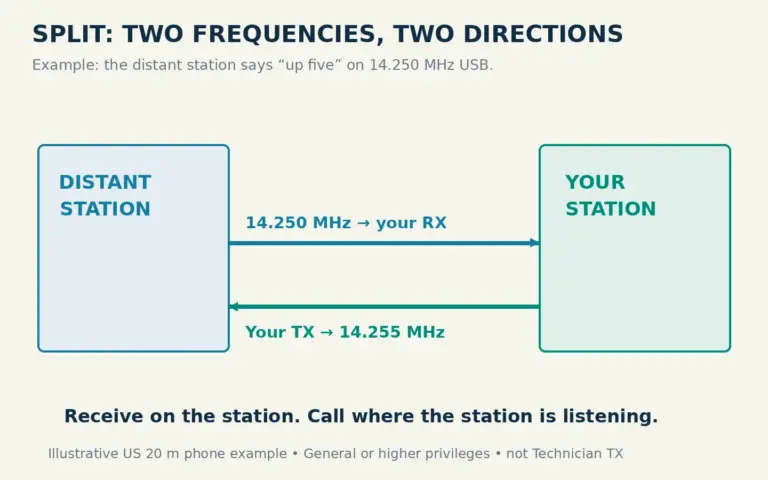
Two stations exchange in opposite directions: distant station transmits 14.250 MHz to your receiver; your transmitter calls back at 14.255 MHz.
Getting Licensed · 7 min

How to Operate in Split Mode

To operate in split mode, set your receiver to the station you want to hear and your transmitter to the separate frequency where that station is listening. Then verify the actual transmit frequency before pressing push-to-talk. The central habit is to think in two directions: I receive here; I transmit there.

Read guide →
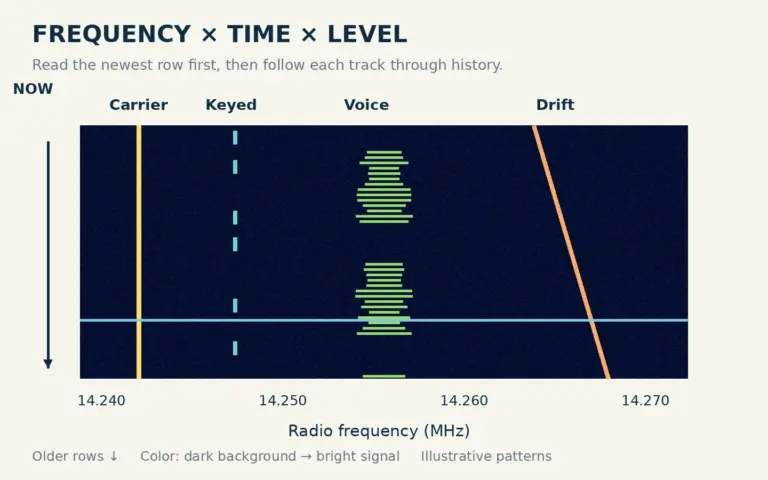
Illustrative waterfall with frequency increasing rightward, newest time at the top, steady, keyed, voice-like and drifting tracks, plus a broadband impulse.
Getting Licensed · 7 min

How to Read a Radio Waterfall Display

A radio waterfall shows frequency across one axis, time across the other, and received level through color or brightness. Read the frequency scale first, locate the newest row, then follow a signal through time. A narrow steady line suggests something different from a broad patch that appears only while someone speaks—but the pattern is a clue, not a positive identification.

Read guide →
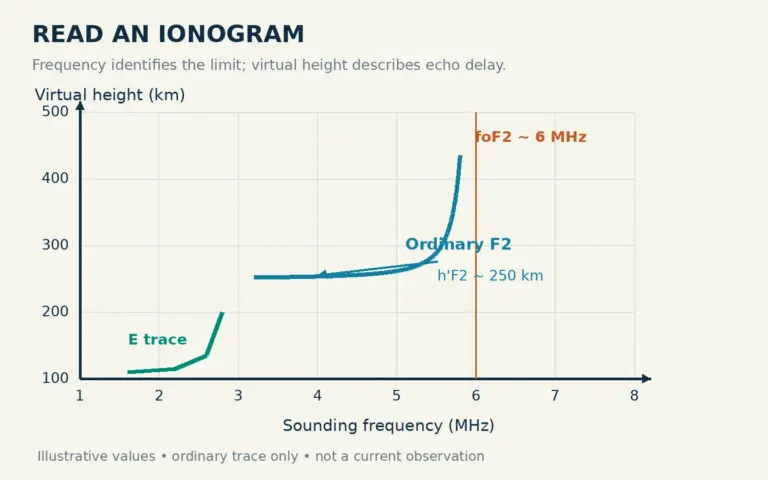
Teaching ionogram with MHz on the horizontal axis, virtual kilometers vertically, an E trace, and an ordinary F2 trace approaching 6 MHz near a 250-kilometer minimum.
Activities and Propagation · 7 min

How to Read an Ionogram

Read an ionogram from the axes inward: check the station and observation time, identify the ordinary-wave ionospheric traces, then read their critical frequencies and virtual heights. The most useful beginner distinction is between foF2, a vertical-sounding limit, and a maximum usable frequency for a particular radio path. They are related, but they answer different questions.

Read guide →