Call and
Signal
Menu

Beginner guides

Guides

Beginner amateur-radio guidance for the United States, with current-rule checks, realistic equipment choices, and clear safety stop points.

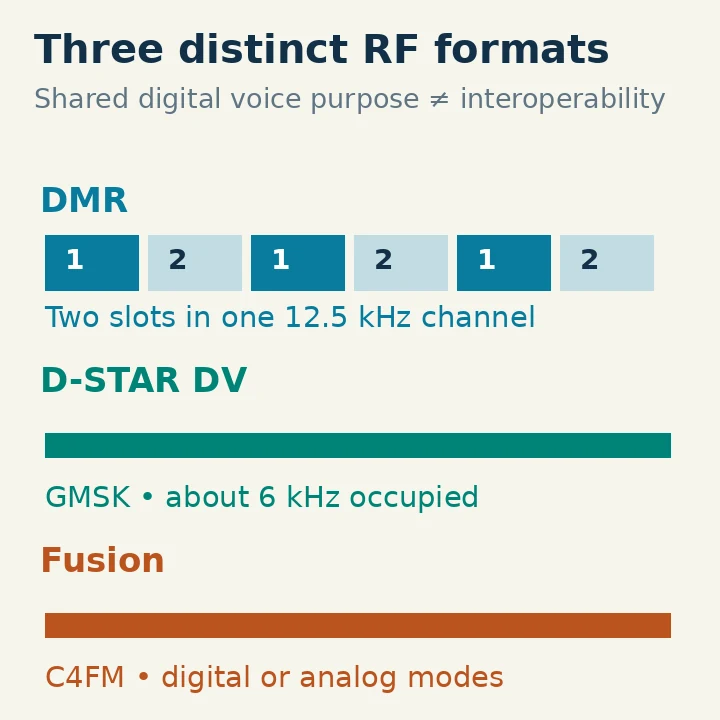
DMR alternating slot 1 and 2 blocks are contrasted with continuous D-STAR DV and Fusion RF paths; DMR channel width and D-STAR occupied width are explicitly different quantities.
Operating Skills · 8 min

DMR vs D-STAR vs System Fusion: Comparing Digital Radio Systems

DMR, D-STAR and System Fusion all carry digital amateur voice, but they are different over-the-air systems. A radio that supports one does not automatically decode the others. For a beginner, the most useful choice usually starts with the repeaters and people you can actually reach, followed by the programming and network features you want to use.

Read guide →
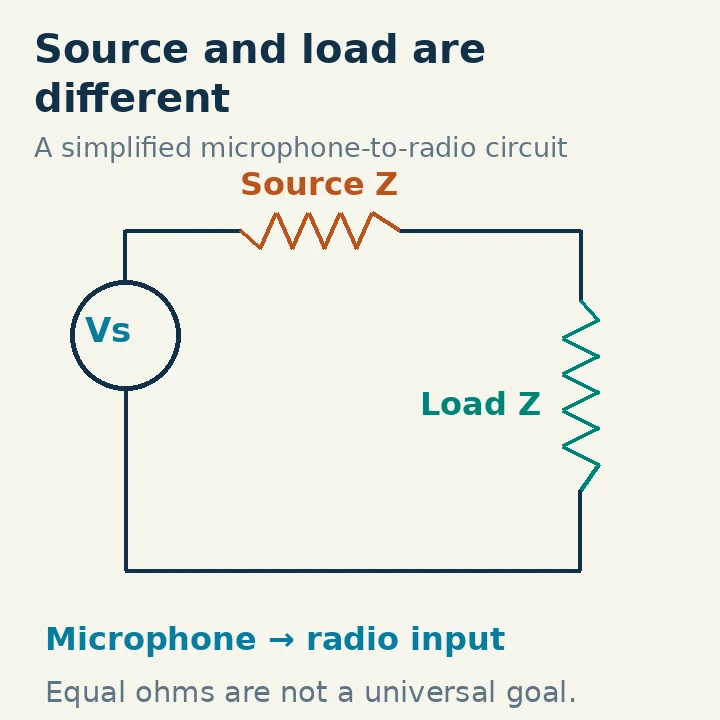
Equivalent circuit with a microphone source voltage and series source impedance driving the radio input load impedance; source and load are visibly distinct.
Antennas and Feed Lines · 7 min

Understanding Microphone Impedance in Ham Radio

Microphone impedance describes the electrical behavior of a microphone's output or a radio's microphone input. It matters because the microphone must deliver an appropriate audio signal into the radio's load. However, a matching ohm number alone does not establish compatibility: output level, microphone power, balanced or unbalanced wiring, connector pinout and push-to-talk all matter too.

Read guide →
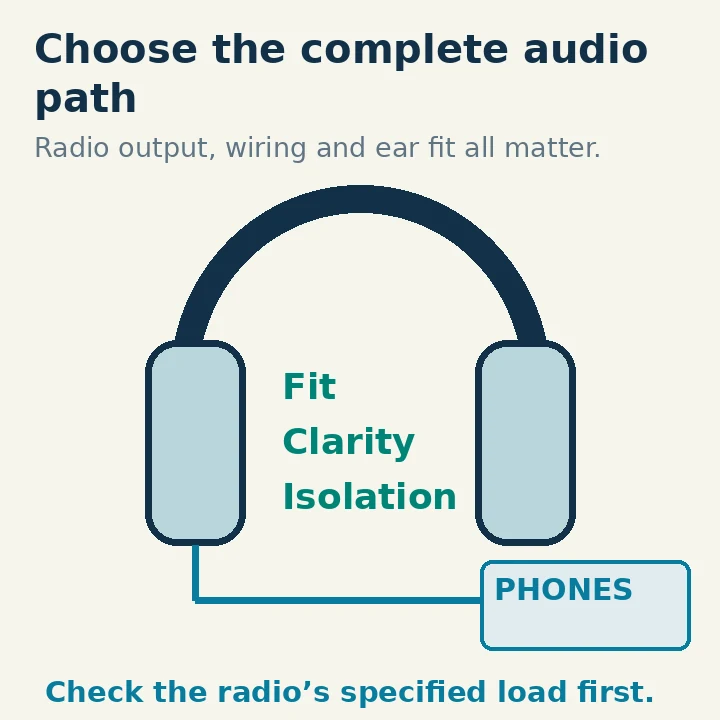
Generic headphone silhouette connected to a radio PHONES output, with fit, clarity and isolation identified as operating considerations; no product model is depicted.
Station Setup · 7 min

How to Choose Headphones for Ham Radio

Choose ham-radio headphones by starting with the radio's headphone output, then checking speech or CW clarity, connector wiring, comfort and the noise around your operating position. A large frequency-range number or high price does not establish that you will copy a weak call sign more reliably.

Read guide →
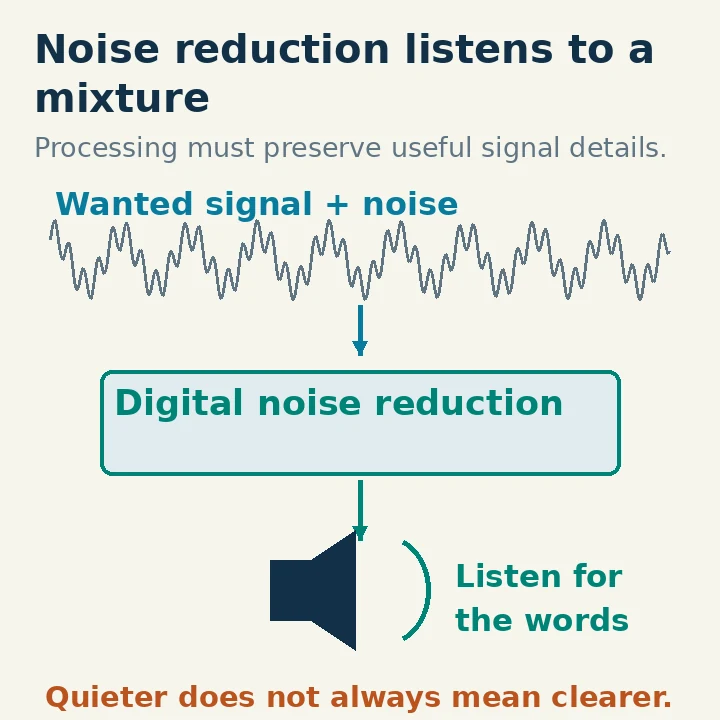
A mixture of signal and noise enters a digital noise-reduction block and then a speaker; the acceptance criterion is intelligibility, with no measured output waveform claimed.
Troubleshooting and Safety · 6 min

How Dynamic Noise Reduction Works in Amateur Radios

Noise reduction in an amateur receiver uses digital signal processing to reduce some unwanted noise while trying to preserve the signal you want to hear. It can make a noisy voice easier to follow, but a quieter speaker is not automatically a more readable signal. Judge the result by the words or Morse characters you can copy.

Read guide →
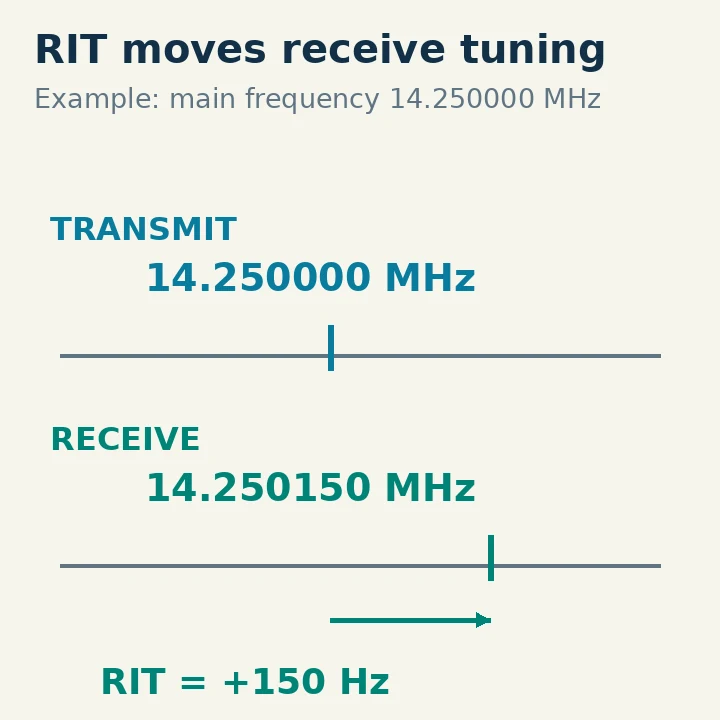
With a 14.250000 MHz main reference and plus 150 Hz RIT, receive moves to 14.250150 MHz while transmit remains at 14.250000 MHz.
Getting Licensed · 6 min

How Receiver Incremental Tuning Control Works

Receiver incremental tuning, usually labeled RIT, shifts your receive frequency without shifting your transmit frequency. It lets you make an incoming SSB voice or CW tone easier to copy while continuing to transmit where the other station expects you. The key is to track the offset separately from the main dial.

Read guide →
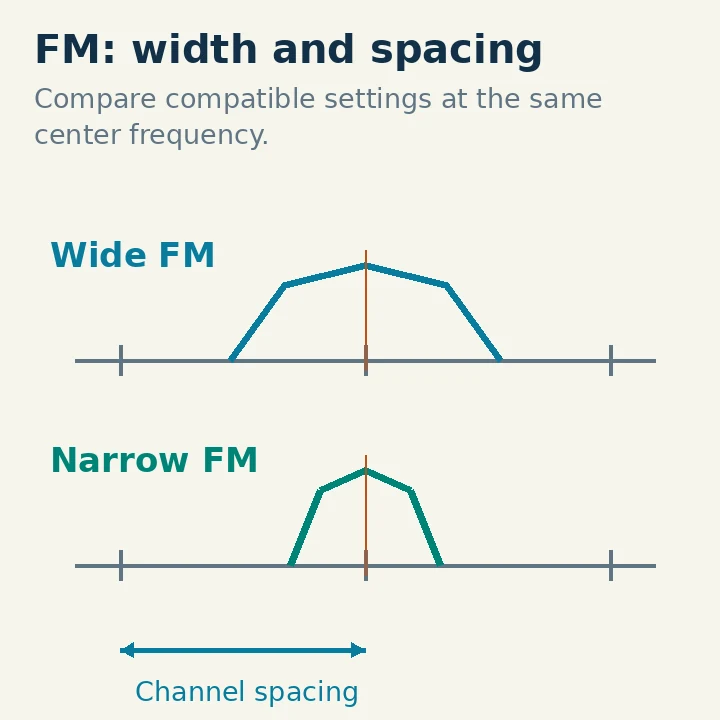
Illustrative FM spectra at the same center frequency: a wider trace and a narrower trace are drawn separately from the spacing between channel centers.
Choosing a Radio · 6 min

Wideband vs Narrowband in Ham Radio: What Changes?

In a typical handheld or mobile FM radio, choosing wide or narrow changes the intended transmit deviation and receive-channel bandwidth. Narrow FM uses a smaller frequency swing and a narrower receiver setting so nearby channels can be packed more closely. The important operating choice is to match the system you are using—not to assume that “wide” means more power or that “narrow” always receives farther.

Read guide →
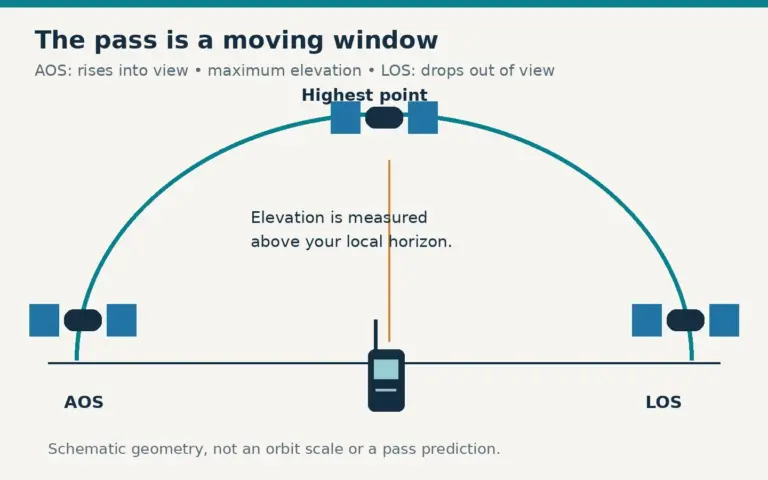
Schematic ISS pass arc from acquisition of signal over the local horizon, through maximum elevation above the observer, to loss of signal.
Activities and Propagation · 9 min

How to Contact the International Space Station by Amateur Radio

You can attempt a voice contact with an ISS crew member when a licensed astronaut is operating, or make a contact with another ground station through the ISS amateur-radio repeater when it is available. These are different activities. Your first practical step is to check the active mode, predict a pass over your location and receive the correct downlink before transmitting.

Read guide →
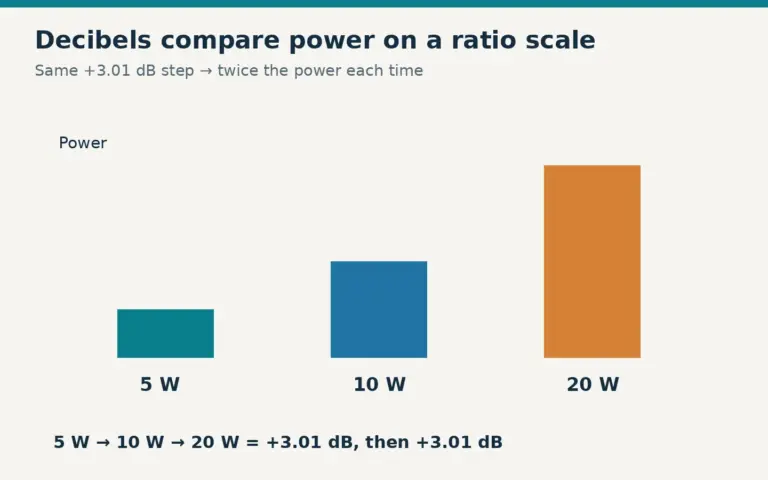
Proportional bars for 5, 10 and 20 watts, illustrating two successive power doublings of about 3 dB each.
Choosing a Radio · 7 min

Decibels in Radio Explained: What dB Values Mean

A decibel, written dB, expresses a ratio. In radio power comparisons, about +3 dB means twice the power, −3 dB means half, and +10 dB means ten times as much. The reference matters: “3 dB more” describes a change, while “3 dBm” describes a power level relative to one milliwatt.

Read guide →
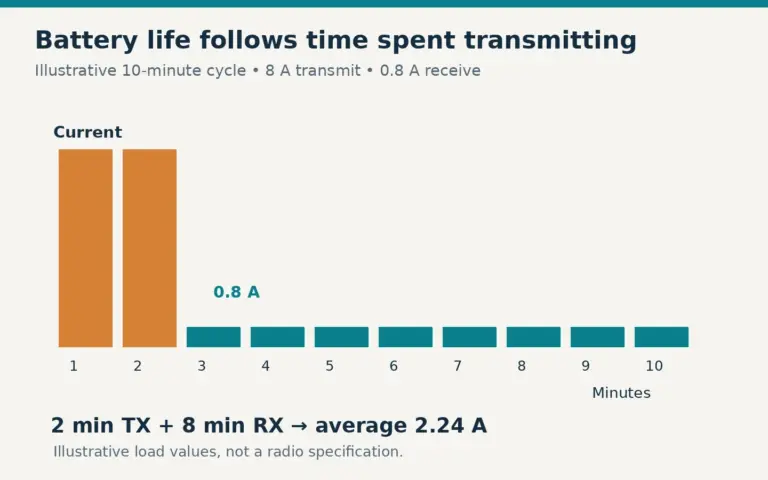
Ten one-minute current bars: two transmit minutes at 8 A and eight receive minutes at 0.8 A, giving a 2.24 A average.
Activities and Propagation · 8 min

How Long Will a Battery Last During a POTA Activation?

A battery lasts approximately as long as its usable amp-hours divided by your station's average battery current. For example, if you plan to use 8 Ah and the station averages 2.24 A, the estimate is about 3.6 hours. The same battery allowance lasts only about 1.8 hours at 4.4 A. The radio, transmit time, accessories and battery limits matter more than the POTA label.

Read guide →
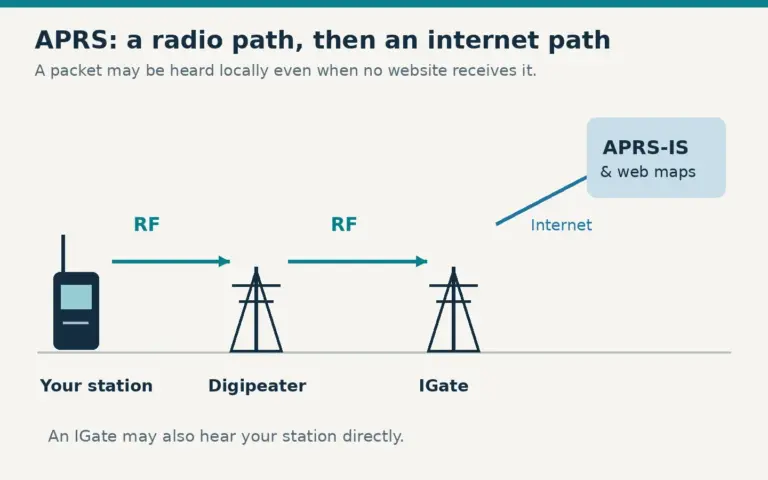
A handheld sends a radio packet through a digipeater to an IGate, which forwards it to APRS-IS and web maps; direct reception by an IGate is also possible.
Operating Skills · 8 min

How to Get Started with APRS

Start with a receiver, a way to decode APRS packets, and a clear distinction between radio traffic and an internet map. Once you can receive local packets, configure your own licensed call sign, a correct position and a locally appropriate path, then send one position report. A successful first session is a verified packet and a short exchange with another operator, rather than an unattended stream of dots.

Read guide →
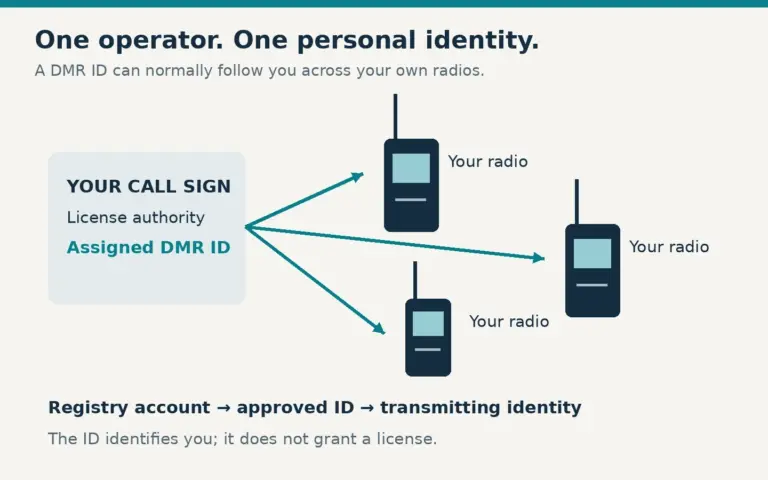
One call-sign record and assigned DMR ID branching to three radios owned by the same operator.
Operating Skills · 7 min

How to Get a DMR ID Number

To get a personal amateur-radio DMR ID, start with an issued amateur call sign, check whether you already have an ID, and apply through RadioID.net with the license documentation it requests. Once the application is approved, enter your assigned number in your radio's programming software. The number identifies your digital transmissions; your amateur license supplies your operating privileges.

Read guide →
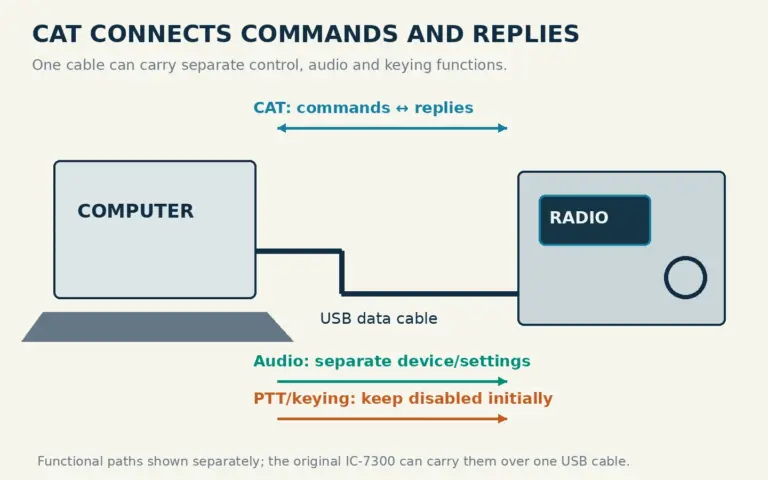
A computer connected to a radio by USB, with CAT command/reply, audio and PTT paths distinguished as separate functions.
Station Setup · 8 min

How to Set Up CAT Control for a Ham Radio

To set up CAT control, connect the radio's documented computer-control interface, install the required driver, select the matching radio and serial port in one application, and make the communication settings agree at both ends. Prove that you can read and change frequency while the radio stays in receive mode before enabling any computer-controlled transmission.

Read guide →